
Payment as Power: India's UPI Diplomacy
UPI has emerged as an instrument of India’s soft power, offering an interoperable and sovereignty-preserving alternative to Western Big Tech and China’s Digital Silk Road. Its international expansion strengthens digital diplomacy and Global South cooperation. However, geopolitical suspicions, market concentration, transaction costs and limited reciprocity remain challenges, requiring stronger regulatory frameworks for sustainable global adoption.

Introduction
UPI facilitates about 24 billion transactions monthly (NPCI, 2026), accounting for about 49% of real-time payments globally (Ministry of Finance, 2026). This has enabled the inclusion of historically excluded shopkeepers, vendors and consumers into the formal financial systems through possession of mobile phones and networks. This places UPI at the centre of India’s Digital Public Infrastructure stack of technologies, which the Department of Economic Affairs defines as a set of digital systems that are secure and interoperable, built on open standards and specifications to deliver and provide equitable access to public and private services at the societal scale (Department of Economic Affairs,2024). It rests on three pillars: digital ID, data sharing frameworks and digital payments. But the real test of UPI’s strength lies not only in what has been achieved at the domestic scale, but in what it is capable of unleashing at the international level. India can position UPI as a reference point in digital governance. This piece argues that UPI functions as an instrument of Indian soft power, a public good alternative to both Silicon Valley’s platforms and China’s state-centric Digital Silk Road.
From Fintech to Foreign Policy
UPI’s story began with Jan Dhan Yojana, which sharply increased the number of adult bank account holders from 35% in 2011 to 89% in 2024 (World Bank, 2025). Consequently, the NPCI launched UPI in 2016, built on the Jan Dhan Yojana, which led to a substantial rise in financial payments throughout the country.
Following the COVID-19 era, the usage of UPI rose manifold. During India’s G20 presidency, DPI was explicitly identified as an economic accelerator. It was deemed that to achieve the SDGs and goals like inclusive and equitable growth, developing DPI becomes essential. In alignment with this vision, the GOI signed MoUs with 24 countries to accelerate digital transformation (Ministry of Finance,2024). The government also created a Social Impact Fund (SIF) to assist in the DPI pilot implementation across Global South countries ( Mukherjee, Arkalji 2026).
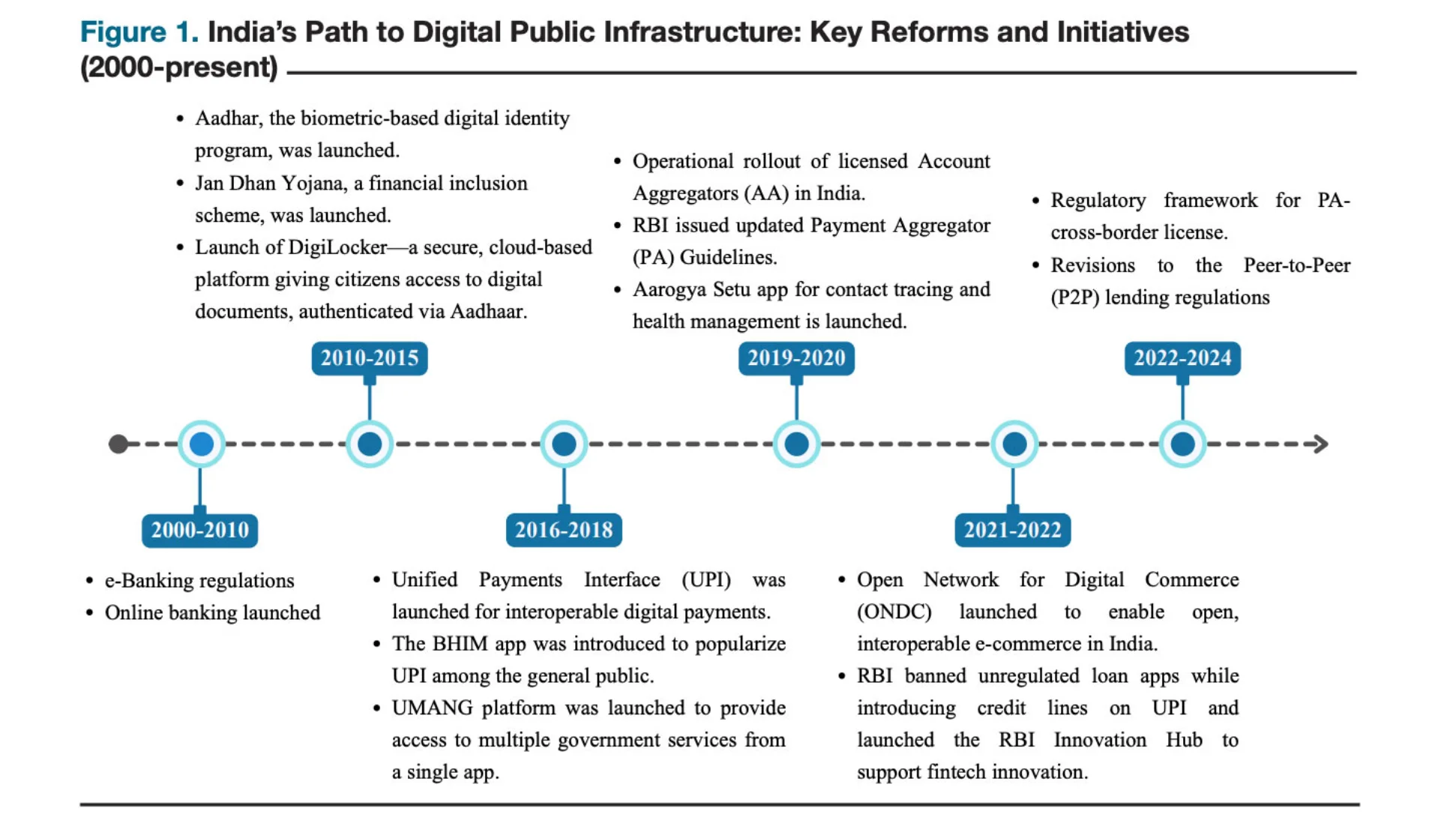
India has already operationalised its linkage with Singapore and MoUs with Kenya, Cuba and many other countries, which witness the joining of forces with the Global South in the fintech arena, enabling instant, low-cost transfers between banks of the two countries. These adoptions reflect success as they built on mutual values of trust and interoperability while preserving sovereignty. These bilateral links point towards a voluntary initiative towards UPI. It is now live in 11 countries (Press Information Bureau, 2026), and India’s open-source identity platform MOSIP has been adopted by more than twenty countries since 2018 (MOSIP, n.d.). Partners such as Sri Lanka have signed DPI cooperation agreements voluntarily. Soft power is reflected in the fact that partners choose to adopt the model and are not tied to supplier dependency or a conditional financing model.
Kaushik(2026) points towards a common misconception: UPI export is often conceptualised as exporting an Indian app. However, its soft power leverage lies in the blueprint that India has developed, which balances the public-private sphere’s functions with interoperability at its centre. This is exactly why UPI comes under the purview of “Digital Public Infrastructure”. The current global digital world requires systems that are flexible and do not create dependence on others. Herein, the basic framework is developed by the public sector, and the digital infrastructure is built subsequently by the private sector, with enough incentives for it to invest and innovate in the ecosystem. Thus, a blueprint that is easily replicable irrespective of the socio-economic background. Leveraging this would ensure India a position in the arena of advanced tech.
Competing Models: DPI and Digital Silk Road
India’s efforts to export UPI do not exist in a vacuum. It has entered a competing space where the Chinese Belt and Road initiative, particularly its digital arm, the Digital Silk Road along with alternatives advanced by Silicon Valley, already exist. They have already developed and operated the infrastructure in Asia, Africa and Latin America, and scholars now describe India’s position as one of strategic competition. The Digital Silk Road, has already been established in countries like Pakistan and Sri Lanka. However, what distinguishes India in this space is its logic. Unlike the Chinese model, which creates dependence on Chinese vendors and fintech, India’s DPI model offers a blueprint that can be implemented according to each country’s specific needs while keeping their sovereignty intact. This is where Joseph Nye’s soft power comes into play, who emphasises that soft power is built on attraction, not coercion. India deploys this by providing a mechanism that is credible and sovereignty-preserving while ensuring economic acceleration. This also provides an opportunity to renew multilateral engagements like SAARC by focusing on non-political cooperation as a way of confidence-building measures (Neyah, 2025).
Limits
There are a few challenges that may slow down the implementation of this model. One is geopolitical suspicion, especially in countries where influence is contested by competing powers like Pakistan, Nepal, etc. There is a risk that these countries are likely to view this initiative through the lens of regional dominance rather than collective benefit. The UPI landscape is dominated by three players, two of which are foreign-owned; this may raise sovereignty and dependency concerns for the adopting nations. Confusion over who bears the Merchant Discount Rate and transaction fees can create friction among stakeholders, ultimately delaying international implementation. The introduction of a 0.4% MDR from 15th October 2026 changes UPI economics, as the zero-cost model is being qualified to bring in financial stability (NPCI, 2026). This concerns India’s soft power, since partner countries will not only inspect UPI’s reach but also who ends up bearing the cost of running this model. The effect on merchant behaviours is yet to be seen, but it may lead to regression which would weaken the case for adopting it elsewhere.
Recommendations
NPCI International should work on building a standard framework covering fees, dispute resolution mechanisms and data protection, which makes the partner countries aware of the costs of this mechanism and makes it easy to adopt. Further, a market-share cap should be placed by the respective governing bodies of the UPI mechanism to ensure dependence on a few players is not created, which is often found in the DSR contracts (Patil & Gupta, 2024). India (RBI and NPCI) should also allow partner countries to use UPI inside India, since Nepali, Bhutanese and Sri Lankan citizens currently cant, thus addressing the reciprocity issue.
Conclusion
UPI can be best understood as a tool of India’s soft power, though a conditional one. A leverage that provides a blueprint, a public-private, interoperable framework which countries can adopt without compromising their autonomy. It has emerged as an alternative in a field dominated by American Big Tech and Chinese state-centric models. Thus positioning India as a possible ‘benchmark rather than a technology adopter. This model already shows success with, UPI being live in 11 countries. However, the issues of reciprocity, dispute settlement, concentration and cost questions after the MDR require a rigorous framework to make it a proposition that is valued by all the benefactors. UPI’s soft power strength will be testified by how many countries turn to it and build their systems on it.
Sources
Department of Economic Affairs, Government of India. (2024). Report of India’s G20 Task Force on Digital Public Infrastructure for economic transformation, financial inclusion and development. https://dea.gov.in/sites/default/files/Report%20of%20Indias%20G20%20Task%20Force%20On%20Digital%20Public%20Infrastructure.pdf
Kaushik, P. (2026, February 24). How UPI can become India’s next soft-power export. Diplomatist. https://diplomatist.com/how-upi-can-become-indias-next-soft-power-export/
Ministry of Electronics and Information Technology. (2026, July 29). India strengthens global digital cooperation through digital public infrastructure partnerships with 24 countries [Press release]. Press Information Bureau. https://www.pib.gov.in/PressReleasePage.aspx?PRID=2291054
Ministry of Finance. (2024, July 15). Report of India’s G20 Task Force on Digital Public Infrastructure released [Press release]. Press Information Bureau. https://www.pib.gov.in/PressReleaseIframePage.aspx?PRID=2033389
Ministry of Finance. (2026, April 30). UPI completes 10 glorious years, emerges as world’s largest real-time payments platform, anchoring India’s digital economy [Press release]. Press Information Bureau. https://www.pib.gov.in/PressReleasePage.aspx?PRID=2257087
MOSIP. (n.d.). Country partners. Retrieved October 11, 2026, from https://www.mosip.io/country_partners
Mukherjee, A., & Arkalji, C. (2026, January 3). Digital public infrastructure and the future of digital payments: Lessons from Pix and UPI [Special report]. Observer Research Foundation. https://www.orfonline.org/research/digital-public-infrastructure-and-the-future-of-digital-payments-lessons-from-pix-and-upi
National Payments Corporation of India. (2026). UPI product statistics. Retrieved October 11, 2026, from https://www.npci.org.in/product/upi/product-statistics
Neyah, M. (2025). UPI and India’s digital diplomacy: Transforming regional cooperation in South Asia. Indian Journal of Integrated Research in Law, 5(5), 1122–1132. https://ijirl.com/wp-content/uploads/2025/10/UPI-AND-INDIAS-DIGITAL-DIPLOMACY-TRANSFORMING-REGIONAL-COOPERATION-IN-SOUTH-ASIA.pdf
Nye, J. S. (2004). Soft power: The means to success in world politics. PublicAffairs.
Patil, S., & Gupta, P. (2024, January 3). The Digital Silk Road in the Indo-Pacific: Mapping China’s vision for global tech expansion (ORF Issue Brief No. 683). Observer Research Foundation. https://www.orfonline.org/research/the-digital-silk-road-in-the-indo-pacific-mapping-china-s-vision-for-global-tech-expansion
Press Information Bureau. (2025, August 15). From cash to digital: India’s leap towards inclusive finance [Factsheet]. Ministry of Information and Broadcasting, Government of India. https://www.pib.gov.in/FactsheetDetails.aspx?Id=149258
Press Information Bureau. (2026, August 24). UPI: Transforming India’s payment landscape [Factsheet]. Ministry of Information and Broadcasting, Government of India. https://www.pib.gov.in/FactsheetDetails.aspx?id=150962
Shivamurthy, A. G., & Raman, M. (2026, June 26). UPI, RuPay, and India’s digital bid for South Asian financial integration [Expert Speak]. Observer Research Foundation. https://www.orfonline.org/expert-speak/upi-rupay-and-india-s-digital-bid-for-south-asian-financial-integration
Singh, M. (2024, May 9). India likely to delay UPI market caps in win for PhonePe-Google Pay duopoly. TechCrunch. https://techcrunch.com/2024/05/09/india-weighs-delaying-caps-on-upi-market-share-in-win-for-phonepe-google-pay/
Srinivasan, R., Sharma, P., & Sarma, A. (Eds.). (2025, July). Decoding digital public infrastructure: Scripting inclusive digital futures. Observer Research Foundation. https://www.iimb.ac.in/cdpg/pdf/Monograph-Decoding-DPI.pdf
World Bank. (2025). The Global Findex Database 2025. https://www.worldbank.org/en/publication/globalfindex
Continue reading
 International Relations · Research Article
BRICS- An Alternative to the Western Power : Challenging Western Hegemony or Complementing existing Global Order
9 November 2026
BRICS seeks to challenge Western hegemony by promoting a multipolar world order, strengthening South-South cooperation and reducing dependence on the US dollar. Through initiatives like the New Development Bank, it offers developing countries an alternative platform. However, ideological differences, competing national interests and continued Western influence limit its ability to fundamentally transform the existing global order.
 International Relations · Research Article
INDIA’S APPROACH TO DIGITAL PUBLIC INFRASTRUCTURE AS EXPORT POLICY
16 October 2026
India’s Digital Public Infrastructure export policy uses platforms like Aadhaar, UPI, and DigiLocker to strengthen digital governance, financial inclusion, and regional connectivity. By sharing these systems with the Global South, India advances its diplomatic influence and technological leadership, though data protection, institutional capacity, and effective implementation remain critical challenges.
 International Relations · Research Article
VISION 2030: Tracking Saudi's Reform Agenda
15 October 2026
Saudi Arabia’s Vision 2030 seeks to diversify the economy beyond oil through private-sector growth, foreign investment, technological innovation, and structural reforms. Despite progress, persistent oil dependence, investment gaps, employment inequalities, and geopolitical instability challenge its long-term economic transformation and strategic autonomy.
Comments
Your comment