
VISION 2030: Tracking Saudi's Reform Agenda
Saudi Arabia’s Vision 2030 seeks to diversify the economy beyond oil through private-sector growth, foreign investment, technological innovation, and structural reforms. Despite progress, persistent oil dependence, investment gaps, employment inequalities, and geopolitical instability challenge its long-term economic transformation and strategic autonomy.
1. Introduction
The Saudi Arabia Vision 2030 is centred on reducing dependence on oil exports, focusing on diversification of the Kingdom’s economy and bringing increased Foreign Investment that drives resilience and sustainability of the economy.
1.1 Takeaways
This policy exhibits how efforts to bring ambitious reforms within the domestic capacity of a country can propel long-term foreign policy efforts. However, a growth in the GDP does not guarantee a uniform growth across sectors. Implying that sustainable growth requires financial planning that distributes resources equitably rather than concentrating investment in giga-projects. Second, states should focus on the redevelopment and reformation of obsolete structures to address the risk of numbers being impressive on paper, but ground reality suggests efforts behind them remain structurally shallow and sustain gaps.
1.2 Future Outlook
Riyadh’s economy might face a stunted pace for the next 12-24 months, due to its exposure to the US-Iran conflict’s disruption of the Strait of Hormuz. Since the main driver of the economy(oil-based exports) is experiencing reduced export volumes as low as 1.7, according to IMF projections. This divergence will make the Kingdom's economy sensitive to the conflict’s duration rather than to the Vision 2030 policy execution. However, the tech and AI sector under SDAIA offers an insulated growth track: flourishing given the recent developments of a native Arabic Large Language AI Model (ALLaM) built alongside IBM and Microsoft, projecting tech as a growing sector while the oil-exposed sectors of the country absorb the economic shocks.
1.3 Context & Drivers
Baseline:
Before 2016, Saudi Arabia's economy had remained largely unchanged since the 1970’s oil boom, and it was largely driven by oil revenues. Citizens naturally opted for government employment. Though the real situation was that female labour force participation stood below 20%, a strict environment prevailed in the sectors of entertainment and tourism, it lacked personal status laws, and there were no established procedures for investor safeguards, preventing private sector risk-taking. The Vision 2030 emerged as a structured and organised successor of decades-long informal policies.
Catalysts:
Economic cause: when crude oil prices fell from around $100/barrel in 2014 to below $30 by early 2016, it exposed the fragile pipelines of income on which the Kingdom was dependent. Secondly, when Mohammed bin Salman was appointed as Deputy Crown Prince in 2015 and Chair of the Council of Economic and Development Affairs (CEDA), it converged two eminent positions in the hands of one single person to carry out political and economic reforms. This was followed by the demographic trigger when it was realised that the majority of the youth under age 30 remained unemployed and could not be absorbed within the existing economic framework of the kingdom, thus necessitating the development of private sector jobs. Finally, the strategic trigger, observing that the world was moving towards sustainable development and global decarbonisation, it was realised that the oil demand was an onerous structure to be dependent upon and calls for reform.
2. Key Milestones and Strategic Framework
2.1 Key Milestone Log
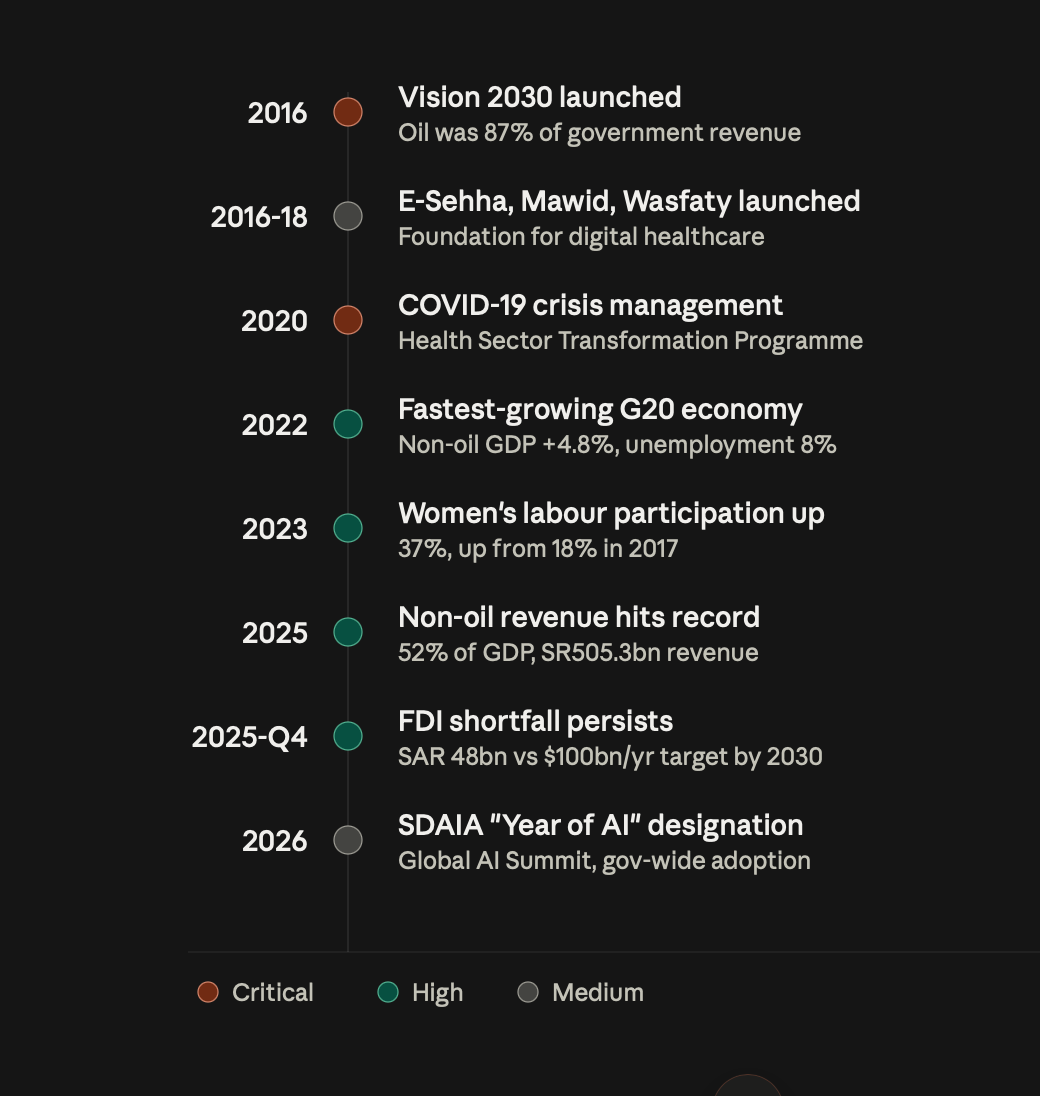
2016: Vision 2030 Launched
Significance: Critical, Takeaway: At launch, oil revenues comprised roughly 87% of government income, and the oil sector dominated GDP; the Vision 2030 was launched to bring reform and diversify the economy.
2016-2018: Digital services launched, including E-Sehha, Mawid, and Wasfaty
Significance: Medium, Takeaway: The development of early detection programs and initiatives laid the foundation for a digital healthcare ecosystem that improved access to medical services and patient outcomes.
2020: Effective COVID-19 crisis management
Significance: Critical, Takeaway: The Kingdom demonstrated strong resilience and coordination during the global pandemic, ensuring the health and safety of citizens and residents via Health Sector Transformation Programmes.
2022: Fastest-growing G20 economy
Significance: High, Takeaway: With the non-oil GDP growing at about 4.8% and unemployment rates declining to their lowest historical level at 8%. Along with a positive transformation in Saudi housing that led to an increase in the percentage of home ownership to 60.6%.
2023: Increased women's participation in the economy
Significance: High, Takeaway: The participation of Saudi women in the labour market reached about 37% (from 18% in 2017), exceeding the target of 30% envisioned by Saudi Vision 2030
2025: Non-oil revenue hits records
Significance: High, Takeaway: Non-oil activities now constitute 52% of GDP, and non-oil government revenues reached a record SR505.3 billion in 2025.
2025-Q4: FDI shortfall persists
Significance: High, Takeaway: FDI inflows reached around SAR 48 billion in Q4 2025, with the GDP gap at 5.7% of the GDP target; the target is $100 billion annually by 2030.
2016–2025 trend: Private sector | 65% GDP target trajectory
Significance: High, Takeaway: The 65% private sector GDP contribution
2026: SDAIA "Year of AI" designation
Significance: Medium, Takeaway: The Saudi Data and Artificial Intelligence Authority is leading what's been framed as Saudi Arabia's "Year of AI 2026," driven by the Global AI Summit and government-wide AI adoption.
2.2 Strategic and Structural Analysis
2.2.1 Stakeholders
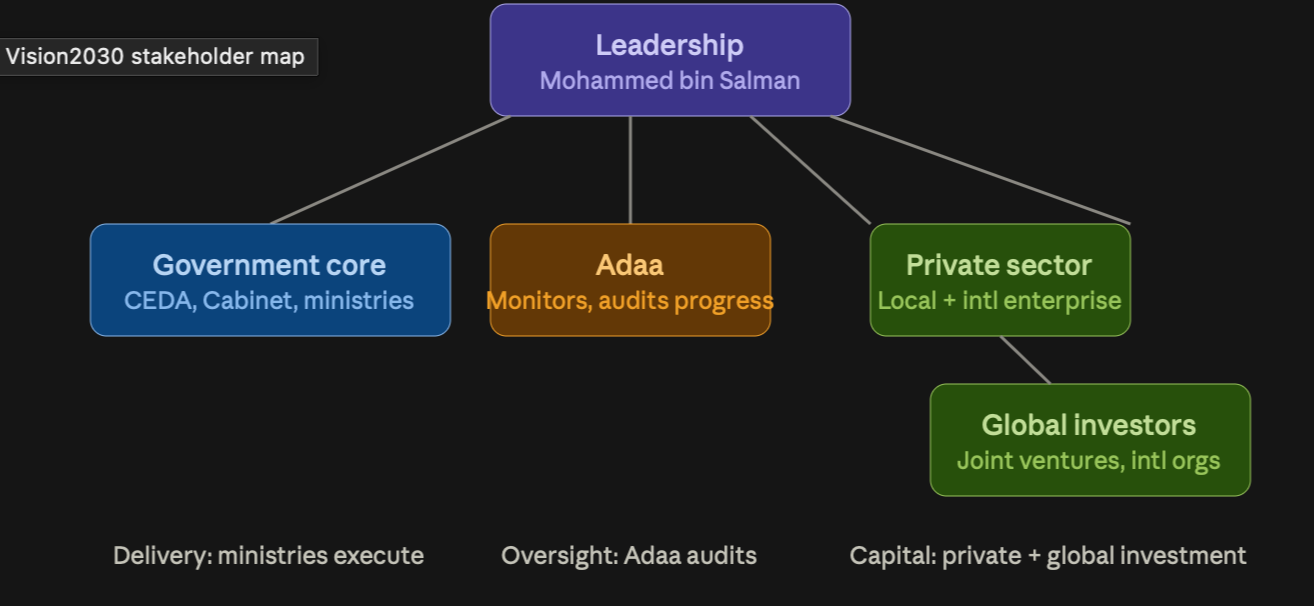
This initiative is led by Mohammed bin Salman and structured through Vision Realisation Programmes. The primary stakeholders consist of: Council of Economic and Development Affairs(CEDA), the Saudi Cabinet and Ministers, including core government departments like the Ministry of Economy and Planning, the Ministry of Finance, Investment authorities, etc. Adaa, which monitors, audits and evaluates the progress and performance across government projects.Local and international private enterprises, which include Businesses that drive the non-oil GDP growth within the country across tourism, housing, manufacturing, mining and renewable energy. Lastly, Global Investors and Joint Ventures with international organisations.
2.2.2 Core Objective
The Vision 2030 is set out to transform and diversify the Kingdom’s socioeconomic landscape. The primary focus is to reduce dependence on oil revenue, since before this policy, about 70-80% of the government revenue came from oil earnings. Furthermore, it aims to transform public sectors like health, education, finance, and housing and delve into new areas and tap into the Kingdom’s unlimited sources through mining, human capability development, public investment funds, the gaming industry, etc.
2.2.3 Constraints
Execution and Fiscal challenges: The simultaneous roll-out of dozens of giga-projects, initiatives and infrastructures creates a huge demand on the fiscal side. Contractor’s capacity, especially in technical areas, is lacking, creating pressure on the labour market for specialised personnel. Foreign Direct Investment Gap: Although FDI has increased, a chasm exists between ideas and their execution. Attracting continuous and sustained FDI requires timely execution, IP protection, profitability, etc. Investors still face limitations in market access due to bureaucratic policies despite long-term reforms. Persistent Oil dependence: the sole reason for the introduction of this policy, diversification has still not been achieved. Prices per barrel remain low, reducing margins for fiscal spending and ultimately shifting pressure on investments and reform implementation. Further, geopolitical risks like drone attacks and the regional wars like the Iran-Israel-US war can impact FDI inflows, tourism and economic stability. Youth Employment: Though overall employment targets have been achieved, the real picture indicates the Kingdom is experiencing a gap in skilled employees. The graduates lack the technical or vocational skills that are required to drive progress, while the public sector job demands remain high. Stagnation in Women's Employment: their economic participation has stagnated after a steady rise since 2017. Participation remains concentrated in specific sectors and regions, while the average income of women remains relatively lower than that of their male counterparts.
2.2.4 Allies
The key allies for Saudi Arabia at “buy-in” levels include the United States and China. With Saudi Arabia being the largest arms purchaser from the US market, there is a need for military cooperation.
2.2.5 Opponents
This project doesn’t primarily face structured political resistance, but due to being centralised and operationalising strict limits, it manifests dissent and bureaucratic inertia. Bureaucratic and Institutional Limit put up a difficult wall of paperwork and legalities for foreign investors. Traditional state employees display resistance to rapid privatisations and cultural shifts. Conservative elements, some religious and traditional elements, push back against rapid privatisations, shifting gender norms and secular entertainment sectors. Economic Analysts and Experts question the sustainability and financial viability of the development of giga-projets and continued oil dependence.
2.2.6 Mechanisms
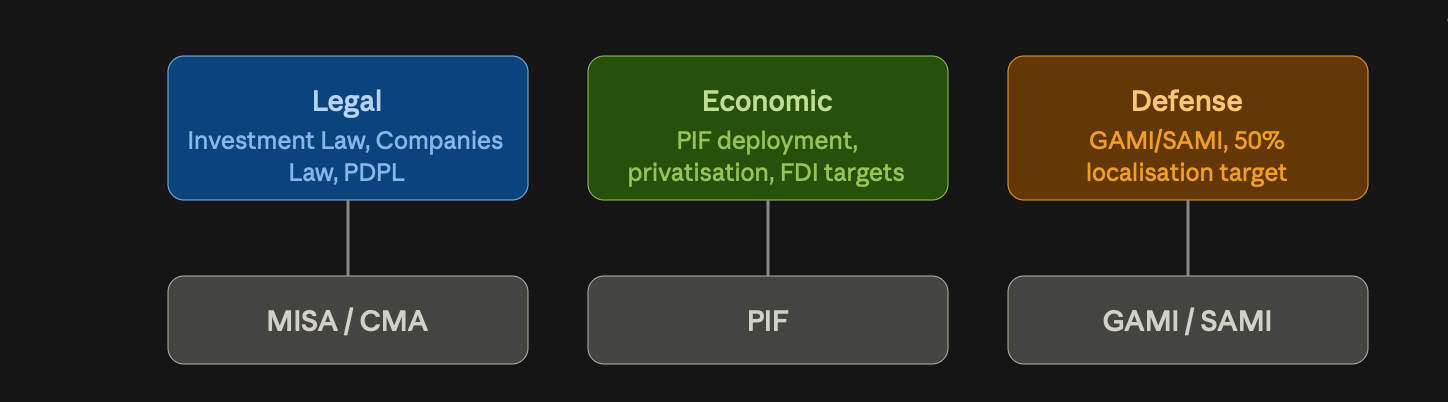
Legal: The legal mechanism includes hard law reforms; this policy is a complete rebuild of the commercial architecture, instead of changes in any single law. Foreign Investment Law Reform allows 100% ownership to foreign investors in most sectors. Took effect in February 2025. Streamlining the Saudi Arabian General Investment Authority into the Ministry of Investment, thus transforming an opaque licensing system. Bankruptcy Law(2018) introduces orderly insolvency procedures. Sector Specific Laws like the Mining Investment Law, Real Estate Registration Law(2023) and SEZ regulations for giga-projects. By 2026, Vision 2030 had produced over 1,200 legislative reforms across 12 national programs.
Economic: Public Investment Funds, the funds are repurposed from a passive holding entity into the state's primary diversification instrument, where different sources put between $930 billion and SAR 3.5 trillion, depending on the date/currency measured. Privatisation, The National Centre for Privatisation assists in implementing the privatisation program to secure Saudi Arabia's economic future, transferring state assets/services to private management. Fiscal instruments like Non-oil revenue growth are the core economic Key Progress Indicator. FDI incentives: Ownership liberalisation, fee suspensions, etc.
Defence: Localisation target and institutions where Saudi Arabia aims to localise 50% of its military procurement by 2030 under GAMI and SAMI. GAMI launched its Industrial Participation Program in 2019 as the successor to Saudi Arabia's Economic Offset Program. The 2025 budget allocated $72.5 billion (21.2 % of total spending) to defence. Product scope herein SAMI's stated remit spans aviation and aerospace systems, defensive munitions, air/land/naval weapons systems, missile defence, and advanced electronics.
Energy Security: The energy sector is one of the crucial pillars of the reform agenda. The Vision 2030 establishes a framework to diversify the energy sector by investing in renewable energy and related national strategies, forming a broader framework to shift dependency from oil and build other sources for the future.
Food Security: One of the important parts of the reform agenda, indicating a broad outlook of the reform policy. The Annual report 2025 of the policy suggests improvement in emergency-response capabilities, strategic reserves, reduced food loss and strengthened supply chains as areas of progress. Although the Global Food Security Index remains updated till 2022, the annual report suggests progress.
Considering these pillars of the reform agenda indicates Riyadh's conception of security centred on broader aspects rather than only defence, strengthening the economic and industrial base, making the kingdom capable enough to sustain itself in a situation of global shocks.
3. Analysis
Saudi Arabia’s Vision 2030 is focused on transforming the entire national infrastructure domestically; at the same time, it brings about crucial geopolitical impacts in the world. This policy demonstrates the capacity of domestic policies in influencing a state's external behaviour in the world and vice versa. Expansion of reforms from economic diversification to digitisation, food security and defence localisations creates a stronger foundation for the Kingdom to build upon its foreign agendas. Saudi Arabia’s progressive expansion into non-oil activities and private sector growth allows Riyadh greater flexibility in pursuing its foreign policy, particularly through investments, trade, technology and economic diplomacy alongside strengthening of strategic resilience and supply chain. In this evolving multipolar world, by virtue of the policy creates a strong position for Riyadh to compete and hedge with global powers such as the US, China, India and Russia, reducing dependency on single strategic partners. However, along with opportunities come constraints, like the development projects still depend on the oil-economy which means any fluctuations in prices can affect the fiscal capacity of such giga-projects. As multiple states seek to invest in the Saudi markets, engaging with them may also create competing expectations from the Kingdom, creating an increasingly complex position for Riyadh. Also, a notable factor is the requirement of regional stability, which is necessary for foreign investments. Hence, Vision 2030 cannot be simply limited to a domestic reform policy; it's a liminal policy where both domestic and external affairs influence and impact each other.
4. Conclusion: Scenarios & Signposts
Vision 2030 continues to progress in a gradual trajectory of diversification, increasing private-sector growth, defence localisation and national security, while the oil economy continues as the major program and source of fiscal capacity.
Optimistic aspect: As per the 2025 Annual Report, private sector contribution to the economy has already reached 51% mark, surpassing a target of 47% and moving towards 65% by the end of the decade. The trajectory is indicating greater FDI, non-oil exports and private investments closing existing gaps. The IMF 2026 assessment supports the possibility of this growing trajectory, considering a reduction in dependence on hydrocarbons, stronger private-sector growth and improved market outcomes.
Pessimistic aspect: The policy faces several constraints as well due to increasing geopolitical and economic tension around the world, as Riyadh diversifies the economy while still having sufficient dependence on hydrocarbons. Several indicators, such as non-oil exports, remain at 22% against a 50% target of 2030; also, FDI stood at 2.8% of GDP against a 5.7% target. Continued regional tensions, blockages in global supply chains, and continued strategic dependence affect the investor's decisions. IMF marks these rising geopolitical tensions and reduction in the momentum of the growth as the main downside risks for the policy to have its objectives successfully completed.
Indicators to Watch: The main indicators to be observed are the progression in the span of 2025 performance and 2030 targets. These shall mainly include non-oil growth in GDP, private sector contribution, FDI, and PIF assets. Particularly, the labour-market sector, examining unemployment, women's participation and graduate employment, shall indicate whether diversification has contributed to the sustainable domestic capabilities of the Kingdom. Beyond this indicator, oil prices, fiscal deficits, giga-projects, defence localisation rates and renewable-energy capacities and such developments should be monitored. Altogether, these indicators can signify the success of Vision 2030.
Sources
GCC Business Watch. (2026, July 15). Saudi Arabia Strengthens Sustainability and Economic Diversification Agenda as Vision 2030 Enters Final Phase. https://gccbusinesswatch.com/news/saudi-arabia-strengthens-sustainability-and-economic-diversification-agenda-as-vision-2030-enters-final-phase/
Government of Saudi Arabia. (n.d.) Retrieved August 25 2026, from https://www.vision2030.gov.sa/en
International Monetary Fund. (2026). Saudi Arabia: 2026 Article-IV consultation — Press Release and Staff Report (IMF Staff Country Reports 2026/210). https://www.elibrary.imf.org/view/journals/002/2026/210/002.2026.issue-210-en.xml?cid=578227-com-dsp-crossref
Kingdom of Saudi Arabia. (2026). Vision 2030 Annual report 2025. Vision2030. https://www.vision2030.gov.sa/en/annual-reports
Saudi Data & AI Authority. (n.d.) SDAIA. Retrieved August 25 2026, from https://sdaia.gov.sa/en/default.aspx
Vision2030.ai (2026, August 1). Saudi Vision 2030 Annual Report Intelligence. https://vision2030.ai/saudi-vision-2030-annual-report-intelligence/
Continue reading
 International Relations · Research Article
INDIA’S APPROACH TO DIGITAL PUBLIC INFRASTRUCTURE AS EXPORT POLICY
16 October 2026
India’s Digital Public Infrastructure export policy uses platforms like Aadhaar, UPI, and DigiLocker to strengthen digital governance, financial inclusion, and regional connectivity. By sharing these systems with the Global South, India advances its diplomatic influence and technological leadership, though data protection, institutional capacity, and effective implementation remain critical challenges.
 International Relations · Research Article
Water as a Strategic Resource: India's Transboundary River Diplomacy
15 October 2026
India’s transboundary rivers shape its relations with Pakistan, China, Nepal, Bhutan, and Bangladesh. From treaty disputes to hydropower projects, water diplomacy reflects competing security and economic interests. The challenge lies in balancing strategic influence with regional cooperation, equitable governance, and climate resilience.
 International Relations · Report
Invisible Arteries of Global Security: The Strategic Role of Submarine Cables
15 October 2026
The strategies for global security adopted under the waters, mainly focusing upon Baltic Sea, Taiwan and Bab-el-Mandeb. With a policy recommendation, the article explores strategic importance of submarine cables and the vulnerabilities posed due to international tensions.
0 likes · 0 comments
Comments
No comments yet.
Your comment