
INDIA’S APPROACH TO DIGITAL PUBLIC INFRASTRUCTURE AS EXPORT POLICY
India’s Digital Public Infrastructure export policy uses platforms like Aadhaar, UPI, and DigiLocker to strengthen digital governance, financial inclusion, and regional connectivity. By sharing these systems with the Global South, India advances its diplomatic influence and technological leadership, though data protection, institutional capacity, and effective implementation remain critical challenges.
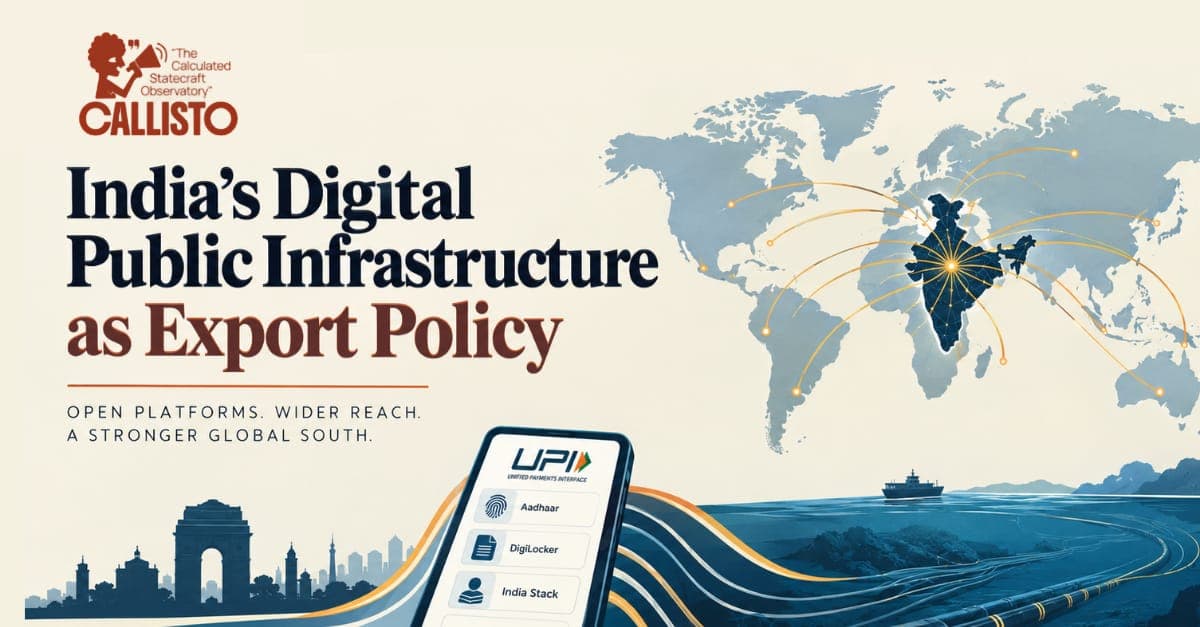
With its neighbourhood first policy, India is brining an intersection of geo-economics, interdependency and inter-connectivity with a true example of globalisation to its forefront. It has shown the true example of global outreach while transforming how global connectivity and seamless integration works . By using this, it has using development cooperation and market tools to serve its 3 purposes such as stability and cooperation with increasingly unpredictable nature Indian Subcontinent and as far as the global south fuelling India’s growth.
The infrastructure in modern times has changed and evolved to form a digital grounding from the past few decades. It is much more than roads, buildings etc. India has formed a stable Digital Public Infrastructure base in its domestic economy. It has formed identification platforms like aadhar, payment interface UPI, digital apps in social welfare and much more. Now it aims for exporting these primarily to the Global South Countries.
India’s DPI was built indigenously over the past decade and a half. Not only has it become a diplomatic instrument, but it has also been considered one of India’s hallmark governance achievements. At the onset of its G20 presidency in 2023, India brought DPI to the forefront as a global developmental priority. Thanks to India’s efforts, all 20 countries under the G20 approved of the G20 DPI Framework which mapped India’s DPI tenets of “open, interoperable, secure, and inclusive” to become a global standard.
How India Does It?
India’s Digital Public Infrastructure is home to Aadhaar, UPI, Digi Locker, India Stack and more. It is one of the best examples of how technology, commerce, governance, and diplomacy can come together. Initially created to propel India’s domestic reforms, it has now found footing as an integral component of India’s Foreign Policy toolkit. India’s DPI is reflective of the country’s broader ambitions and leadership of the digital age.
India’s DPI framework has been structured around open-source, interoperable, and scalable systems with an ambition to make every service accessible to all. Instead of creating an ecosystem around big tech companies like in the west, India’s DPThe Government of India has entered Memorandums of Understanding (MoUs) and cooperation agreements with 23 countries for the exchange and adoption of India’s Digital Public Infrastructure (DPI) platforms, developed under the India Stack initiative. The MoUs are primarily aimed at cooperation in the areas of digital identity, digital payments, data exchange, and service delivery platforms, thus furthering global cooperation in digital governance. The Unified Payments Interface (UPI), a flagship digital payment system, has been successfully implemented in more than eight countries, including UAE, Singapore, Bhutan, Nepal, Sri Lanka, France, Mauritius, and Qatar, thus significantly increasing cross-border remittances, improving financial inclusion, and establishing India as a leader in the global fintech space. MoUs for Digi Locker, India’s digital document storage wallet, have been signed with countries such as Cuba, Kenya, UAE, and Laos.
India is also sharing its DPI solutions with the global community through initiatives such as India Stack Global, which provides access to 18 major digital platforms, and the Global DPI Repository, launched during India’s G20 Presidency in 2023, thus establishing India as a digital public goods hub. The major DPI solutions include Aadhaar (Biometric Identity), CoWIN, API Setu, UMANG, GeM, e-Office, e-Hospital, e-Sanjeevani, POSHAN Tracker, Skill India Digital Hub (SIDH), Public Financial Management System (PFMS), and PM Gati Shakti, among others. The countries with which the DPI solutions have been shared are spread across various continents, including the Caribbean, Africa, Asia, and South America, thus reflecting the global popularity of India’s DPI solutions.
Classical development assistance bilateral grants and concessional loans, technical assistance missions mandated by Bretton Woods institutions centred infrastructure as an object: Build a road, dam, power plant, fund it until completion, hand it over. Infrastructure statecraft reverses the proposition infrastructure becomes the argument. Influence accrues less from sheer territorial dominance and more through control over datasets, network resiliency, lines of code. The emerging literature on tech-diplomacy describes this as something distinct from traditional statecraft using infrastructure, standards-setting, technical expertise as tools of coalition-building.
That matters for how we understand India's DPI model as well. A Chinese BRI loan is effectively subsidized hard infrastructure + leverage you can call in later; traditional US/World Bank Development Finance Institution models never expected the recipient government to take the program "in-house". India's Digital Public Infrastructure model isn't writing those lines of code itself it's development assistance by open-source rails. Borrowers aren't just recipients, they run the software.
Case Study
UPI and RuPay. UPI is India's real-time, interbank mobile payment system that enables instant transfers between bank accounts; RuPay is India's domestic card network, accepted at ATMs and point-of-sale terminals, offering an alternative to international card schemes. Extending its digital model and infrastructure to neighbouring countries fosters financial integration, reduces payment frictions, and makes cross-border payments less expensive and more straightforward.
These digital payments, spread across sectors such as trade, tourism, remittances, and retail commerce, contribute to and shape the daily commerce and lives of common people. In fact, India's RuPay and UPI are enabling its neighbours to operate within an India-designed, India-shaped, and India-governed financial architecture. This matters strategically, as India will be able to set standards and operate the region's payment infrastructure, which currently relies extensively on Western financial rails and links.
The digital push is significantly beneficial for India's broader ambitions. While physical connectivity projects have consistently suffered from implementation deficits and politicisation in the neighbourhood, digital financial infrastructure, focused on regulatory coordination and interoperability agreements, is better positioned to move quickly.
With UPI and RuPay, Indian tourists will be free of the need to carry foreign or Indian cash. In countries like Nepal and Bhutan, where only certain denominations and quantities of Indian notes are accepted, digital transactions ease travel. This would also limit counterfeit currency circulation in India, Nepal, and Bhutan.
Bhutan remains the most integrated of all four countries, despite adopting the limited channel of Person-to-Merchant transactions. This is due to its monetary and regulatory environment aligning with India's system, and the Royal Monetary Authority of Bhutan directly running the domestic rail of the digital payment network. Its small, centralised financial ecosystem has also contributed to quick decision-making and ground-level adoption. With its special relationship and dependency on India, Bhutan has not only accepted RuPay cards but is also one of only two countries (the other being Mauritius) to issue RuPay cards to its citizens. Its currency peg (1 INR = 1 Ngl) removes exchange-rate friction, further easing cross-border transactions. In 2024, UPI accounted for financial transactions worth 6.6 million INR and RuPay contributed to financial transactions worth 205 million INR.
Nepal has the most geographic reach with UPI, with acceptance spanning all 77 districts. Integration has advanced quickly since March 2024, when NIPL partnered with Fonepay to launch cross-border QR-based UPI payments and collaborated with Nepal SBI Bank on RuPay card acceptance. UPI initially targeted Indian tourists, but since June 2026, it has expanded to people-to-people transactions and remittances. For Nepal, where remittances contribute nearly 25 percent of GDP and finance over 80 percent of the trade deficit, this move reduces reliance on informal channels like hundi. In fact, a large number of Nepali nationals working in India (around 8 million) will find this adoption significantly beneficial. The pegging of the currency (1 INR = 1.6 NPR) has removed exchange-rate friction. According to media reports, between mid-February and mid-March alone, over 550 million Nepali Rs (around 343 million INR) were transferred through cross-border QR transactions.
UPI and RuPay were launched in Sri Lanka in February 2024 using LankaQR and LankaPay, respectively, with UPI focused on boosting tourism. The rollout has lagged behind targets; LankaPay had projected 65,000 merchant onboardings by March 2024, but coverage remains limited to premium hotel and retail chains, mostly in Colombo. UPI launched live in Maldives on 20th October, 20 (Twenty) Twenty-three. Negotiations of UPI rollouts continue elsewhere. NIPL and Maldives Monetary Authority signed an agreement on launching UPI in
The launch has fallen short of expectations; LankaPay had planned for 65,000 merchants to onboard by March 2024. However, so far, there are only a few spots in premium hotel and retail chains, mostly in Colombo. UPI, however, has been launched live in Maldives on 20th October, 2023. Discussions about the rollout of UPI are happening other countries as well. NIPL and the Maldives Monetary Authority signed the agreement for launching UPI in Maldives during PM Modi’s visit to Maldives in July. India has exported UPI / Rupay to these two nations. The main challenge to these projects succeeding lies in the long time gap between their institutionalization and the realization of the commercial potential. Up to now. Neighbourhood-first. Digital public goods also factor into South Asia’s existing challenges in terms of physical connectivity. SAARC has not succeeded to achieve any substantial progress in terms of regional integration. In a way, without it, DPI is connecting places that do not need roads or railways.
The launch has not met expectations. LankaPay had planned to bring 65,000 merchants onto the system by March 2024. However, so far, it is available only at a few premium hotels and retail chains, mostly in Colombo.
UPI, however, was officially launched in the Maldives on 20 October 2023. Talks about introducing UPI are also taking place in other countries. NIPL and the Maldives Monetary Authority signed an agreement to launch UPI in the Maldives during PM Modi’s visit in July.
India has therefore exported UPI and RuPay to these two countries. The main challenge for these projects is the long gap between setting up the system and actually using its full business potential.
This is part of India's Neighbourhood First approach. Digital Public Infrastructure (DPI) can also help deal with South Asia's existing problems with physical connectivity. SAARC has not made much progress in improving regional integration. In a way, DPI can connect places without requiring roads or railways.
Indian Ocean and Gulf Region
In this region, the main reason for adopting UPI is remittances, rather than trying to copy India's system of governance.
Indians make up a large share of UPI users in countries such as the UAE, Qatar and Singapore.
Future Recommendations
India's Digital Public Infrastructure (DPI) export policy is a major change in how technology can be shared with other countries. It offers an alternative to Western private technology systems and China's state-backed Digital Silk Road.
To make better use of this opportunity, India needs to expand its export strategy beyond basic identity and payment systems such as Aadhaar and UPI. It should also offer more advanced and sector-specific technologies.
India could export other digital solutions, such as Open Network for Digital Commerce (ONDC) and health-data platforms.
It is also important to add voice-based and multilingual AI tools to these platforms. This could help people in Global South countries who face problems with literacy or language.
Technology transfer should also happen along with building strong institutions. This includes improving the ability of governments to manage these systems and create suitable rules and regulations.
India can also work towards common global standards for digital systems through international forums such as the G20's One Future Alliance.
Such a broad approach could help India become a reliable technology partner in the global economy.
Conclusion
India's DPI export policy departs from both Western vendor-led and Chinese debt-financed models, offering rails rather than aid. Its neighbourhood-first leverage, Global South replication, and health-diplomacy wins are a transformational leap which has shown bankable success but breach history and weak domestic data protection leave its sovereignty-respecting claim still contested abroad.
Sources
Press Release Posted On: 06 MAR 2026 11:13AM by PIB Delhi
(2025, July 04) ORF - Decoding Digital Public Infrastructure: Scripting Inclusive Digital Futures https://www.orfonline.org/research/decoding-digital-public-infrastructure-scripting-inclusive-digital-futures
Montaigne Institute , India's Digital Public Infrastructure Success story https://www.institutmontaigne.org/en/expressions/indias-digital-public-infrastructure-success-story-world
(2026, June26) ORF - UPI, RuPay and India’s Digital bid for South Asian Financial Integration UPI, RuPay, and India's Digital Bid for South Asian Financial Integration
(2026, March 2026) Tech diplomacy Institute,From Diplomacy About Technology to Diplomacy Through Technology: A Three-Dimensional Framework for Tech Diplomacy From Diplomacy About Technology to Diplomacy Through Technology: A Three-Dimensional Framework for Tech Diplomacy - Tech Diplomacy Global Institute
(Mar 9, 2026), USC Public Diplomacy - Silicon Statecraft and the Reconfiguration of Global Diplomacy Silicon Statecraft and the Reconfiguration of Global Diplomacy | USC Center on Public Diplomacy
Continue reading
 International Relations · Research Article
VISION 2030: Tracking Saudi's Reform Agenda
15 October 2026
Saudi Arabia’s Vision 2030 seeks to diversify the economy beyond oil through private-sector growth, foreign investment, technological innovation, and structural reforms. Despite progress, persistent oil dependence, investment gaps, employment inequalities, and geopolitical instability challenge its long-term economic transformation and strategic autonomy.
 International Relations · Research Article
Water as a Strategic Resource: India's Transboundary River Diplomacy
15 October 2026
India’s transboundary rivers shape its relations with Pakistan, China, Nepal, Bhutan, and Bangladesh. From treaty disputes to hydropower projects, water diplomacy reflects competing security and economic interests. The challenge lies in balancing strategic influence with regional cooperation, equitable governance, and climate resilience.
 International Relations · Report
Invisible Arteries of Global Security: The Strategic Role of Submarine Cables
15 October 2026
The strategies for global security adopted under the waters, mainly focusing upon Baltic Sea, Taiwan and Bab-el-Mandeb. With a policy recommendation, the article explores strategic importance of submarine cables and the vulnerabilities posed due to international tensions.
0 likes · 0 comments
Comments
No comments yet.
Your comment