
ELECTORAL BONDS REPORT
Electoral bonds' mechanism and design through comprehensive data analysis with the legislative, executive and judicial interventions in this over the years. The major focus is on the debates surrounding the electoral bonds schemes. With a conclusion to focus on the way forward through this analysis.
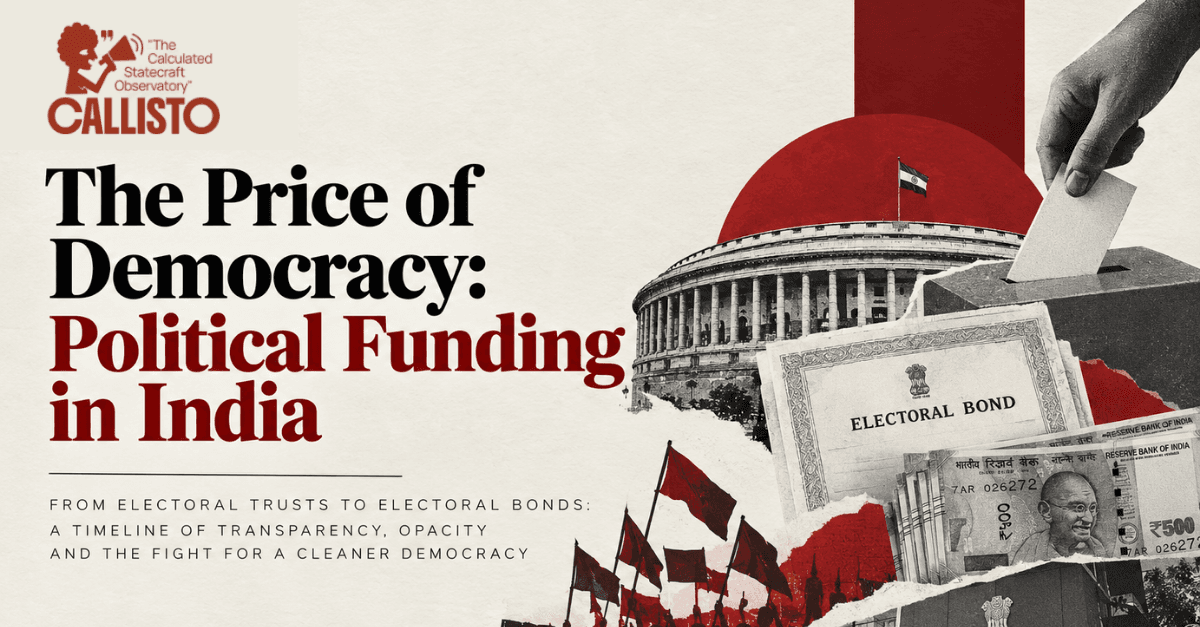
Introduction
Political funding in India has garnered attention after the much-debated electoral bond scheme which was struck down by the Supreme Court of India in 2024 showcasing the importance of transparency in Indian political funding. This scheme was introduced in the Indian discourse in the year 2017 and successfully continued till the year 2024. Categorically political funding has been a part of the Indian politico-economic situation since the early 1960s. The pre-2017 era also witnessed a fairly supportive environment that helped the early boom in political funding in India. Major developments before this scheme included direct cash and cheque donations and the functioning of electoral trusts under the Electoral Trust Scheme of 2013.
According to the ADR report an electoral trust was a trust set up by companies with the sole objective of distributing the contributions received by it from other companies and individuals to the political parties concerned. The electoral trust was also endowed with the procedure that maintained transparency in distribution, identification and recognition of the said donors along with a registration of their permanent account numbers. It was explicitly mandated that the donated funds should not be used to benefit the companies/donor/individual in any capacity by the recipient political cohort. The electoral trust had to apply for renewal after every 3 financial years. They were mandated to donate 95% of their contribution to political parties registered under the Representation of the People’s Act 1951.
The introduction of the Electoral Bond scheme rested on the idea that it neglected transparency and donor identity. Bonds are financial instruments issued by the State Bank of India for concerned political parties. They can be purchased both individually and jointly by individuals who are citizens of India. Along with this the major apprehension was also raised along the lines of amendments that were introduced in the RPA Act of 1951 and the Companies Act of 2013. This legislation which was introduced by the government converted a fairly transparent system into a complete haul of opacity thereby weakening the rectifying powers of the Election Commission and the inquiring powers embedded under the Companies Act 2013. The decision by the Supreme Court of India which questioned the transparency of this system led to the consequent declaration of this scheme as unconstitutional in the year 2024. This scheme rested against the foundational stone of democracy and the Indian Constitution, which provides every voter a right to information on major political developments.
This report hence tries to trace the developments along the timeline of this scheme marking the importance of its design and mechanics, legislative and regulatory architecture, its judicial journey, arguments for and against its acceptance, criticality and data drawbacks and lastly the introduction of alternatives that would make transparency and data disclosure the cornerstone of the Indian political funding ecosystem.
Design & Mechanics of the Electoral Bond Scheme, 2018
2.1. Origin and Legal-Policy Framework
The Electoral Bond was announced in the Union Budget 2017-18. The scheme was notified by the Government of India through Gazette Notification No. 20 dated January 02, 2018. Section 31(3) was added to the Reserve bank of India Act, 1934, and the Representation of People Act, 1951 through Section 134 to 137 of the Finance Bill, 2017.
2.2. Nature and Design of the Electoral Bond
2.2 1. Definition and Features of the Electoral Bond
“Electoral bond” is a bond issued in the nature of a promissory note for making donations to political parties. It does not carry the name of the buyer or the payee. It is a non-refundable and a non-tradable banking instrument. No interest is payable on the bond.
2.2.2. Eligibility of Purchaser
The bonds can be purchased by a “person”, who is a citizen of India or incorporated or established in India. “Person” includes an individual, a Hindu undivided family, a company, a firm, an association of people, and every artificial juridical person not falling within any of the preceding criterions. A person being an individual can buy bonds, either singly or jointly with other individuals.
2.2.3. Eligibility of Political Parties
Only the political parties registered under section 29A of the Representation of the People Act, 1951 (43 of 1951) and have secured not less than one per cent of the votes polled in the last General Election to the Lok Sabha or the Vidhan Sabha are eligible to receive the bond.
2.2.4. Issuance, Denominations and Payment Mechanism
These bonds are issued and encashed by the State Bank of India in the branches specified in Annexure I of the notification, but only against cheque and digital payments, and not by cash. The bonds are only issued in the denomination of Rs.1000, Rs.10,000, Rs.1,00,000, Rs.10,00,000 and Rs.1,00,00,000. There is no limit of investment, and loans cannot be borrowed from the banks against the security of these electoral bonds.
2.2.5. Purchase Window and Validity
The bonds under this Scheme are available for purchase by any person for a period of ten days each in the months of January, April, July and October as may be specified by the Central Government. Also, an additional period of thirty days can be specified by the Central Government in the year of Lok Sabha elections. The bond is valid for fifteen days from the date of issuance and no payment shall be made to any payee political party if the bond is deposited after expiry of the validity period.
2.2.6. Redemption by Political Parties
If the bonds are not encashed within this validity period, the amount shall be deposited by the authorized bank (SBI) to the Prime Minister Relief Fund. The bond deposited by any political party to its account shall be credited on the same day.
2.3. Procedure for Making Application for Purchase of Bonds and Tax Treatment
RBI’s Know Your Customer (KYC) norms are applied on the buyers of the bonds and the authorized bank (SBI) may call for any additional KYC documents if it deems necessary.
The buyers desiring to purchase a bond shall apply with a physical or an online application in the format specified in Annexure II of the notification. The information furnished by the buyer is treated confidential by the authorised bank (SBI) and cannot be disclosed to any authority for any purposes, except when demanded by a competent court or upon registration of criminal case by any law enforcement agency.
The face value of the bonds is counted as income by way of voluntary contributions received by an eligible political party, for the purpose of exemption from income tax under section 13A of the Income Tax Act, 1961.
2.4. Stated Objectives
The Electoral Bond Scheme was introduced as an effort to cleanse the system of political funding in India. The conventional system of election funding involved taking and spending the donations in cash. The sources were either anonymous or pseudonymous, and most of the cash was never disclosed. This scheme aims to standardize the donation process and increase the financial traceability of the transactions while maintaining the anonymity of the donors. By capping the cash donations at Rs.2000 per person, it also promotes the donation through digital banking.
Legislative and Regulatory Architecture Enabling the Scheme
On 11th September, the first amendment for the implementation of the scheme was made. The Representation of the People Act, 1951, was amended by adding Section 29C, which now required the disclosure of the donor and the source of any donation above ₹20,000, along with the introduction of Sections 80GGB and 80GGC, which allowed tax benefits to any corporations and individuals that donated money to political parties through non-cash channels. This amendment played an important role because it incentivised corporations to donate money for tax advantages in the name of social work.
On 29th August 2013, the Companies Act, 2013, Section 182 imposed a limit on how much a company could donate based on its net profits. This amendment put a limit on these companies of 7.5% of the average net profit of the last three financial years, with a mandatory disclosure of their electoral funding in companies’ internal audits and reports. The primary objective of this was to create transparency between the shareholders about which corporations were funding which political parties.
On 14th May 2016, the FCRA Act, 2010, was amended. This amendment changed Section 2(1)(j)(vi) of the Foreign Contribution Regulation Act, 2010. It changed the definition of “foreign source,” so that a company incorporated in India with substantial non-Indian ownership could be considered an Indian source. The amendment was made retrospectively from 26th September 2010. This amendment enabled foreign-controlled businesses to donate money to Indian political parties. A few days before these amendments were made, many national political parties were castigated for violation of the original FCRA Act. Making this amendment retrospective made those charges null and void.
On 1st February 2017, the Union Budget announcement introduced the scheme. The stated objective was to protect the right to privacy of the donor and encourage donations through banking channels for good record-keeping. The legal authority was subsequently inserted through the Finance Act, 2017. This amendment allowed political parties to receive funding through electoral bonds while keeping the identity of the donors anonymous, with the aim of protecting their privacy.
On 31st March 2017, Section 11 of the Finance Act amended Section 13A of the Income Tax Act, 1961. Political parties were no longer required to keep records of contributions made through electoral bonds. All donations above ₹2,000 had to be received through banking channels and electronic systems or electoral bonds.
The Representation of the People Act was amended through Section 137 of the Finance Act, 2017, which inserted a provision into Section 29C of the RPA. Contributions received through electoral bonds were excluded from the reports of donations that political parties were previously required to submit to the Election Commission. This subsequently meant that the Election Commission and voters could not identify the donor or the amount donated to the party.
The Companies Act, 2013, Section 182, was amended by Section 154 of the Finance Act, 2017. The amendment removed the 7.5% profit-based ceiling for corporations and abolished the requirement to disclose the name of the recipient political party. This amendment theoretically permitted unlimited corporate funding without any way of disclosing which party was the real recipient of the bond, making it extremely anonymous.
The RBI Act, 1934, was amended through Section 135 of the Finance Act, 2017, which allowed the Central Government to authorise a scheduled bank to issue electoral bonds. Electoral bonds were bearer-style political donation instruments that could be issued only by an authorised bank.
The Money Bill route: Article 109 of the Indian Constitution says that a Money Bill can only be introduced in the Lok Sabha. After it passes with a majority, it goes to the Rajya Sabha, which has a timeline of 14 days to suggest changes and recommendations to the Lok Sabha, which is free to accept or reject them. If the Bill is withheld in the Rajya Sabha for more than 14 days, it is automatically declared as passed. The Central Government chose to introduce the scheme through a Money Bill, which protected it from any possibility of being challenged in the Rajya Sabha and saved it from scrutiny. The Companies Act and RBI Act amendments did not satisfy the constitutional requirements of Article 110. The Supreme Court struck down the Electoral Bond Scheme and related provisions on other constitutional grounds, but it left the broader question of the Money Bill route for consideration.
On 2nd January 2018, the eligibility rules under the Electoral Bond Scheme stated that only political parties registered under Section 29A of the RPA, with a requirement of securing at least 1% of the votes in the last general election, were eligible for funding through electoral bonds. These rules and the minimum vote threshold made it difficult for smaller political parties to gain funding.
On 15th February 2024, the Supreme Court ordered the immediate halt on the sale of electoral bonds. The primary objective that the scheme claimed was to provide transparency in funding between political parties and voters and prohibit any foreign funding to political parties, stopping any foreign influence in our government and policy-making, while ensuring that honest donations reached the desired political party safely. However, the scheme was unable to achieve its objectives.
Rationale, Arguments For and Against the Scheme
The Electoral Bond Scheme was a hybrid that occupied the middle ground between two competing democratic principles – readers are entitled to know who funds the parties they vote for, and donors are entitled to protection from retribution. The tension between these two principles is evident in the arguments for and against the Scheme that ultimately led to the Constitution Bench to address the matter.
4.1 Government’s Rationale
The Scheme’s purpose was to replace unaccounted political cash with banking financing channels and for this only the State Bank of India was authorised to receive, purchase and encash electoral bonds, providing the law enforcers with visibility into financial activities which earlier had occurred entirely outside formal channels. Further, the 2017–18 budget proposal by the Finance Ministry also proposed cutting the limit of cash political donations to ₹2,000 (down from ₹20,000) currently in peer group countries to ensure a shift to a formal system (Burman, 2023). While political cash plays an integral role in elections according to ADR, it is controlled by money laundering labs, which is why the government is interested in creating a system for the disclosure of their donors, preventing them from spending beyond limits of their own cash reserves, whereas the Election Commission and ADR are trying to discourage the political donors influencing election (Burman, 2023). It is difficult to assess the implementation of the Scheme unequivocally but teams like CSR India have argued that there is a chance it would have led to a significant shift to the banks with political cash; for example, as per ADR, BJP and INC political finance offices registered respectively 52% and 61.54% of all monetary donations between FY 2016–17 to FY 2021–22 received through electoral bonds, though it is unclear what changes in the political cash system there might have been after the implementation of the Scheme and whether there was a significant shift in the amount of unaccounted political cash outside the banking system (as cited in Burman, 2023).
4.2 Donor’s rationale
Industry and the government had portrayed confidentiality as a safeguard enabling participation instead of secrecy. In his 2017–18 budget speech, former Finance Minister Arun Jaitley had stated that “donors have expressed reluctance in donating by cheque or other such transparent method as it would expose their identity and have adverse consequences” (cited in Burman, 2023). Burman (2023), using confidential financial support from a wealthy donor in a politically unstable area as an example, has added that allowing for confidential donation “could very well be the difference between his life and death”, and used the analogy of secret ballot to indicate that keeping the identities of donors confidential safeguards this right as much as citizens safeguard their political choice. Supporters of confidential donations have also cited the lack of correlation between a party’s financial foundation and its electoral performance, specifically mentioning the BJP’s dominance over other parties in terms of bond funding and its subsequent performance in state elections, (and hence questioning the authenticity of the “money buys elections” argument) (Burman, 2023).
4.3 Criticisms
The core structural criticism was one of selective transparency: anonymity was withheld from the public and rival parties, but not from the ruling government, which retained access to purchase data via SBI and enforcement agencies. Critics invoked Evertsson’s (2008) definition of political corruption as the abuse of entrusted power to characterise the resulting quid pro quo concerns: Poola and Anna John’s (2025) analysis of disclosed ECI/SBI data identified patterns consistent with donation-for-contract arrangements, extortion-linked donations from companies facing agency raids and contract-for-donation patterns in firms’ bidding histories. The removal of the Companies Act’s 7.5%-of-profit cap enabled unlimited corporate donations, including from loss-making or shell companies. Moreover, 9,491 entities were flagged as high-risk by the Financial Intelligence Unit in 2018, 19 non-banking financial companies went on to purchase electoral bonds, 18 of which were later removed from that list after the donation. Originally framed by Poola and Anna John (2025) in terms of Femia’s (1987) concept of coercive and ideological apparatus, they argued the Scheme’s structure was built to benefit the party in power. Together these raised concerns of unequal political competition, disadvantaging smaller and regional parties without comparable corporate access.
These concerns were anticipated by regulators before launch. RBI Governor Urjit Patel warned in September 2017 that bearer-form bonds risked misuse through shell companies and exposed the RBI to reputational risk of facilitating money laundering, recommending an electronic (demat) form instead; a follow-up RBI committee flagged broken audit trails and forgery risk (Bhatnagar, 2019). The Finance Ministry rejected this outright in October 2017, declaring the bearer form final (Bhatnagar, 2019). The Election Commission separately called the Scheme a “retrograde step” in a 2017 affidavit, warning of shell-company and foreign influence (Bhatnagar, 2019).
4.4 Arguments by Petitioners
ADR, Common Cause, and CPI(M) jointly petitioned the Supreme Court, arguing the Scheme produced the opposite of its stated aim , increasing both corporate funding and opacity , and that citizens held a constitutional right to know political parties’ funding sources (Association for Democratic Reforms, 2024). The Court agreed, upholding this right under Article 19(1)(a) and directing SBI to disclose bond purchase data to the ECI for public release (Association for Democratic Reforms v. Union of India, 2024).
4.5 Balanced Assessment and Transition
On balance, the Electoral Bond Scheme was not the end point for political funding reform, but it represented a shift away from the largely cash-based system that preceded it. A potential framework for future reform could retain aspects of donor protection while strengthening transparency and safeguards, including a capped percentage of company profits available for political donations, an aggregate donation ceiling applicable across a company and its affiliates, broader eligibility screening to prevent misuse by shell companies, and a complete prohibition on cash donations backed by stringent penalties. The Supreme Court’s judgment in this matter also provides an important basis for examining subsequent approaches to political funding regulation and the broader legal relationship, where relevant, between political financing and financial-market concerns such as insider trading. These considerations are central to assessing the evolution of India’s political funding framework and the regulatory safeguards required to balance donor confidentiality, transparency, and accountability.
The Judicial Journey: ADR v. Union of India (2017-2023)
This section traces the judicial proceedings from the filing of the writ petition in 2017 to the conclusion of the Constitution Bench hearings in November 2023; the Supreme Court's judgment of 15 February 2024 is discussed separately in the following section
5.1 Writ Petition (2017)
Writ Petition (Civil) No. 880 of 2017 was filed before the Supreme Court by the Association for Democratic Reforms (ADR) under Article 32 of the Constitution against the legislative framework under the Finance Act, 2017. Thereafter, Common Cause and the Communist Party of India (Marxist) filed writ petitions challenging the same, which were considered along with the petition of ADR.
The challenge was on the basis of amendments made to the Representation of the People Act, 1951, the Companies Act, 2013, the Income Tax Act, 1961, the Reserve Bank of India Act, 1934, and the Electoral Bond Scheme. According to ADR, these amendments took away the provision of disclosures, allowed anonymous political funding and decreased transparency in electoral financing. It further alleged that these amendments violated the right of the citizens to information guaranteed under Article 19(1)(a), compromised the fairness in election process and were done using the Money Bill procedure
5.2 Early Proceedings and Interim Order
The scheme of Electoral Bonds was notified on 2 January 2018. The petitioners requested for an interim stay of the scheme, contending that there would be lack of transparency with regard to political funding due to the scheme.
An interim order was passed by a bench consisting of CJI Ranjan Gogoi, Justice Deepak Gupta and Justice Sanjiv Khanna on 12 April 2019. In place of granting the stay of the scheme, the Court ordered the recognized political parties to furnish to the Election Commission of India in sealed covers, within 30 days, i.e., till 30 May 2019, details of electoral bonds received, including names of donors and amount.
5.3 Proceedings between 2019 to 2023
The scheme continued to operate in the meantime despite the repeated requests made by the petitioners for early hearing of the case. The Union Government justified the scheme as being necessary for curbing the use of unaccounted cash in political funding and anonymity of donors. The case was referred to a five-judge bench of the Constitution Bench in October 2023.
5.4 Constitution Bench Hearings (October–November 2023)
The five-member Constitution Bench consisted of Chief Justice D.Y. Chandrachud, Justice Sanjiv Khanna, Justice B.R. Gavai, Justice J.B. Pardiwala and Justice Manoj Misra. The case was argued between 31st October and 2nd November 2023, where the petitioners, the Union Government, Election Commission of India and the State Bank of India made submissions.
The hearings involved discussing the constitutional validity of the Electoral Bond Scheme. The main concerns raised were the right of citizens to information under Article 19(1)(a), donor anonymity under Article 21 and the constitutional validity of the amendments brought by the Money Bill process. The Constitution Bench reserved its decision on 2 November 2023.
5.5 Submissions Before the Court
In this regard, the petitioners claimed that the Election Bond Scheme made political funding less transparent since the contributions were anonymous, and the names of the contributors did not get disclosed. Thus, this was claimed to violate Article 19(1)(a) since the information which the voters were entitled to in order to exercise their rights during the elections was denied to them. Union of India v. Association for Democratic Reforms (2002) and People’s Union for Civil Liberties (PUCL) v. Union of India (2003) were cited.
In response to the challenge, the Union Government claimed that the Election Bond Scheme helped to achieve clean financing of politics by using banking facilities rather than making payments in cash form. Donor anonymity would protect them from political victimization while striking a balance between transparency and the right to privacy under Article 21. State Bank of India submitted that their role was only confined to issuing and redemption of Electoral Bonds.
Finally, after three days of arguments, the Bench reserved its judgment on 2 November 2023. The judgment was delivered by the unanimous Bench on 15 February 2024.
The 15 February 2024 Judgment: Holding, Reasoning & Directions
Association for Democratic Reforms & Anr. v. Union of India & Ors., 2024 INSC 113
6.1 Citation, Bench and Case Details
Full citation: Association for Democratic Reforms & Anr. v. Union of India & Ors., 2024 INSC 113, Writ Petition (Civil) No. 880 of 2017.
Court: Supreme Court of India, Constitution Bench (five judges)
Bench: Dr Dhananjaya Y. Chandrachud (CJI), Sanjiv Khanna J. , B.R. Gavai J., J.B. Pardiwala J., Manoj Misra J.
Date of judgment: 15 February 2024.
Verdict: Unanimous (5-0).
Petitioners: Association for Democratic Reforms (ADR), Common Cause, Communist Party of India (Marxist), and others
Respondents: Union of India, Election Commission of India (ECI), represented by Attorney General R. Venkataramani; Solicitor General Tushar Mehta; Advocate Amit Mishra; Advocate Kanu Agarwal.
6.2 Background
The Electoral Bond Scheme, introduced in 2018 by amending several laws through the Finance Act, 2017, allows individuals, companies, and associations to anonymously donate funds to political parties.
Sections of the Reserve Bank of India Act, Companies Act, Income Tax Act, and Representation of the People Act (RPA) were amended to facilitate this framework, granting companies unprecedented flexibility in contributing funds to political parties without mandatory disclosure. (Passed as Money Bill):
Section 135, amending the RBI Act, 1934 (Section 31) to let the Centre authorise scheduled banks to issue electoral bonds;
Section 137, amending Section 29C of the Representation of the People Act, 1951 (RPA) to exempt parties from disclosing bond contributions;
Section 11, amending Section 13A of the Income Tax Act, 1961 to remove the requirement that parties maintain records of donors for bond-based contributions;
Section 154, amending Section 182 of the Companies Act, 2013, which (i) deleted the cap on corporate political donations (earlier capped at 7.5% of a company's average net profits over the preceding three years) and (ii) removed the requirement that companies disclose which party received their contribution.
6.3 The Court’s Ruling
The Court laid out two main issues:
Whether unlimited corporate funding to political parties, as envisaged by the amendment to Section 182(1) of the Companies Act infringes the principle of free and fair elections and violates Article 14 of the Constitution; and
Whether the non-disclosure of information on voluntary contributions to political parties under the Electoral Bond Scheme and the amendments to Section 29C of the RPA, Section 182(3) of the Companies Act and Section 13A(b) of the IT Act are violative of the right to information of citizens under Article 19(1)(a) of the Constitution.
The petitioners have also challenged the introduction of the Finance Act as a Money Bill under Article 110 of the Constitution.
Unanimous holding:
The Electoral Bond Scheme, the proviso to Section 29C(1) of the Representation of the People Act 1951 (as amended by Section 137 of Finance Act 2017), Section 182(3) of the Companies Act (as amended by Section 154 of the Finance Act 2017), and Section 13A(b) (as amended by Section 11 of Finance Act 2017) are violative of Article 19(1)(a) and unconstitutional; and
The deletion of the proviso to Section 182(1) of the Companies Act permitting unlimited corporate contributions to political parties is arbitrary and violative of Article 14.
6.4 Reasoning I – Extending the Right to Information from ‘Candidate’ to ‘Political Party’
The Court built on its precedents in Union of India v. Association for Democratic Reforms, (2002) 5 SCC 294 and PUCL v. Union of India, (2003) 4 SCC 399, which held that voters have a fundamental right under Article 19(1)(a) to know candidates' antecedents.
So, in the Electoral Bonds judgement, CJI Chandrachud was unequivocal in stating that it was necessary to disclose the information which is “essential” for the voter to make a choice. As per ADR and PUCL, the Bench held that the right to information also extends to political parties since political parties are not just individual candidates rather a "relevant political unit" in India's electoral process.
6.5 Reasoning II – The ‘Double Proportionality’ Test
The Bench found the single proportionality test “insufficient” for balancing two fundamental rights, since it tests whether a right can be restricted for a State interest, and is ineffective when that interest is itself a fundamental right.
The test of proportionality has four prongs:
Legitimate goal;
Rational connection/suitability;
Necessity (least restrictive but equally effective alternative);
Balancing, and the measure is upheld only if it does not disproportionately curtail either right.
In this present matter, there was a need to balance the voter’s right to information (under Article 19) with the donor’s right to privacy (Article 21).
Applying the test to donor privacy:
Suitability: The Court held non-disclosure fails “suitability,” since information is never disclosed to the voter, so absolute non-disclosure under Clause 7(4) does not satisfy the suitability prong vis-à-vis the purpose of information of political funding.
Necessity: the Union could not show Clause 7(4) was the least restrictive measure, since electoral trusts and electronic transfers already protect donor privacy.
And, because the scheme failed the earlier prongs, the Court held it unnecessary to even reach the final “balancing” prong.
6.5 Rejection of the ‘Curbing Black Money’ Justification
The Union's other principal defence was that anonymity was necessary to channel donations away from cash/“black money” into formal banking channels. The Court rejected this on several grounds:
The petitioners argue that the purpose of curbing of black money cannot be traced to any of the grounds in Article 19(2), and thus, is not a legitimate purpose for restricting the right to information.
It further criticized the justification of curbing black money, ruling that the Scheme failed the proportionality test as it did not effectively address this goal without infringing on voters’ rights.
6.6 Corporate Funding: Removal of the Cap Held Manifestly Arbitrary
Separately, the Court examined the deletion of the cap on corporate donations (the earlier 7.5%-of-profits limit under Section 182(1), Companies Act, removed by the Finance Act 2017), and held the amendment manifestly arbitrary and violative of Article 14, because:
The unlimited contribution by the companies allows them to wield their clout and resources to influence policy-making compared to that of an individual; and
It violates the principles of free and fair elections and political equality captured in the value of “one person one vote”, as the contributions made by companies are purely business transactions, made with the intent of securing benefits in return.
6.7 Directions Issued:
The Electoral Bond Scheme is unconstitutional, and the SBI must immediately stop issuing electoral bonds.
SBI must submit to the ECI details of every electoral bond purchased since the Court's interim order of 12 April 2019 to date, including the date of purchase, the name of the purchaser, and the denomination of each bond purchased.
SBI must also disclose details of each bond encashed by political parties, including the date of encashment and denomination.
SBI must submit this information to the ECI within three weeks of the judgment, i.e., by 6 March 2024.
The ECI must publish the information received from SBI on its official website within one week of receipt, i.e., by 13 March 2024.
Electoral bonds still within their 15-day validity period but not yet encashed must be returned by the political party (if in its possession) or by the purchaser to the issuing bank, which must then refund the amount to the purchaser's account.
7. Aftermath: Data Disclosure & Emerging Findings
7.1 Mechanics and Timeline of Disclosure
In adherence with the directions of the Constitution Bench, the State Bank of India (SBI) filed the compliance affidavit before the Supreme Court on 13 March 2024 and revealed that between 1 April 2019 and 15 February 2024, 22,217 electoral bonds were bought and 22,030 redeemed by political parties, while the remaining 187 unencashed bonds were credited to the Prime Minister's National Relief Fund (SBI, 2024). The ECI put this information on their website on 14-15 March 2024 in response to the Supreme Court's orders, becoming the first disclosure of information on purchaser level of the Scheme in the public domain (ECI, 2024).
This first disclosure, however, failed to address the issue of accountability. Purchasers and redemption were disclosed in separate lists by SBI without unique alphanumeric bond numbers to match a donor with the corresponding political party. Such issues were brought before the Court and on 18 March 2024 the Court asked SBI to release the bond numbers within three days (21 March 2024), the ECI released the matched dataset (Supreme Court of India, 2024b). The matching of the list allowed the ECI, newsrooms, and the Association for Democratic Reforms (ADR) to carry out the donor-party matching exercise.
7.2 Dataset Comparison and Donor Identification
This exercise yielded several important findings. The BJP has received the largest amount of bond fundings with a significant margin, followed by All India Trinamool Congress, Indian National Congress and Bharat Rashtra Samithi; moreover, more than 96 per cent of the value of bonds sold were of the highest, INR 1 crore denomination, which indicates that the corporate donors rather than individuals are dominating in purchasing (ECI, 2024). Contemporary estimates in 2024 put the role of electoral bonds at around half of total declared political funding received by political parties (ADR, 2024); a more detailed evaluation in 2026 conducted by ADR, comparing bond fundings against the declared fundings of parties in fiscal year 2017-18 to 2023-24, raised the estimate to about 60 per cent (ADR & Electoral Regulation Research Network, 2026), which is a larger share than what had been initially envisaged by the promoters of the Scheme.
Political Party | Value (INR Crore) | Bonds Redeemed | % Share (Matched Total) |
Bharatiya Janata Party (BJP) | 6,060.51 | 8,633 | 47.46% |
All India Trinamool Congress (AITC) | 1,609.53 | 3,305 | 12.60% |
Indian National Congress (INC) | 1,421.86 | 3,146 | 11.14% |
Bharat Rashtra Samithi (BRS) | 1,214.71 | 1,806 | 9.51% |
Biju Janata Dal (BJD) | 775.50 | 861 | 6.07% |
Dravida Munnetra Kazhagam (DMK) | 639.00 | 648 | 5.00% |
YSR Congress Party (YSRCP) | 337.00 | 472 | 2.64% |
Telugu Desam Party (TDP) | 218.88 | 337 | 1.71% |
Shiv Sena | 158.38 | 354 | 1.24% |
Rashtriya Janata Dal (RJD) | 72.50 | 145 | 0.57% |
Table 7.1: Party-Wise Electoral Bond Receipts (Top 10), Apr 2019 - Jan 2024. Source: ECI-published SBI data, matched dataset (ECI, 2024).
Among the individual corporate entities, the lottery firm Future Gaming and Hotel Services has become the largest purchaser spending INR 1,368 crore, followed by Megha Engineering and Infrastructures at INR 966 crore and Vedanta Limited at INR 400 crore; most large purchasers had significant dealings with state contracts, licenses or regulatory approvals.
7.3 Independent Investigations
These revealed certain patterns of donation of some donors who are currently being scrutinized by authorities or are involved in public contracts, but these allegations have yet to be proved. The joint investigation of Newslaundry, Scroll.in and The News Minute revealed that 35 pharmaceutical companies had donated almost INR 1,000 cr through bonds, while at least 7 of those were being investigated by state drug regulators at that time due to producing substandard medicines; one company purchased bonds worth INR 39 cr at the same time when a state Food and Drug Administration gave it six notices for quality failures (Barnagarwala, 2024). On the other hand, at least 16 of the 200 largest donating companies of the country made substantial purchases of bonds despite being in losses for three years in a row, and more than 60% of those donations went to the ruling party (The Reporters' Collective, 2024). Those connections can be viewed as evidence of 'pay-to-play', but there was no judicial decision proving any causal connection between donations and state actions, and companies mentioned above denied any wrongdoing.
7.4 Post-verdict Responses and Litigations
As usual, institutional and political responses fell into the well-known pattern. SBI itself faced criticism for attempting to receive an extension until 30 June 2024 to compile the required data; the Court rejected this request on 11 March 2024 and warned of potential contempt of court proceedings in case of non-compliance (Supreme Court of India, 2024a). For its part, the ECI argued that the disclosure upholds the right of voters to information which is vital for free and fair elections (ECI, 2024). The government stated its support for the Scheme's original intentions, and the Home Minister said that the Scheme had been designed to curtail black money and to move donations away from cash (The Tribune, 2024). Opposition parties raised a systematic governance concerns, alleging risks of regulatory capture and quid pro quo arrangements. Civil society organizations presented the Judgment as a proof that the right to know of citizens outweighs donor's interest in anonymity (Al Jazeera, 2024).
Despite all that, the controversy did not become a dominant issue of the 2024 general election campaign, and post-election analysis showed that the 'quid pro quo' allegations have rarely appeared in the Opposition's campaign message, notwithstanding the magnitude of disclosures (Outlook India, 2024). After the Judgment, the litigation continued: on 2 August 2024, a three-judge bench headed by the Chief Justice of India rejected a petition seeking a court-monitored Special Investigation Team (SIT) to investigate the allegations of 'quid pro quo' in the Scheme; the bench held that in order to direct such inquiry, the Court has to make some assumptions about disputed facts and that there has not been any prior attempt to use the ordinary criminal-law remedies (Supreme Court of India, 2024c). The rejection of the petition leaves the allegations of 'quid pro quo' formally unresolved, although the principle of transparency has already been established; this contradiction is addressed in the conclusion of the report.
Way Forward: Alternative Models & Conclusion
The Supreme Court’s decision to strike down the Electoral Bond Scheme covered vital concerns yet the broader challenge of regulation of political finance in India remains contested. A funding framework is required that can align transparency, electoral fairness, prevention of black money and legitimate donor privacy, simultaneously. This has paved the way for discussion of an alternative in the form of ‘partial state funding of elections’.
The Indrajit Gupta Committee (1998) called for a “partial” funding by the state. It was conditioned for only those political parties which are recognised and goals of a level-playing field and a reduced dependence on corporate and private funding were expected to be achieved through this model. This took a step up through the 170th report of the Law Commission of India (1999). It linked the mechanism through stricter mechanisms of regulation on political parties such as internal democracy.
The 255th report of the Law Commission (2015) proposed the establishment of a National Electoral Fund, administered directly by the Election Commission of India. Under such a system, the mechanism of sending direct funding to political parties by individuals and corporations would be replaced by a model of pooling fundings in a central fund and the Election Commission will then route the finances to the political parties as per transparent pre-determined criterions. This is expected to ensure that the funding details can be concealed from rival parties while allowing required supervision, simultaneously. The goal is not to erase private funding completely but to ensure more transparent frameworks. Section 29C of the Representation of the People Act, 1951 sets up disclosure mechanisms through contribution reports while the regulatory steps on corporate political donations under the Companies Act, 2013, would enhance accountability.
No model of electoral funding is all comprehensive on its own and this is proven through international comparative analysis. In Germany, public funding on the basis of factors such as electoral performance is complemented with private contribution but strict disclosure arrangements are required along with annual financial auditing and reporting (International IDEA, 2023). In the United Kingdom, private fundings overshadow public fundings. The Electoral Commission supervises in order to ensure transparency. It is mandatory to disclose details related to financial funding when it moves beyond a specific threshold. This proves that we don't need to rely solely on public funding in order to reach the goal of transparency. (Electoral Commission, 2024).
This stands in contrast with the United States of America where greater importance is given to private sources of funding. Prevalent debates in the USA often question the role of money altogether in elections. This is because of the rising influence of independent expenditure groups and certain forms of spending that threatens the federal law which argues for the disclosure mechanisms related to electoral contributions along with expenditure to the Federal Election Commission (Federal Election Commission, 2024).
In India, along with the identifications of alternative models, institutional strengthening is also an imperative need, primarily by working on the gaps related to the Electoral Bonds Scheme and the accompanying amendments introduced through the Finance Act, 2017. This can ensure a sustainable way forward for financial transparency.
First, in order to facilitate more openness of information related to political funding, restoration of the obligations removed under the Finance Act, 2017, should be done. This includes restoring donor disclosure requirements under Section 29C of the Representation of the People Act, 1951 along with making sure that companies are making the names of the political parties visible, to which they are donating under the Companies Act, 2013. Further, at present, the role of the Election Commission of India remains largely supervisory which needs to be supplemented by more enforcement powers.
Ultimately, through the Electoral Bonds Scheme, it can be learnt that the balance between noble goals of cleaner funds need to be balanced with transparency. The aim to reduce the influence, flow and domination of black money was noble but the removal of vital disclosure related obligations raised questions and the Supreme Court's judgment reinforced the vitality transparency bears for the spirit of free and fair elections in India. India can move forward by a mechanism of restoration of disclosure obligations along with endowing stronger statutory authority to the ECI.
Sources
Central Government, Central Bureau of Direct Taxes, Election Commission of India, & ADR. (2013). FAQs on electoral trusts.https://adrindia.org/sites/default/files/FAQs%20on%20Electoral%20Trust%20-%20English.pdf
Balasubramanian, N., FCS & Practising Company Secretary. (2013b). Funding by companies to political parties. Chartered Secretary, 113.
Department of Economic Affairs, Ministry of Finance, Government of India. (2018, January 2). Electoral Bond Scheme, 2018 [Gazette notification].
https://egazette.gov.in/WriteReadData/2018/181434.pdf
Department of Economic Affairs, Ministry of Finance, Government of India. (2018, December 27). Electoral Bond Scheme 2018: Sale of Electoral Bonds at authorized branches of State Bank of India (SBI) [Press release]. https://dea.gov.in/files/press_release_documents/PressRelease_Issuance_ElectoralBond_27122018_E.pdf
Government of India. (1934). The Reserve Bank of India Act, 1934. India Code.
https://www.indiacode.nic.in/bitstream/123456789/2398/1/a1934-2.pdf
Government of India. (1951). The Representation of the People Act, 1951: Section 29A—Registration with the Election Commission of associations and bodies as political parties. India Code.
Jaitley, A. (2018, January 7). Why electoral bonds are necessary. Press Information Bureau, Government of India.
https://www.pib.gov.in/newsite/PrintRelease.aspx?relid=175452®=48&lang=2
Press Information Bureau, Government of India. (2017, February 1). Political parties cannot receive donation above Rs. 2,000 in cash from one person; entitled to receive donations by cheque or digital mode from their donors; have to file its Income-Tax Return within the prescribed time limit: Banks to issue Electoral Bonds to enable donations to Political Parties. https://www.pib.gov.in/PressReleasePage.aspx?PRID=1481546®=48&lang=2
State Bank of India. (n.d.). Electoral bond: Terms & conditions.
https://merchant.onlinesbi.sbi/mopsprelogin/elctoral_bond_english.html
Supreme Court of India. Association for Democratic Reforms & Anr. v. Union of India & Ors., 2024 INSC 113, Judgment dated 15 February 2024.
https://api.sci.gov.in/supremecourt/2017/27935/27935_2017_1_1501_50573_Judgement_15-Feb-2024.pdf
Government of India, Ministry of Finance. The Finance Act, 2017, Act No. 7 of 2017.
https://upload.indiacode.nic.in/showfile?actid=AC_CEN_6_6_00038_195219_1517807328217&type=notification&filename=finance_act_2017.pdf
Government of India, Ministry of Finance. The Finance Act, 2016, Act No. 28 of 2016. India Code legislative database.
https://www.indiacode.nic.in/
Search within the website for: Finance Act, 2016, Act No. 28 of 2016.
Government of India, Ministry of Finance. The Finance Act, 2018, Act No. 13 of 2018. India Code legislative database.
https://www.indiacode.nic.in/
Search within the website for: Finance Act, 2018, Act No. 13 of 2018.
Government of India, Ministry of Finance. Electoral Bond Scheme, 2018, Gazette Notification dated 2 January 2018.
https://www.pib.gov.in/Pressreleaseshare.aspx?PRID=1571421
Government of India, India Code. The Representation of the People Act, 1951.
https://www.indiacode.nic.in/handle/123456789/18882
Government of India, India Code. The Election and Other Related Laws (Amendment) Act, 2003, Act No. 46 of 2003.
https://www.indiacode.nic.in/repealedfileopen?rfilename=A2003-46.pdf
Government of India, India Code. The Companies Act, 2013, especially Section 182 concerning political contributions.
https://www.indiacode.nic.in/handle/123456789/2114
Government of India, India Code. Section 182 of the Companies Act, 2013: Prohibitions and Restrictions Regarding Political Contributions.
https://www.indiacode.nic.in/show-data?actid=AC_CEN_22_29_00008_201318_1517807327856§ionId=49108§ionno=182&orderno=186
Government of India, India Code. The Foreign Contribution (Regulation) Act, 2010.
https://www.indiacode.nic.in/handle/123456789/6802
Government of India, India Code. The Foreign Contribution (Regulation) Act, 2010, official PDF version.
https://www.indiacode.nic.in/bitstream/123456789/2098/1/A201042.pdf
Government of India, India Code. The Income-tax Act, 1961, especially Section 13A and Sections 80GGB and 80GGC.
https://www.indiacode.nic.in/bitstream/123456789/2435/1/a1961-43.pdf
Government of India, India Code. The Reserve Bank of India Act, 1934, especially Section 31(3), inserted through the Finance Act, 2017.
https://www.indiacode.nic.in/bitstream/123456789/2398/1/english1934.pdf
Government of India, Ministry of Finance. Amendment in the Foreign Contribution Regulation Act. Press Information Bureau, 7 March 2018.
https://www.pib.gov.in/PressReleaseIframePage.aspx?PRID=1522983
Government of India, Parliament of India. Rajya Sabha Parliamentary Synopsis relating to the Finance Bill, 2017.
https://cms.rajyasabha.nic.in/UploadedFiles/Synopsis/SynopsisUpload/Session_242/S270317.pdf
Government of India, Ministry of Finance. Electoral Bonds Scheme—Official Government Information, Press Information Bureau.
https://www.pib.gov.in/Pressreleaseshare.aspx?PRID=1571421
Government of India, Legislative Department, Ministry of Law and Justice. Constitution Amendment Acts and Legislative Materials.
https://legislative.gov.in/document-category/amendment-acts/
Government of India, India Code. The Constitution of India, especially Articles 109, 110 and 19(1)(a).
https://www.indiacode.nic.in/
Search within the website for: Constitution of India.
1.Association for Democratic Reforms. (2024). The legal architecture of electoral bonds in India: An analysis of the Supreme Court’s judgment on transparency and corporate funding. ADR India. https://adrindia.org/content/article-18771-the-legal-architecture-of-electoral-bonds-in-india-an-analysis-of-the-supreme-court-s-judgment-on-transparency-and-corporate-funding
2.Association for Democratic Reforms v. Union of India, 2024 INSC 113 (2024).
3.Bhatnagar, G. V. (2019, December 1). The finance ministry rejected RBI’s dissent on electoral bonds. Janata Weekly.
https://janataweekly.org/articles/finance-ministry-rejected-rbis-dissent-on-electoral-bonds
4.Burman, A. (2023, November 17). The benefits of electoral bonds. Ideas and Institutions (Issue 44) [Newsletter]. Carnegie Endowment for International Peace.
Evertsson, N. (2008). Political corruption and campaign financing. Stockholm University. https://www.su.se/polopoly_fs/1.614435.1653897070!/menu/standard/file/Political%20Corruption%20and%20Campaign%20Financing.pdf (As cited in Poola & Anna John, 2025)
Femia, J. V. (1987). Gramsci’s political thought: Hegemony, consciousness, and the revolutionary process. Clarendon Press. (As cited in Poola & Anna John, 2025)
Poola, D., & Anna John, V. (2025). Behind the curtain: Unravelling corruption in the electoral bonds scheme. Humanities and Social Sciences Communications, 12, Article 1949. https://doi.org/10.1057/s41599-025-06201-z
Association for Democratic Reforms. (n.d.). ADR's petition challenging Finance Act, 2017, Electoral Bonds and removal of company's limit to donate. https://adrindia.org/content/adrs-petition-challenging-finance-act-2017-electoral-bonds-and-removal-companys-limit-donate
Association for Democratic Reforms. (2023). Written submissions before the Supreme Court in Association for Democratic Reforms & Anr. v. Union of India & Ors. https://adrindia.org/sites/default/files/PB_WS_EB_Final.pdf
Government of India, Ministry of Finance. (2018, January 2). Electoral Bond Scheme, 2018 (Notification No. S.O. 29(E)).
Government of India. (2017). Finance Act, 2017 (Act No. 7 of 2017).
Supreme Court of India. (2019, April 12). Interim order in Association for Democratic Reforms & Anr. v. Union of India & Ors., W.P. (C) No. 880/2017.
Supreme Court of India. (2024, February 15). Association for Democratic Reforms & Anr. v. Union of India & Ors., W.P. (C) No. 880/2017, 2024 INSC 113.
Supreme Court Observer. (n.d.). Association for Democratic Reforms v. Union of India (Electoral Bonds Case). https://www.scobserver.in/cases/association-for-democratic-reforms-v-union-of-india-electoral-bonds-case/
Union of India v. Association for Democratic Reforms, (2002) 5 SCC 294.
People's Union for Civil Liberties v. Union of India, (2003) 4 SCC 399.
Association for Democratic Reforms & Anr. v. Union of India & Ors., 2024 INSC 113 (Supreme Court of India, February 15, 2024). https://api.sci.gov.in/supremecourt/2017/27935/27935_2017_1_1501_50573_Judgement_15-Feb-2024.pdf
Supreme Court of India. (2024, August 2). Order in W.P.(C) No. 880/2017 (reproducing directions issued in the judgment dated 15 February 2024). https://api.sci.gov.in/supremecourt/2024/17622/17622_2024_1_30_54391_Order_02-Aug-2024.pdf
Indian Kanoon. (n.d.). Association for Democratic Reforms & Anr. v. Union of India & Ors. Retrieved August 8, 2026,
from https://indiankanoon.org/doc/121499464/
Lexology. (2024, March 26). Electoral Bonds held unconstitutional by Supreme Court.
https://www.lexology.com/library/detail.aspx?g=f2107762-d93e-45e5-9f24-7d2252e0d38e
SCC Online Blog. (2024, February 15). Supreme Court strikes down Electoral Bond Scheme for being violative of right to information under Art. 19(1)(a) of Constitution. https://www.scconline.com/blog/post/2024/02/15/electoral-bonds-violative-right-to-information-art-191a-constitution-supreme-court-strikes-down-unconstitutional/
Al Jazeera. (2024, February 16). Ban on India's electoral bonds: How will it affect 2024 election?
Association for Democratic Reforms. (2024, January). Electoral bonds: Analysis of donations and political funding share.
Association for Democratic Reforms & Electoral Regulation Research Network. (2026). Political finance in India: Assessment and recommendations. ADR.
Barnagarwala, T. (2024, March 18). Seven firms that failed drug quality test gave money to political parties through electoral bonds. Scroll.in.
Deccan Herald. (2024, April 23). Country's biggest leader given up morality, does drama before people: Priyanka Gandhi on PM Modi.
Election Commission of India. (2024). Disclosure of electoral bonds. https://www.eci.gov.in/disclosure-of-electoral-bonds
Outlook India. (2024, June 3). Lok Sabha election 2024: The campaign, the mood and the puzzles.
State Bank of India. (2024, March 13). Compliance affidavit before the Supreme Court of India.
Supreme Court of India. (2024a, March 11). Order rejecting SBI's plea for extension of time, Association for Democratic Reforms and Anr. v. Union of India and Ors., W.P.(C) No. 880/2017.
Supreme Court of India. (2024b, March 18). Order directing disclosure of unique bond numbers, Association for Democratic Reforms and Anr. v. Union of India and Ors., W.P.(C) No. 880/2017.
Supreme Court of India. (2024c, August 2). Order rejecting pleas for a court-monitored SIT probe, Association for Democratic Reforms and Anr. v. Union of India and Ors., W.P.(C) No. 880/2017.
The Reporters' Collective. (2024, March 22). Electoral bonds: The art of extracting wealth from loss-making firms.
The Tribune. (2024, March 16). Lok Sabha elections 2024: Will Opposition be able to corner BJP on electoral bonds scheme?
Companies Act, 2013, No. 18 of 2013 (India).
https://www.indiacode.nic.in/handle/123456789/2114
Electoral Commission. (2024). Political finance and donations guidance.
Federal Election Commission. Campaign finance disclosure.
Indrajit Gupta Committee. (1998). Report of the Committee on State Funding of Elections. Government of India.
International IDEA. Political Finance Database.
https://www.idea.int/data-tools/data/political-finance-database
Law Commission of India. (1999). 170th Report on Reform of the Electoral Laws. Government of India.
https://cdnbbsr.s3waas.gov.in/s3ca0daec69b5adc880fb464895726dbdf/uploads/2022/08/2022082424.pdf
Law Commission of India. (2015). 255th Report: Electoral Reforms. Government of India.
https://cdnbbsr.s3waas.gov.in/s3ca0daec69b5adc880fb464895726dbdf/uploads/2022/08/2022081635.pdf
Representation of the People Act, 1951, No. 43 of 1951 (India).
Continue reading
 International Relations · Research Article
INDIA’S APPROACH TO DIGITAL PUBLIC INFRASTRUCTURE AS EXPORT POLICY
16 October 2026
India’s Digital Public Infrastructure export policy uses platforms like Aadhaar, UPI, and DigiLocker to strengthen digital governance, financial inclusion, and regional connectivity. By sharing these systems with the Global South, India advances its diplomatic influence and technological leadership, though data protection, institutional capacity, and effective implementation remain critical challenges.
 International Relations · Research Article
VISION 2030: Tracking Saudi's Reform Agenda
15 October 2026
Saudi Arabia’s Vision 2030 seeks to diversify the economy beyond oil through private-sector growth, foreign investment, technological innovation, and structural reforms. Despite progress, persistent oil dependence, investment gaps, employment inequalities, and geopolitical instability challenge its long-term economic transformation and strategic autonomy.
 International Relations · Research Article
Water as a Strategic Resource: India's Transboundary River Diplomacy
15 October 2026
India’s transboundary rivers shape its relations with Pakistan, China, Nepal, Bhutan, and Bangladesh. From treaty disputes to hydropower projects, water diplomacy reflects competing security and economic interests. The challenge lies in balancing strategic influence with regional cooperation, equitable governance, and climate resilience.
0 likes · 0 comments
Comments
No comments yet.
Your comment