
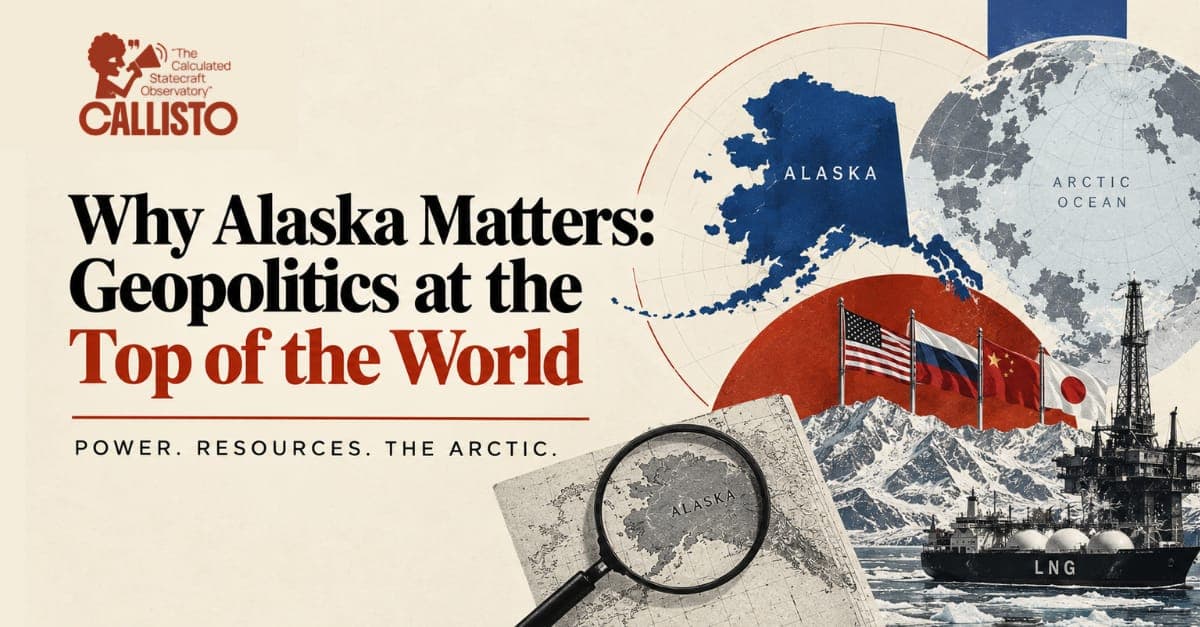
Why Alaska Matters: Geopolitics at the Top of the World
Introduction
In the ever-shifting narratives of global cooperation, territorial expansion, and development, control over resources remains the primary task of nations. Resource geopolitics shapes the power dynamics, strategies, and conflicts among states through control, distribution, and access to natural resources. Resource geopolitics has driven many well-known ventures into Africa, the Middle East and North Africa (MENA), South America, and the Pacific.
The story of Alaska revolves around similar profit-oriented ventures aimed at gaining control of natural resources and accessing them for innovation, development, and other purposes.
Alaska has often been ostracised as just an icy land that houses polar bears and has pretty manifestations of the Aurora Borealis. However, it is much more than that, and the history of the aforementioned land is quite fraught with conflict. Alaska was sold by Russia to America on March 30, 1867, for $7.2 million (the cession of Russian America to the United States) (Office of the Historian, 2019; Hernik, 2022). This deal gave the USA access to the northern Pacific. It opened new opportunities for capitalist ventures, but the strategic importance of Alaska was not fully recognised until World War II (Office of the Historian, 2019).
In the current era, Alaska’s reservoir of natural resources (oil, natural gas, mineral deposits, and new maritime routes) attracts cooperation and rivalry among several states (Bremmer, 2024). This context makes Alaska a significant case study in resource geopolitics. For the United States of America, Alaska serves as a tool to strengthen its influence in the Arctic region and, at the same time, maintain its sovereignty by securing domestic resource security. Furthermore, for Russia, Japan, and China, the region offers strategic opportunities to gain control of untapped resources and reduce dependence on other countries. The question here is how Alaska’s resources and geographic position could shape the future balance of power.
Why Alaska Matters
Alaska remains at the extreme northwest of the North American continent. It is “bounded by the Bering Strait and the Bering Sea to the west” (Miller & Lynch, 2018) and is crucial as it connects North America with Asia (Miller & Lynch, 2018). Its western tip is present within 60 miles of the Asian coast and connects North America with Asia (Brooks et al., 1906). Ever since the land was sold to the USA, Russian influence within North American territory has ended, thus giving the USA a dominant hand along the northern Pacific and in the Asia-Pacific region (Office of the Historian, 2019).
The proximity to the Bering Strait and the Aleutian Islands allows Alaska (at the interface of the Pacific and Arctic regions) to be a central actor in maritime movement and to witness major power rivalry (Holmes, 2020). Alaska sits at the point where North America meets Russian Asia, thus giving it a strategic position in economic and security terms. Alaska’s geographic importance directly links it to the theory of resource geopolitics. These resources are “strategic assets” that shape industrial competitiveness and national security (Shinoda, 2026), and access to them is a vital part of the theory, which is shaped by maritime trade, transportation, geopolitical cooperation, and infrastructural development.
As mentioned earlier, Alaska is part of a shared history of both the United States of America and Russia. This shared history was highlighted once again when the President of the USA, Donald Trump, met Russian President Vladimir Putin in Anchorage, Alaska. The Alaska Summit was intended to establish a peace framework and to bring about a pause in the war in Ukraine (Dumanlar, 2025). Although the summit failed to incorporate a peaceful solution, the Alaska Summit stood for greater symbolism. It emerged as a ground for cooperation between the two countries. Alaska has had a conflicting history for ages, and the summit in Anchorage was perceived as an act of cooperation, diplomatic deliberation, and convergence of great powers (if the situation compels them to). This was the first time both presidents had met since the outbreak of the war in Ukraine, and their meeting suggested that great rivalries aren’t absolute. They are determined by personal political incentives (Zhang & Shichen, 2025).
Much of Alaska’s global importance stems from its energy reserves. The state’s oil production has supported domestic energy production in the United States, and, due to its Arctic presence, these resources have attracted foreign interests. The best examples are Japan, Russia and China. China has been expanding its presence in the Arctic, and Russia has intensified consolidation of its military infrastructure along the Northern Sea Route (NSR). Together, China and Russia have formed a collaborative stance in the Arctic to exert pressure on the USA, as their collaboration is based on a mutual opposition to the USA (Itoh, 2025; Rodrigues, 2026). The Sino-Russian relationship is underpinned by the resolution of border issues, joint military exercises, and arms agreements that enhance security cooperation (Rodrigues, 2026). In order to balance the rising share of power between the two countries, Japan and the USA also see Alaska as a “bridgehead” to build on for their Arctic strategies.
Ever since the Ukraine war, the global energy market has become volatile, and countries have begun searching for alternatives. The best example of this is Japan. Japan’s history with Alaska dates back to 1969, when Alaska began exporting liquefied natural gas (LNG) to Japan. Although shipping has ceased, if it were to restart, Japan’s dependence on Russia’s Sakhalin-2 project and West Asia would be removed or reduced. To provide context, 60% of the LNG produced by the Sakhalin-2 project is intended for supply to Japan, which accounts for just 9% of Japan’s LNG imports (Mesmer, 2022; Nippon.com, 2022). Additionally, Japan imports 11% of its LNG from Qatar, Oman, and the United Arab Emirates (Golubkova, 2026). It would be a shift in the balance of power, as Russia and West Asia thrive on resource exports, which are a vital mechanism for maintaining leverage in the world, thereby allowing Japan to strengthen its LNG security (Itoh, 2025).
Adding to this, the conflict over Alaska also involves the competition over critical mineral supply chains. Access to critical minerals is pivotal because it holds substantial power in manufacturing, energy systems, computational advancements, and defence. Through mineral supply chains, an exporting country utilises mineral supply and demand for profit, carries out processes such as extraction, processing, and manufacturing as it sees fit, and imposes economic constraints to prevent other actors from getting involved. This is one of the reasons that define the interests of the USA and Japan in Alaska and the Arctic. Both the USA and Japan are focused on rebuilding their supply chains for critical minerals to reduce dependence on China (Itoh, 2025). China has been actively achieving dominance in rare-earth processing in the global market as it has progressively tightened its export controls. To put things in perspective, China controls over 70% of global rare earths production and over 90% of rare earths refining (Carr, 2025). On 9th October 2025, Beijing imposed jurisdiction over foreign-made products that use Chinese-origin rare-earth materials, and overseas firms now require export licenses from the Chinese Ministry of Commerce (Risse, 2025). In addition to avoiding import dependence on China for elements such as tungsten, indium, bismuth, tellurium, and molybdenum, the USA and Japan also depend on Alaska to strengthen economic security and diversify import sources of critical elements (Itoh, 2025). In 2025, Alaska exported $2.33B worth of Minerals and Ores and $1.1B worth of Primary Metal Manufacturers to Japan (Consular Office of Japan in Anchorage, 2024). In August 2026, Alaska exported zinc ore, precious metal ore, lead ore, and gold ore that accounted for a total of $1.145B, and these exports led to a substantial increase in the growth of Alaska’s year-over-year exports (The Observatory of Economic Complexity, 2025).
Beyond the existing competition for resource access, the development of critical infrastructure to transport resources and enable resource extraction is of significant importance. The proposed Alaska LNG project is intended to transport natural gas from Alaska’s North Slope to Alaskans to meet domestic energy demand (Alaska LNG, 2017). It’s an attempt to provide reliable, stable, and more affordable energy. The project is supposedly developed in two financially independent phases, with phase one involving the construction of a 739-mile, 42-inch pipeline that will deliver the natural gas to fulfil domestic demand, followed by phase two, which will be focused on the construction of the LNG liquefaction facility in Nikiski that will enable export of LNG to global markets (Alaska LNG, 2017). These developments will strengthen “Alaska’s long-term economic foundation as new job opportunities and state revenue will be created” (Alaska LNG, 2017).
Lastly, climate change has significantly reshaped Alaska’s geopolitics. The declining Arctic sea ice has opened new Arctic sea routes. The transport of goods through the Arctic saves significant time and fuel and reduces dependence on existing geopolitical chokepoints such as the Strait of Malacca and the Suez Canal (Kennedy, 2022). Ever since President Xi Jinping introduced the Polar Silk Road, a network of Arctic shipping routes that extended the Belt and Road Initiative into polar waters in 2018, the Arctic’s political importance has been rising, but accessibility issues remain a prominent concern (Ng, 2021; Bandurski, 2026). Logistical barriers such as seasonal ice, extreme weather, limited infrastructure, and navigational risks undermine the competitiveness of the states.
Conclusion
Alaska explains how natural resources and geographic location shape the distribution of power in international politics. The oil, natural gas reserves, critical mineral deposits, and proximity to Arctic shipping routes make it an important component of the bilateral relationships among China, Russia, the USA, and Japan. One thing to note is that it’s not just resource accumulation but also the diversification of supply chains, which reduces external dependencies and strengthens the position in the competitive Arctic zone (Holmes, 2020; Itoh, 2025).
We should know that resource abundance is not the same as geopolitical dominance. The mere fact of ownership of resources will not confer power; the ability to access, finance, and ship will determine power. As the Arctic becomes increasingly accessible, competition for resources and access to them either intensifies existing geopolitical rivalry (for example, China’s stance when the USA announced its ownership of Greenland) or creates new opportunities for economic development.
Ultimately, Alaska stands for the intersection of resource security, economic sovereignty, and power competition. The state that can access, process, transport, and utilise the resources in the Arctic will dominate the future prospects of the same. As time passes and the demand for critical minerals and alternative energy supplies intensifies, Alaska will become an increasingly important part of a broader battleground that will shape the strategic order of the Arctic.
Sources
Alaska LNG. (2017, February 7). Project overview - Alaska LNG. Alaska-Lng.Com. https://alaska-lng.com/project-overview/
Bandurski, D. (2026, January 19). Polar silk road - China Media Project. China Media Project. https://chinamediaproject.org/the_ccp_dictionary/polar-silk-road/
Bremmer, I. (2024, August 10). Ian explains: Alaska is not just a state, it’s a geopolitical outpost. GZERO Media. https://www.gzeromedia.com/video/ian-explains/ian-explains-alaska-is-not-just-a-state-is-a-geopolitical-outpost
Brooks, A. H., Abbe, C., & Goode, R. U. (1906). The geography and geology of Alaska; a summary of existing knowledge, with a section on climate, and a topographic map and description thereof | U.S. geological survey. Www.Usgs.Gov. https://www.usgs.gov/publications/geography-and-geology-alaska-a-summary-existing-knowlege-a-section-climate-and-a
Carr, E. (2025, October 17). China’s new export controls: Critical implications for U.S. businesses. Forbes. https://www.forbes.com/sites/earlcarr/2025/10/17/chinas-new-export-controls-critical-implicatins-for-us-businesses/
Consular Office of Japan in Anchorage. (2024). Economy of Alaska | Consular Office of Japan in Anchorage. Emb-Japan.Go.Jp. https://www.anchorage.us.emb-japan.go.jp/itpr_en/econ.html
Dumanlar, E. (2025, August 20). Putin and Trump’s Alaska summit: Symbolism, strategy and the future of diplomacy. Atlas Institute for International Affairs. https://atlasinstitute.org/putin-trump-alaska-summit-symbolism-strategy-and-the-future-of-diplomacy/
Golubkova, K. (2026, March 4). Japan’s Middle East energy dependency - and how it mitigates shocks. Reuters. https://www.reuters.com/sustainability/boards-policy-regulation/japans-middle-east-energy-dependency-how-it-mitigates-shocks-2026-03-04/
Hernik, J. (2022, October 31). The role of Alaska in U.S. arctic strategy. Warsaw Institute. https://warsawinstitute.org/role-alaska-u-s-arctic-strategy/
Holmes, J. (2020, June 13). The geopolitics of Alaska. The National Interest. https://nationalinterest.org/feature/geopolitics-alaska-162711
Itoh, S. (2025). The geostrategic importance of Alaska to the U.S.-Japan alliance. Csis.Org. https://www.csis.org/analysis/geostrategic-importance-alaska-us-japan-alliance
Kennedy, M. R. (2022, July 5). Alaska’s geopolitical importance in the age of Great Power competition. The Hill. https://thehill.com/opinion/national-security/3546396-alaskas-geopolitical-importance-in-the-ag-of-great-power-competition/
Mesmer, P. (2022, August 29). Japan cannot afford to lose out on Russia’s Sakhalin-2 oil and gas project. Le Monde.Fr. https://www.lemonde.fr/en/economy/article/2022/08/29/japan-cannot-afford-to-lose-out-on-russia-s-sakhalin-2-oil-and-gas-project_5995159_19.html
Miller, M. M., & Lynch, D. (2018). Alaska | flag, facts, maps, capital, cities, & weather. In Encyclopædia Britannica. https://www.britannica.com/place/Alaska
Ng, A. (2021, May 20). Tensions will likely grow as China seeks bigger role in the arctic. CNBC. https://www.cnbc.com/2021/05/20/tensions-likely-to-grow-as-china-seeks-a-bigger-role-in-the-actic.html
Nippon.com. (2022, May 16). Japan and the Sakhalin Energy Projects. Nippon.Com. https://www.nippon.com/en/japan-data/h01321/
Office of the Historian. (2019). Purchase of Alaska, 1867. State.Gov. https://history.state.gov/milestones/1866-1898/alaska-purchase
Risse, M. (2025). A widening net: A short history of Chinese export controls on critical raw materials and their usage - global trade alert. Globaltradealert.Org. https://globaltradealert.org/blog/a-short-history-of-chinese-export-controls-on-critical-raw-materials
Rodrigues, C. (2026). A Sino-Russian cooperation in the Arctic Region in the 21st century. Frontiers in Political Science, 8, Article 1632547. https://doi.org/10.3389/fpos.2026.1632547
Shinoda, K. (2026). Lessons from Japan’s rare earth shock. Resource Geopolitics, 18(1). https://eastasiaforum.org/wp-content/uploads/2026/02/East-Asia-Forum-Quarterly-Volume-18-Number-1.pdf
The Observatory of Economic Complexity. (2025). Alaska (USA) Exports, Imports, and Trade Partners. The Observatory of Economic Complexity. https://oec.world/en/profile/subnational_usa/alaska
Zhang, J., & Shichen, T. (2025, August 22). Alaska meeting: No deal, but a signal. China-US Focus. https://www.chinausfocus.com/foreign-policy/alaska-meeting-no-deal-but-a-signal
Continue reading
 International Relations
Flags and Coffins: Competing Narrative and the Politics of Symbolism
24 October 2026
The geopolitical dualities on the 4th of July particularly in the year 2026 as America celebrating their 250th year of independence and on the same day Iran mourned the death of their Supreme Leader Khamenei.
 International Relations
How Should India and the EU Strengthen Semiconductor Resilience in an Era of Geopolitical Competition?
23 October 2026
The India-EU semiconductor partnership faces critical gaps in implementation and rare earth diversification. This article explores how coordinated policies, strategic mineral partnerships, and reduced dependence on China can strengthen supply chain resilience amid geopolitical competition.
 International Relations
Close in Interest , Far in Reach : India's Central Asia Problem
17 October 2026
A region Delhi calls its extended neighborhood matters for energy, security and diplomacy, yet it remains hard to reach.
0 likes · 0 comments
Comments
No comments yet.
Your comment