
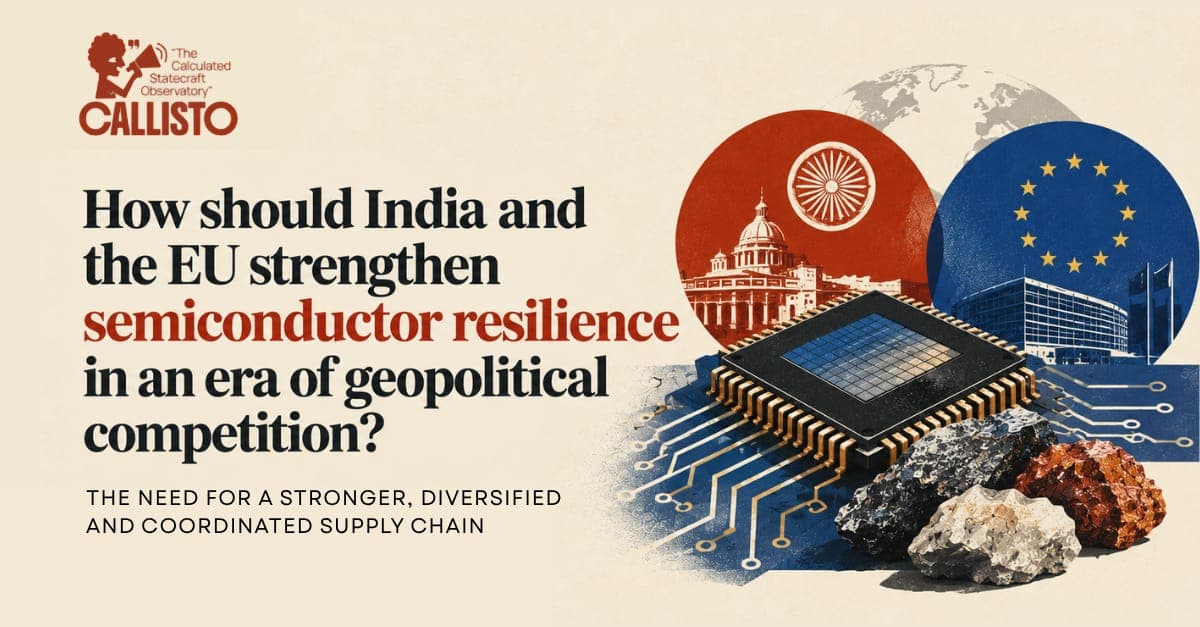
How Should India and the EU Strengthen Semiconductor Resilience in an Era of Geopolitical Competition?
Background
A series of India-EU Trade & Technology Council meetings have been held to deepen India-EU ties, diving into issues across three Working Groups. The semiconductor market is an area under technology and innovation that the two parties aim to grab a foothold, in the coming future. This market comes under Working Group One (strategic technologies), coupled with supply chain resilience, under Working Group Three (along with trade and investment). Both sides have made efforts of their own; EU introduced the Chips Act (2023) and India had already introduced its Semiconductor Mission (2021). This was followed by the signing of an MoU (2023), a serious commitment to cooperation on this ecosystem.
Rare Earth Elements are a non-negotiable component of semiconductor chips, used heavily in the AI supply chain. Some key examples include; silicon for microchips, cobalt for enhancing memory and logic devices, and others for high-performance magnets. REEs come at the centre of a highly concentrated supply chain, one led by China owning approximately 70% of global REE production and 85% processing capacity. This severity leads to insecure countries,those not having the potential to use REEs for designing chips, as critical minerals form an inevitable component of this product.
Problem Statement
There are primarily 2 gaps. First, the ambiguities brought by TTC and creating a determined strategy towards linking REEs with the semiconductor industry.
The Ambiguities Brought by TTC
There is a clear difference between ambition and implementation. Despite the strategic intent of the semiconductor commitments that the Agenda has made, its structural gaps remain unaddressed. As identified by ORF’s analysis of the Agenda, the lack of a coordinating mechanism between the EU Chips Act and Semiconductor Mission in India; the lack of a talent exchange model with an effective pathway to industrial repatriation; and the lack of a coordinating OSAT (Outsource Semiconductor Assembly and Test) agenda that has achieved no demand side anchor. Compared to the history of the US-India iCET (Initiative on Critical and Emerging Technology), which turned dialogue into investment, the India-EU partnership casts doubt on institutional structure rather than political will.
A closer look at the Agenda shows a familiar pattern. Its provisions related to semiconductors are quite similar to the ones made at the 2022 and 2023 Trade and Technology Council (TTC) ministerial meetings. The 2026 Agenda actually makes negligible difference because some of the previous agreements have failed to include performance goals, accountability provisions, or designated institutional heads.
The Deal With Critical Minerals
While India & EU have initiated deeper coordination over semiconductor fabrication and design, they have kept critical minerals almost entirely outside the purview of discussions. As evidenced by the MOU signed on November 21, 2023, there are no specific provisions for the rare earth elements discussed in the agreement or any of the TTC meetings. While supply chain resilience continues to be a subject of utmost importance, its enhancement is limited to R&D, exchange of experiences and practices, advanced skills, and transparency of subsidies to the industry.
This is alarming because this field comes with a significant dependency upon countries like China over REEs, that if appropriate measures for diversification of sources of critical minerals aren’t taken, the lack of independence could make supply chains come to a standstill and almost impossible to make them resilient. Any disruption in rare earth exports can be disadvantageous to the availability and cost of necessary components for AI. Since REEs form the basis of the making of semiconductor chips, it is integral for India-EU to do a strategic assessment of its usage because supply chain resilience can fail if this industry is not strengthened without the due consideration of diversification of REEs from across the world.
Comparison Between US-India iCET & EU-India TTC
The comparison with the US-India iCET is something worth taking a close look at. Launched in 2023, iCET helped Micron’s S$825 million Assembly, Testing, Marking, and Packaging (ATMP) investment to be cleared in Gujarat in less than 18 months. That pace was possible because iCET worked through a direct channel between the national security councils of both governments - the NSC (National Security Council of USA) and NSCS (National Security Council Secretariat of India). TTC is based on a more government-to-government cooperation that runs through ministries (commerce, trade, etc).
These agencies have to coordinate with each other, get sign-off from multiple domestic domains. This process is generally slow because it has to move along the lines of bureaucratic consensus-building. By contrast, these security councils are specially made to handle matters framed as national security priorities. They sit at the top of the executive branch and cut through routine procedures because it has the authority of the head of the state behind it which helps fast track incentives and cut through administrative timelines. That is exactly why the iCET works smoothly as compared to the TTC; iCET inculcates a channel between these security councils, while TTC works through ministerial, governmental procedures.
The India-EU TTC does not have any comparable institutional channel, no anchor investment in place currently, and no agreed mechanism to coordinate the EU Chips Act and India’s Semiconductor Mission as complementary programmes. The two initiatives have broadly similar goals, but have evolved independently, and there has not been a joint funding vehicle or a common delivery framework to align them. Until then, the TTC will continue to function as an arena for building consensus more than as a mechanism for driving investments that a trade diplomacy forum cannot.
Analysis
Strategic competition in the semiconductor market operates mainly between two players; USA and China. Control over REE processing has become an important source of China’s geopolitical leverage. Over physical resources, China’s approach is administrative-centric through coercive tools like customs licensing, state supervision of major producers, especially over critical minerals. China introduced licensing restrictions over gallium and germanium (of which it is 98% of the globe’s supplier) and are important semiconductor resources for satellite, radar, and 5G components.
Broadly, its limits extend to the electrification supply chain through controls over high-purity graphite (necessary for EV battery anodes). Thirdly, it banned the export of technology necessary for REE extraction, separation, and smelting (a core requirement for transforming mined ore into usable materials), acting similar to US restriction procedures over semiconductor manufacturing machinery. China’s licensing restrictions over the USA have escalated to direct prohibition for the US market (2024). As an addition, any foreign-made product consisting of 0.1% or more REE constituents of Chinese origin, and/or manufactured using processing technologies of China, would require licensing. Lastly, certain REEs like samarium, gadolinium, lutetium, silver, etc. have been added to China’s Export Licensing Catalogue (2026).
This is risky for India-EU’s future because China’s monopolistic control over REEs has had direct consequences over them. As estimated by ECB economists, 80% European firms fall under China’s 0.1% threshold rule, as discussed above, despite not having any direct trading relations with it. These restrictions have gotten aggravated ever since China’s Ministry of Commerce placed 14 EU-based entities on its Export Control Watchlist, thus restricting Chinese-origin raw material access to Europe. European businesses in turn have suffered €250 million in additional costs and impact over 20% of the global revenue (2025). Such circumstances prompted many firms towards supply chain diversification, away from China. China’s curtailment over seven critical minerals crucial for the automotive-electronics-semiconductor nexus has led to derailments in India’s automotive sector because it imports approximately 90% of its REE-based permanent magnets from China itself.
Therefore, diversification is a necessary step towards self-reliancy in the semiconductor market especially in terms of REE production and processing. Although, a step towards this has come with its own demerits. India tried reducing its dependence on China via a Rs. 7,280 crore scheme backed by the government, by building its own rare-earth magnets to reduce its reliance on Chinese ones. But the process underwent obstructions because the machinery necessary for processing raw materials is monopolistically produced by Chinese firms. Thus, it put forth restrictions not just on the raw materials, but also on the processing equipment.
Since the India-EU dialogue is situated less on the REE ecosystem, considering China’s inevitable dominance, it is most integral for the two parties to set their groundwork in the semiconductor toolchain, otherwise the consequences would be far worse than the present circumstances.
Policy Recommendation- Diversification of Rare Earth Elements
Logically speaking, diversification of REEs is easier when a single country is involved. That specific state will only see to its own foreign relations and the dynamics it shares with other countries to make them possible sources of minerals. But, when a group of countries is involved, diversification becomes harder to initiate let alone maintain, because the individual alliances and frequency of bonding may overpower and affect the group’s ultimate goal. This is why, India-EU must step up and create a channel that benefits both sides.
The EU in itself has the capacity to source critical minerals. Its domestic potential lies with- Sweden, which holds the largest known REE deposit in Europe; Estonia, which hosts the Neo Performance Material’s Narva facility; France, which has Solvay’s western France processing operation and separation/recycling projects; Germany which has committed 1 billion euros (2024-2028) for domestic extraction/processing/recycling capacity alongside Poland and Italy; and lastly Finland, Greece, Spain too.
Yet, the disadvantage lies in the fact that intra-EU capacity is still mostly pre-production, making its need to become an external diversifier, necessary. If the EU signs a deal with another country, that doesn’t equate it to 27 member countries individually agreeing to consider the other party. The 27-member bloc is a real collaborative approach, but not insurmountable. The council’s critical minerals agreements and existing MoUs with Zambia and the DRC are negotiated by the EU as a whole, single actor.
India-EU diversification should be built along similar lines. The two parties must create a model that pushes for a unified negotiating channel and a dedicated India-EU Critical Minerals and Rare Earths MoU. This partnership takes direct influence from the India-US critical minerals MoU (2024). Therefore, India has already demonstrated an institutional and diplomatic capacity to successfully follow through with this mechanism, but has never been extended to the EU.
Furthermore, this model must incorporate the strengths of both parties. The EU’s existing critical minerals MoUs frameworks could aid in creating an African track involving the DRC, Zambia, etc. QUAD, being India’s partner, centred on Australia, may utilise Lynas Rare Earths’ Mount Weld mine which supplies non-Chinese manufacturers.
Conclusion
Semiconductor chips are not ordinary commodities. They are significant enough that countries are racing to overpower each other in this market. Gaining supremacy over the manufacture of semiconductor chips is equivalent to ingraining balance and self-reliance within a country and the prevention of being held at mercy for critical minerals and chip design by other countries. Therefore, India and the EU must look into these grave gaps and vouch for supremacy in a sector that is the oil of the 21st century!
Sources
Baskaran, G. (2025, October 9). China’s new rare earth and magnet restrictions threaten U.S. defense supply chains. Center for Strategic and International Studies. https://www.csis.org/analysis/chinas-new-rare-earth-and-magnet-restrictions-threaten-us-defense-supply-chains
Delivorias, A. (2024, January). EU-India Trade and Technology Council (PE 757.587). European Parliamentary Research Service. https://www.europarl.europa.eu/RegData/etudes/ATAG/2024/757587/EPRS_ATA(2024)757587_EN.pdf
European Commission. (2023, November 23). Memorandum of Understanding signed between the European Union and India on working arrangements on semiconductors ecosystem, its supply chain and innovation under the framework of EU-India Trade and Technology Council (TTC). European Union. https://digital-strategy.ec.europa.eu/en/library/memorandum-understanding-semiconductors-india
European Parliament. (2025). European Parliament resolution on tackling China’s critical raw materials export restrictions (CELEX No. 52025IP0166). EUR-Lex. https://eur-lex.europa.eu/legal-content/EN/TXT/HTML/?uri=CELEX:52025IP0166
European Parliament & Council of the European Union. (2023). Regulation (EU) 2023/1781 of the European Parliament and of the Council of 13 September 2023 establishing a framework of measures for strengthening Europe’s semiconductor ecosystem (Chips Act). EUR-Lex. https://eur-lex.europa.eu/legal-content/EN/TXT/?uri=CELEX:32023R1781
GLOBSEC. (2023, December 8). GLOBSEC on China export ban [Press release]. https://www.globsec.org/what-we-do/press-releases/globsec-china-export-ban
Goldman Sachs. (2023, September 13). Resource realism: The geopolitics of critical mineral supply chains. Goldman Sachs Research. https://www.goldmansachs.com/insights/articles/resource-realism-the-geopolitics-of-critical-mineral-supply-chains
International Energy Agency. (2024). Global Critical Minerals Outlook 2024. IEA Publications. https://www.iea.org/reports/global-critical-minerals-outlook-2024
LKAB Minerals. (n.d.). Critical minerals and rare earth elements. https://www.lkabminerals.com/news/critical-minerals/
Ministry of Commerce of the People’s Republic of China. (2025). MOFCOM Announcement No. 18 of 2025. https://english.mofcom.gov.cn/Policies/AnnouncementsOrders/art/2025/art_0dd87cbee7b045bf93fabe6ab2faceee.html
Puri, V. (April 10, 2026). Redesigning the India-EU Semiconductor Partnership for Industrial Impact. Observer Research Foundation. https://www.orfonline.org/expert-speak/redesigning-the-india-eu-semiconductor-partnership-for-industrial-impact
Rare Earth Mining Editor. (2026, March). Europe rare earth: Key deposits & EU strategy. https://rare-earth-mining.com/europe-rare-earth/
Szczepański, M. (2025, November). China’s rare-earth export restrictions (Briefing PE 779.220). European Parliamentary Research Service. https://www.europarl.europa.eu/RegData/etudes/ATAG/2025/779220/EPRS_ATA%282025%29779220_EN.pdf
Tribune News Service. (2023, June 21). Govt approves Micron’s $2.7 bn chip plant. The Tribune. https://www.tribuneindia.com/news/business/govt-approves-microns-2-7-bn-chip-plant-519282
Unteachable Courses. (n.d.). Gallium & germanium: China’s export controls. https://unteachablecourses.com/gallium-germanium-china-export-controls/
Continue reading
 International Relations
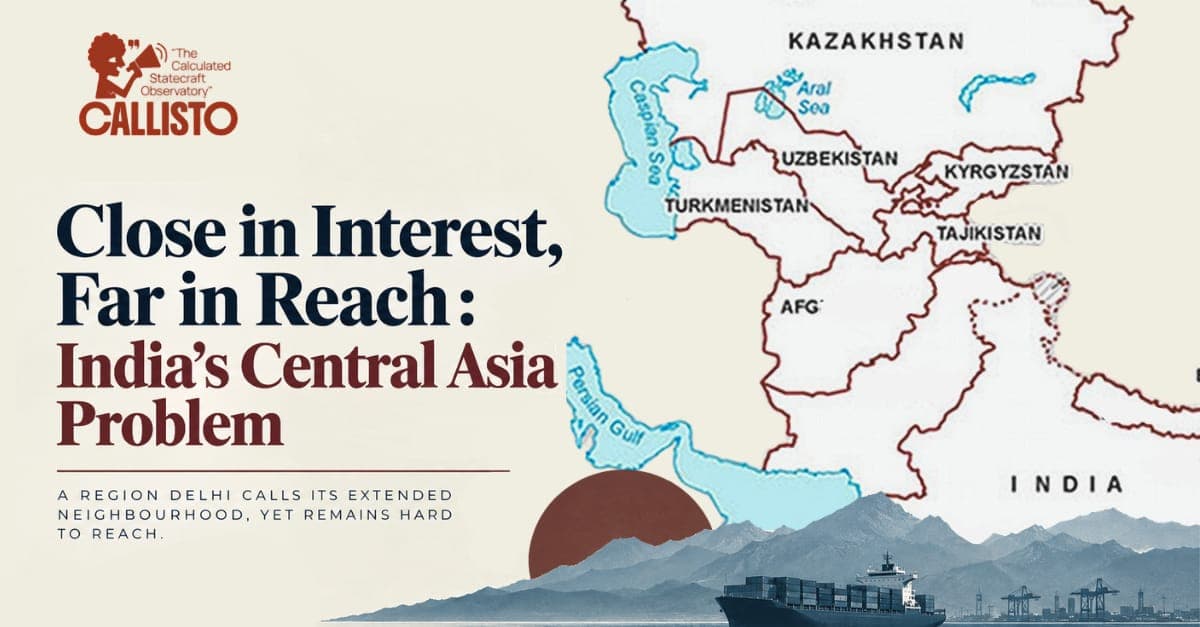
Close in Interest , Far in Reach : India's Central Asia Problem
17 October 2026
A region Delhi calls its extended neighborhood matters for energy, security and diplomacy, yet it remains hard to reach.
 International Relations
Trump-Xi Summit: Navigating a New Cold War
10 October 2026
Trade relations of the commodity of AI tech are analyzed through the Trump-Xi Summit in the context of the changing dynamics of U.S.-China relationship and Taiwan as a site of importance in this.
 International Relations
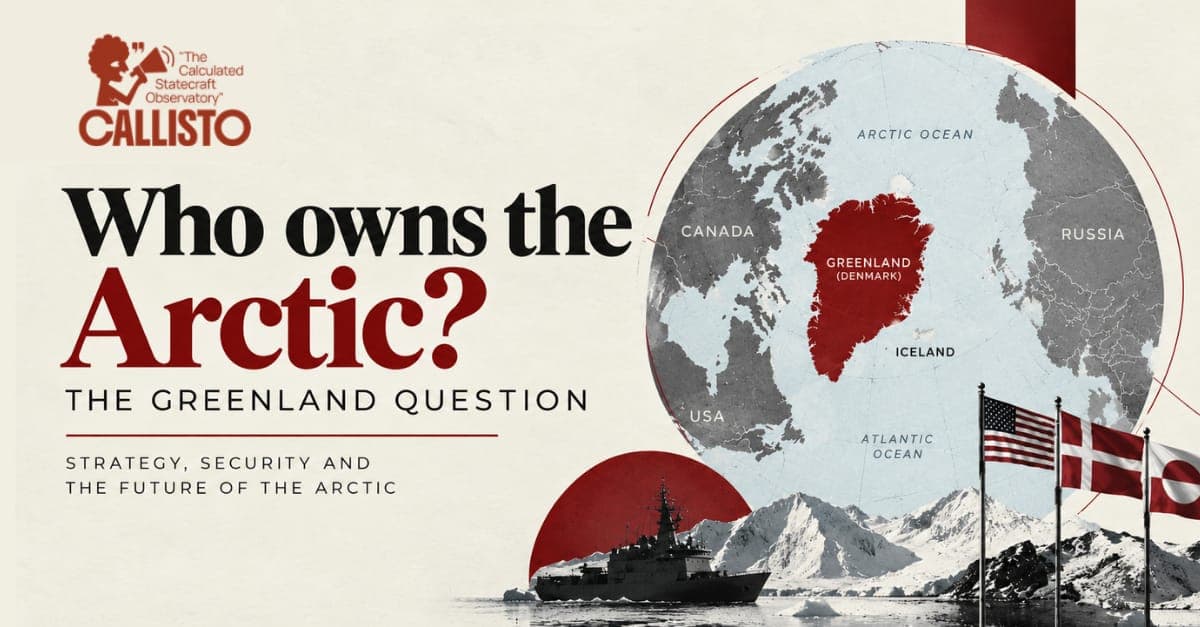
WHO OWNS THE ARCTIC? THE GREENLAND QUESTION
3 October 2026
Greenland’s strategic importance is reshaping Arctic security, but the new U.S.–Denmark–Greenland defence agreement raises questions beyond military cooperation. As Washington expands its presence, Greenland’s sovereignty, self-determination, environment, economy, and cultural priorities remain central to understanding the Arctic’s changing geopolitical landscape.
0 likes · 0 comments
Comments
No comments yet.
Your comment