
Close in Interest , Far in Reach : India's Central Asia Problem
A partnership running ahead of its plumbing
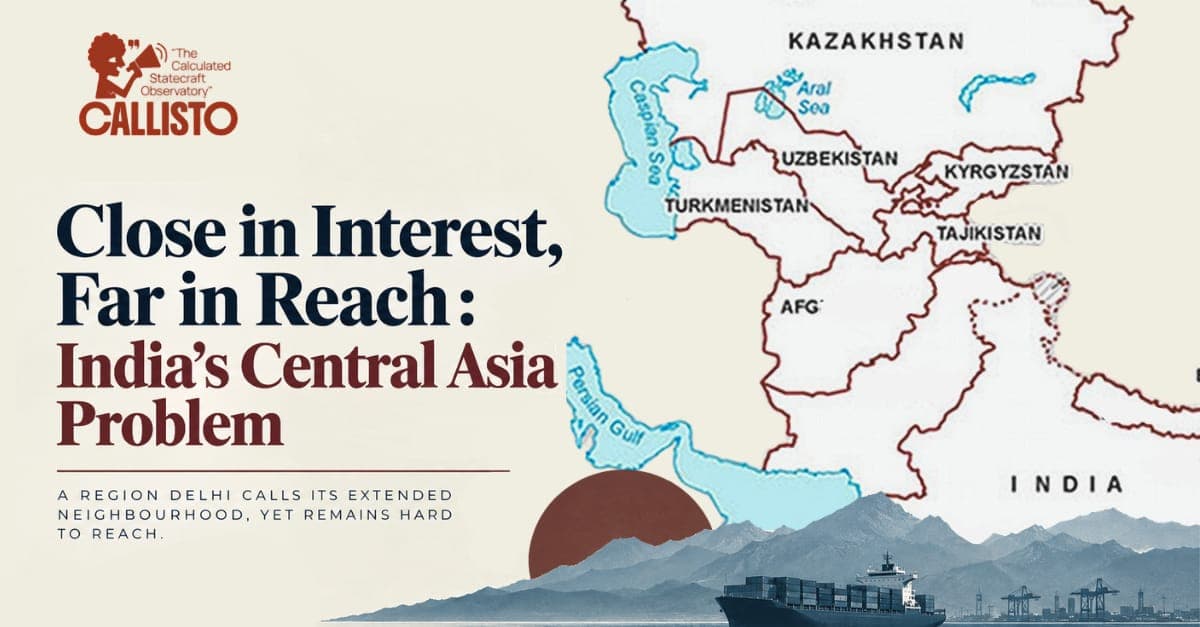
Indian Prime Minister Narendra Modi and the President of Uzbekistan Shavkat Mirziyoyev on Aug 30 , 2026 agreed to raise bilateral cooperation to a Comprehensive Strategic Partnership with an ambitious target of $5 billion trade by 2030. Although Modi’s novel bid to assert greater Indian influence in the region is welcome, numbers from recent years make a rather embarrassing reading. The aggregate Indian trade with all five countries in the region during 2023 was a meager $1.7 billion while they accounted for a mere 0.1% of India’s imports as revealed by a recent joint study by the Eurasian Development Bank (EDB) & Export Import Bank of India (India Exim Bank)
A problem is Indian’s interests to the trade in Central Asia have not yet found right routes. Lack of implementation is another problem that has worsened in 2026. It will be proper for India to function as a second partner for the countries in the region in those areas and sectors where Indians have special interests and India can be of help and also have added value without depending on any single corridor.
Why the region matters and what that does not mean?
India considers the five Central Asian states as part of its extended neighborhood. Energy is one of the reasons for India’s interest in Central Asia. As observed “Of the total imports from Central Asia , 35.3% pertained to mineral fuels and India imports uranium from both Kazakhstan and Uzbekistan” . India and Central Asia expressed interest in joint exploration of rare earths and critical minerals in June 2025. Separately, Modi welcomed progress on a long term uranium-supply arrangement with Uzbekistan in 2026. Speaking at the 26th Shanghai Cooperation Organisation Summit in Bishkek, Kyrgyzstan on 1 September 2026, Modi said: “Our shared aspiration for a peaceful and secure Eurasia is also closely linked to peace and stability in Afghanistan’’.
While the strategic weight of India may not translate into economic muscle, it is notable that pharmaceutical products accounted for 37.9% of India’s exports to the region while imports from Kazakhstan comprised about 64.5% of total Indian imports from the region. Outward investment from India to the region (April 2000 to March 2024) stood at a meager 0.1% of total outward investment from India, while the trade of India with the region was marginally below 1% of $241 billion total trade of Central Asia . The EDB–India Exim Bank study estimates Central Asia’s total merchandise trade at about $241 billion in 2023 compared with India–Central Asia trade of $1.72 billion. These figures illustrate the limited scale of India’s commercial engagement.
The route problem
According to the EDB study currently no land connection between India and Central Asia is in operation and air freight is best suited for expensive goods. The major share of the current trade is carried through the International North South Transport Corridor (INSTC) through Iran multi modal or through Suez and Black Sea. Although INSTC is shorter for land connection various administrative barriers and other bottlenecks restrict its optimal utilization and hence most of the cargo is carried through Suez route which is roughly three times the distance via land connection. Chabahar Port in Iran has been another attempt by India to create an alternative land route around Pakistan, work on which has seen an investment of over $120 million (approximately) by India to make functional its terminal at the port. India has looked to Chabahar in Iran as an alternative route towards Afghanistan and Central Asia that avoids transit through Pakistan. The U.S. in September 2025 revoked its earlier exemption from sanctions for Chabahar and while a temporary waiver was granted that was to expire on April 26, 2026, there is no extension forthcoming as yet. In fact, reports are that the Indian entity is even contemplating transfer of its interest to an Iranian party, though no agreement has as yet been reached . In fact, by end June all the southern routes to connectivity via Iran, Afghanistan and Pakistan have effectively fallen to the ongoing wars. The China–Europe “Middle Corridor” through Central Asia has poorly digitalised customs and no experience of co-ordinated and scheduled services, the World Bank noted in its report. It is easier to announce a new corridor than to start operating it.
Great powers and the republic’s own choices
China is the region’s dominant economic partner. China and Russia are major trading partners for Central Asia, whereas India’s commercial presence remains comparatively limited. This compared with Russia, which supplied 21.8% of imports. While India may have ambition to be a counterbalance to Russia’s dominance in the region, it would be foolish for New Delhi to assume that the five republics collectively would see it in this light. The governments of the five republics are skilled hedgers who since 2022 have been saying nice things to Moscow and to the capitals of the West and, above all, bringing in lots of partners to safeguard their sovereignty.
Momentum but not yet delivery
Though the diplomacy has increased , the 2025 India Central Asia Dialogue declaration is yet to be implemented in letter and spirit . The second leader’s summit was planned for 2025. The August 2026 India–Uzbekistan joint statement reaffirmed support for engagement at heads of state level. Such commitments should be assessed alongside the implementation of specific bilateral initiatives.
The Tashkent visit also appears to be following a similar script. The joint statement reads that a “feasibility study for Preferential Trade Agreement between India and Central Asia completed and to set up a working group on non tariff barriers on investment including conformity assessment” and “To explore further steps on a time-bound basis.” PMO said that the two leaders discussed ways to pursue “multimodal routes” and to “ restore freight services on all operating routes”. Official trade between India and Uzbekistan was $1.3 billion in 2025. Therefore, a fourfold increase by 2030 is needed .
What India can realistically do?
Three priorities follow.
Maximizing trade with the region would require going country by country, starting with those with which already there is trade. In terms of value, the share of exports to the region that go to two countries is very high, in 2023 it was 45.3% to Uzbekistan and 35% to Kazakhstan. The agreement to be signed with Uzbekistan and the working group that will be set up in this country will be a test case for India’s follow-through.
Second, focus on that which is feasible on trade able to tolerate poor connectivity. India’s largest trade with the region is in the sector of pharmaceuticals trading by air is the obvious way to go. Digital payments and trade finance for the SMEs, also highlighted in the EDB–India Exim Bank study, are areas of interest too but require action by relevant regulators and banks on both sides. However, the percentage of value of trade finance applications of SMEs that get rejected in Central Asia is a monstrous 57% (33% on average in rest of Asia) and needs to be highlighted and addressed.
Chabahar should be viewed as an option for enhancing trade with the region rather than the catalyst for change. Michael Kugelman in his Al Jazeera comments to Gretchen Blankenship said that the “best case” for India would be a long term game with slow returns. He noted the “worst case” for India would be it “writing off” losses . For now, till a change occurs in the US - Iran relations and the development of Chabahar port takes place, India must deliver on its promised words , hold a promised summit and also give effect to the promised $1 billion credit line which was promised to be given in 2020 .
Conclusion
A Central Asia policy by India is all idea, institutions and good will and needs a road and a record of fulfillment. The governments in Central Asia are multipolar players and will expect tangible value for what India promises. Signing a trade agreement, the punctual transport of cargo, and the generation of interest from franchisees of Indian pharmaceutical companies and of the Indian payment systems would be minimum requirements to demonstrate that value. The evidence for this is rapidly unfolding in 2026 as Chabahar unfolds and the conflict with Iran takes shape.
Sources
All India Radio. (2025, June 7). India and 5 Central Asian countries express interest in joint exploration of rare earth and critical minerals. News on AIR. https://www.newsonair.gov.in/india-5-central-asian-countries-express-interest-in-joint-exploration-of-rare-earth-critical-minerals
Chatham House. (2025, March). Playing both sides: Central Asia between Russia and the West [Expert comment]. https://www.chathamhouse.org/2025/03/playing-both-sides-central-asia-between-russia-and-west
Eurasian Development Bank, & Export-Import Bank of India. (2025). Exploring trade and investment relations between India and Central Asia: Unlocking economic benefits. https://www.eximbankindia.in/sites/default/files/2025-09/EDB-India%20Exim%20Bank%20Joint%20Study%20on%20Central%20Asia.pdf
Fergana Agency. (2026). Uzbekistan and India deepen strategic ties with new $5 billion trade goal. https://en.fergana.agency/news/149018/
Ibragimova, G. (2026, June 19). Multiple wars are ruining Central Asia’s efforts to diversify its trade routes. Carnegie Endowment for International Peace. https://carnegieendowment.org/russia-eurasia/politika/2026/06/central-asia-trade-routes
Mohan, C. R. (2026, August 28). The SCO’s diminishing usefulness for India. Foreign Policy. https://foreignpolicy.com/2026/08/28/sco-shanghai-cooperation-organisation-summit-india-china-pakistan-russia-bishkek/
Prime Minister’s Office. (2026a, August 30). Joint statement during the state visit of the prime minister to Uzbekistan. Government of India. https://www.pmindia.gov.in/en/news_updates/joint-statement-during-the-state-visit-of-prime-minister-narendra-modi-to-uzbekistan/
Prime Minister’s Office. (2026b, September 1). PM participates in the 26th SCO Summit in Bishkek, Kyrgyz Republic. Government of India. https://www.pmindia.gov.in/en/news_updates/pm-participates-in-the-26th-sco-summit-in-bishkek-kyrgyz-republic/
Sajjanhar, A. (2026, August 27). PM Modi travels to Central Asia: A welcome move [Issue brief]. Manohar Parrikar Institute for Defence Studies and Analyses. https://idsa.in/wp-content/uploads/2026/08/Issue-Brief-Amb.-Ashok-Sajjanhar-27-August-2026.pdf
Sharma, Y. (2026, April 29). Is India’s Chabahar dream in Iran dead? Al Jazeera. https://www.aljazeera.com/features/2026/4/29/is-indias-chabahar-dream-in-iran-dead
World Bank. (2024, April 17). 10 priority actions that can triple trade in the Middle Corridor by 2030. https://www.worldbank.org/en/brief/2024/04/17/10-priority-actions-that-can-triple-trade-in-the-middle-corridor-by-2030
Continue reading
 International Relations
Trump-Xi Summit: Navigating a New Cold War
10 October 2026
Trade relations of the commodity of AI tech are analyzed through the Trump-Xi Summit in the context of the changing dynamics of U.S.-China relationship and Taiwan as a site of importance in this.
 International Relations
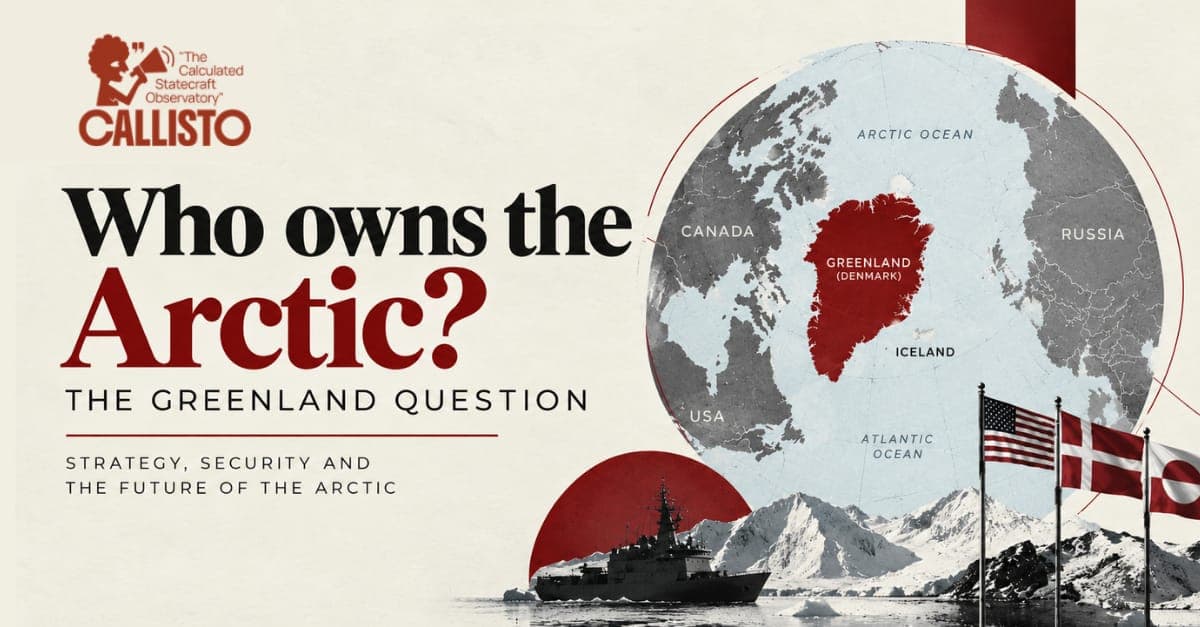
WHO OWNS THE ARCTIC? THE GREENLAND QUESTION
3 October 2026
Greenland’s strategic importance is reshaping Arctic security, but the new U.S.–Denmark–Greenland defence agreement raises questions beyond military cooperation. As Washington expands its presence, Greenland’s sovereignty, self-determination, environment, economy, and cultural priorities remain central to understanding the Arctic’s changing geopolitical landscape.
 International Relations
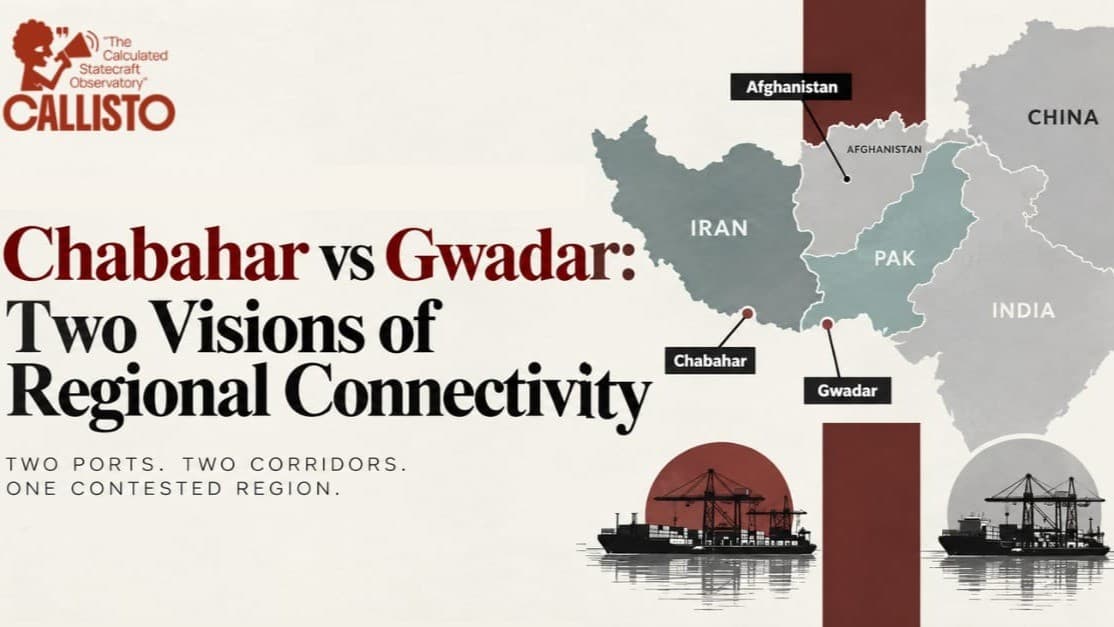
CHABAHAR VS GWADAR: TWO VISIONS OF REGIONAL CONNECTIVITY
24 September 2026
Chabahar and Gwadar embody rival visions of regional connectivity. India’s Chabahar offers a Pakistan-bypass route to Afghanistan and Central Asia via INSTC, while China’s Gwadar under CPEC aims for strategic depth but faces Baloch insurgency and chokepoint risks.
0 likes · 0 comments
Comments
No comments yet.
Your comment