
CHABAHAR VS GWADAR: TWO VISIONS OF REGIONAL CONNECTIVITY
Introduction
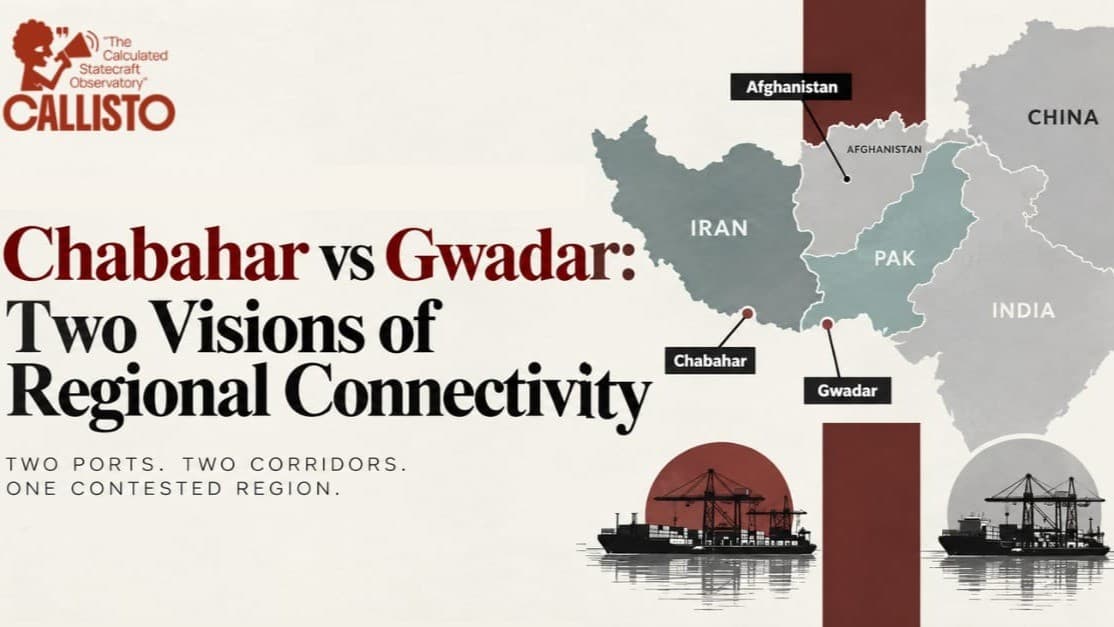
Geopolitics is built on fragile alliances and unintended instances that play a strong role in enabling countries to develop their foreign policies accordingly. The Gwadar & Chabahar port projects are examples of how South & Central Asian Countries: India, China, Pakistan, Afghanistan are building self-reliance. Considering the upheaval caused by the blocking of the Strait of Hormuz, and Houthis’ activities causing obstruction to the Bab-el-Mandeb (Red Sea), India & China, having envisioned future constraints, began building trading corridors and maritime passages to bypass these chokepoints. But, this strategy of gaining self-reliance has gradually turned into a platform of rivalry which brings us to the elephant in the room; Gwadar v/s Chabahar, which will endure longer and why?
Chabahar Project- India’s Vision
The Chabahar port project has been in operation for more than a decade. It is situated in the Sistan and Baluchistan Province of Iran, on the coast of Makran. It is one of Iran’s limited ports that has direct access to the Arabian Sea. Chabahar has a deep-water port and can handle large bulk carriers. But its strategic importance is intensified due to its geography. It bypasses the Strait of Hormuz and sits on the Gulf of Oman, providing a significant alternative to countries in case of a blockage.
India signed a 10-year contract with Iran to develop the Shahid Beheshti Terminal (2003), but it reached little development due to US sanctions against Iran. From India’s perspective, the Chabahar port offers to bypass Pakistan and the capabilities of establishing direct access pathways to Afghanistan and further into Central Asia. This has become a first for India to manage an overseas port that can bring a “multiplier effect on trade”.
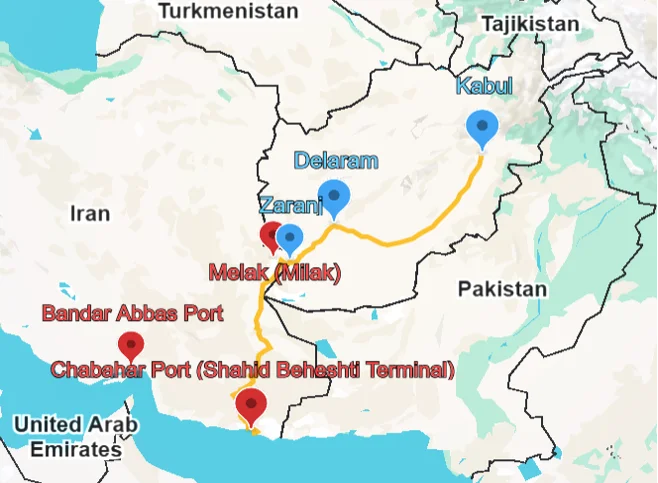
This project provides overland connectivity via Afghanistan’s Zaranj-Delaram highway, which India helped construct. This integrates the road network and helps circumvent Pakistani territory altogether. The Taliban have welcomed India’s support to strengthen this port because it provides ‘connectivity’, something the country has had difficulties acquiring. Being a landlocked country, Afghanistan has had a long-standing dependency upon its rival, Pakistan’s ports and transit corridors to access international markets. The fresh possibilities to bypass Pakistan has encouraged Kabul to invest US$35 million in the project. In fact, the port has been utilised by India to send humanitarian aid to Afghanistan.
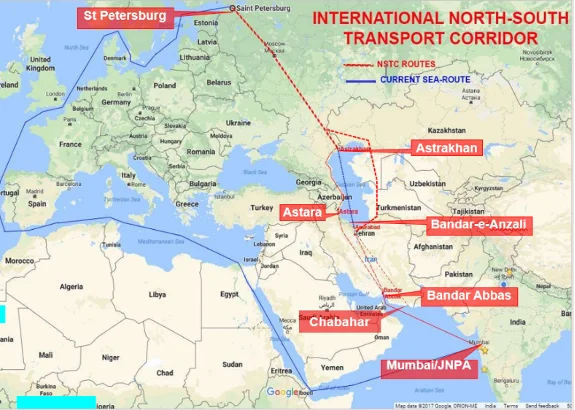
This port is deemed to act as a “key hub” for the INSTC (International North-South Corridor). It is 7,200 km long constituting freight movement across India, Iran, Afghanistan, Armenia, Azerbaijan, Russia, Central Asia, Europe. Central Asia is necessary to India because it is a rich source of REEs. India’s imports (crude petroleum, metals) and exports (high-value manufactured goods, pharmaceuticals, engineering products), despite increments, remain “relatively modest to its potential”. This cavity exists due to infrastructural and economic constraints that the Chabahar port project aims to tackle.
Gwadar
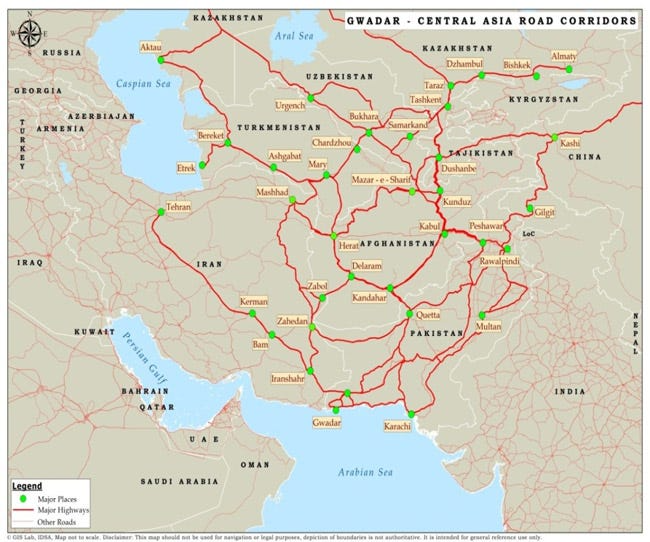
The Gwadar Port project initiated by Pakistan and China has been in construction since 2002. Originally owned by Oman, Pakistan bought this enclave back in 1958, after which China showed interest in 1999. It was announced as part of CPEC (China Pakistan Economic Corridor), under the Belt & Road Initiative, in 2015. Resembling a ‘hammer-head’, it protrudes outwards from Pakistan’s South-Western portion of the Arabian Sea coastline, thus acting like an important reference point to South Asian geopolitics.
This project invites a variety of diverse opinions. The crux of these arguments lies in the question, whom does it actually serve, China or Pakistan? For the latter, Gwadar is a solution to its underdeveloped and often ignored region, Balochistan. It helps make it more independent as compared to the growing dominance of India in South-East Asia. Gwadar also aids in lifting the burden off the Karachi Port. This would make Pakistan quite relevant and bring economic improvements.
For China, “Gwadar has significant strategic importance”. Currently, the country shares vulnerabilities at Malacca, and longer transportation duration with Africa and West Asia. Reports of China’s military ambitions in Gwadar enlarging its military base presence in Djibouti can also be found. Using a policy of ‘strategic vagueness’, China has the opportunity to stage naval activity as per its time of choice.
Through BRI, it is expanding its influence towards Africa, which connects to the Gulf of Aden. Several new ports have been emerging at this Gulf which has made the development of the Gwadar Port imperative.
While this project has its advantages, the subject of its construction has created a lot of turmoil. Being located in Balochistan, has led to insurgency challenges. There are 2 primary reasons for the same; the capitalisation by China of the Gwadar Port, and the surge in non-Baloch population in the concerned area of construction. This may end up converting the Balochi population to a minority in their own state. At the same time, China-Pakistan can not manage to transfer operations because Gwadar’s location at Balochistan is a strong asset. Pakistan has the advantage against other landlocked countries like Afghanistan. Being a part of the broader CPEC, it gives potential access to Central Asia.
Comparison
Earlier, the Chabahar Port held more symbolic importance as compared to its newly identified significance. India viewed it primarily as a route that could help it bypass Pakistan and provide aid to Afghanistan. Recent developments in the global sphere, such as the obstruction to the world economy caused by the blocking of the Strait of Hormuz, has renewed the port’s importance as not merely a mechanism to self-reliance, but also a strong alternative to imperative chokepoints. The Chabahar Port holds exceptional importance because it is a tool to tackle China’s BRI. The INSTC provides the apparatus to challenge BRI. Its significance becomes tenfold because the corridor extends all the way to Russia, therefore anchoring the port by 2 strongly allied countries, India and Russia.
Gwadar’s advantage is geared by its extension to Africa, a resource rich continent. It is also projected to handle approximately 400 million tons worth of cargo annually, which largely outnumbers Chabahar, holding a mere capacity of 10 to 12 million tons. While this is a matter of importance, considering the present geopolitical dynamics, the ‘diplomacy of connectivity’ has made more ground than quantitative measures. Gwadar’s disadvantage lies in the fact that it plans to link with the Gulf of Aden, which is already a location of severe vicissitudes in the context of Houthi attacks and the possible blockage of the Bab-el-Mandeb. The port is also prone to insurgency attacks by Baluchis.
Conclusion
Both Chabahar & Gwadar Ports provide legitimacy to South and Central Asia; self-reliance that has been largely denied by geography or Western led imperialistic gains that have permeated into the geopolitical intricacies of the 21st century.
Simultaneously, considering the various actors involved, it could also become a region of contest no sooner than later. The question shouldn’t be, Chabahar v/s Gwadar; it should be which survives longer to materialise its military-economic gains and create a successful web of connectivity.
Sources
Bansal, A. (June 5, 2023). India, Iran, Chabahar Port and multimodal trade corridors. IMPRI Insights. https://www.impriindia.com/insights/india-iran-chabahar-port-and-multimodal-trade-corridors/
Deccan Herald. (2024, January 15). Explained: Why is Chabahar Port in Iran strategically important for India? Deccan Herald. https://www.deccanherald.com/india/explained-why-is-chabahar-port-in-iran-strategically-important-for-india-3021488
Dinesh, S. (2021). Strategic salience of the Gwadar Port: An analytical study. Journal of Defence Studies, 15(1), 1–30. Manohar Parrikar Institute for Defence Studies and Analyses. https://idsa.in/publisher/journal-of-defence-studies/strategic-salience-of-the-gwadar-port-an-analytical-study
Future Center. (n.d.). Rivalry by the Sea. Future Center. https://www.futureuae.com/en-US/Mainpage/Report/9366
Pant, H. V., & Saha, S. (2020, February 18). Chabahar Port amid geopolitical flux: Implications for Afghanistan and India. Observer Research Foundation. https://www.orfonline.org/expert-speak/chabahar-port-amid-geopolitical-flux-implications-for-afghanistan-and-india
Singh, A. (2020, September 14). Chabahar Port: The limits of maximum pressure. National Maritime Foundation. https://maritimeindia.org/chabahar-port-the-limits-of-maximum-pressure/
Small, A. (2018, July 5). Along the road: Gwadar and China’s power projection. Carnegie Endowment for International Peace. https://carnegieendowment.org/posts/2018/07/along-the-road-gwadar-and-chinas-power-projection
Continue reading
 International Relations
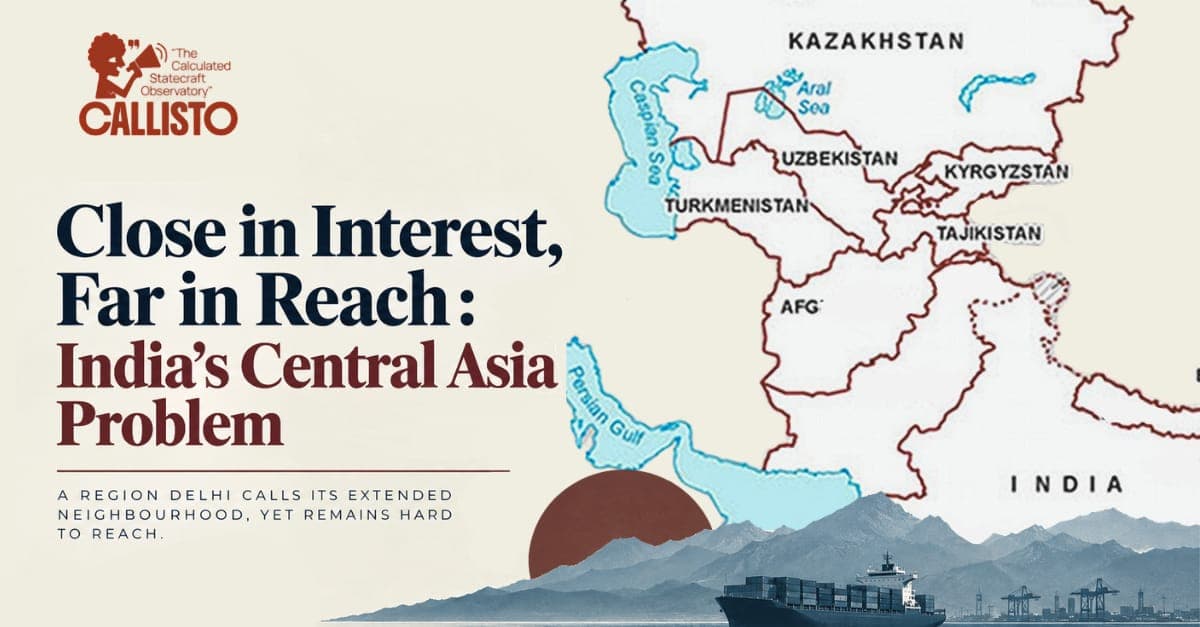
Close in Interest , Far in Reach : India's Central Asia Problem
17 October 2026
A region Delhi calls its extended neighborhood matters for energy, security and diplomacy, yet it remains hard to reach.
 International Relations
Trump-Xi Summit: Navigating a New Cold War
10 October 2026
Trade relations of the commodity of AI tech are analyzed through the Trump-Xi Summit in the context of the changing dynamics of U.S.-China relationship and Taiwan as a site of importance in this.
 International Relations
WHO OWNS THE ARCTIC? THE GREENLAND QUESTION
3 October 2026
Greenland’s strategic importance is reshaping Arctic security, but the new U.S.–Denmark–Greenland defence agreement raises questions beyond military cooperation. As Washington expands its presence, Greenland’s sovereignty, self-determination, environment, economy, and cultural priorities remain central to understanding the Arctic’s changing geopolitical landscape.
0 likes · 0 comments
Comments
No comments yet.
Your comment