
Geopolitics of Automated Front
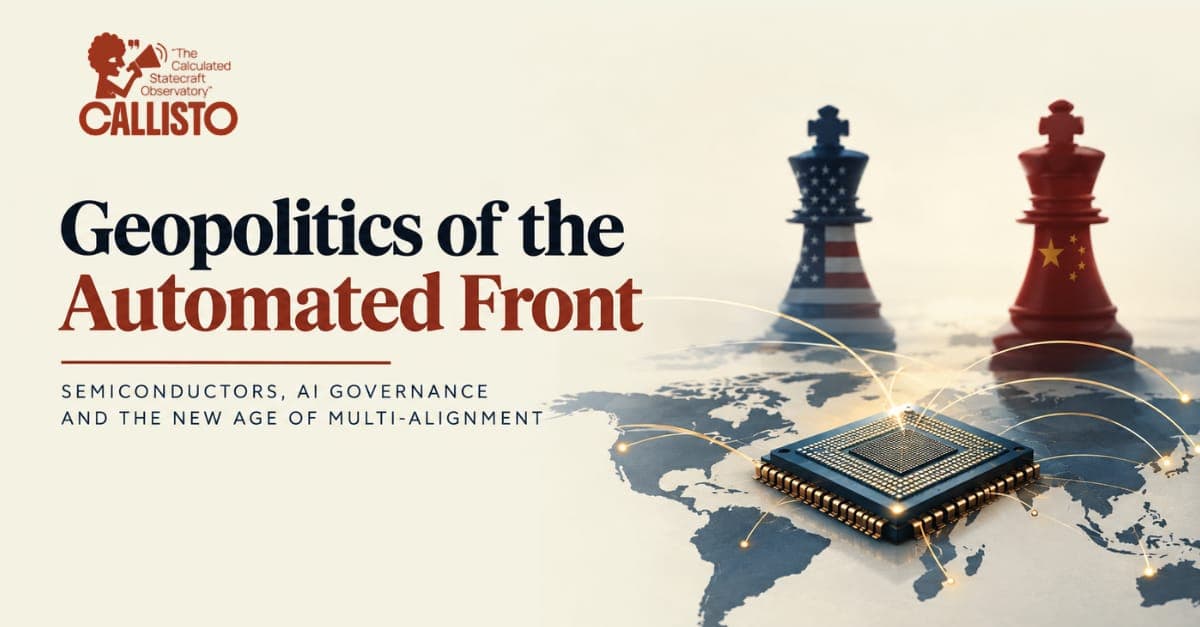
The US-China tech rivalry spans semiconductors, AI governance, and digital inequality. India and other middle powers are pursuing technological autonomy through domestic innovation, strategic cooperation, and multi-alignment while navigating global competition and the widening digital divide.
Introduction
The geopolitics of the automated front concerns the US-China technology struggle for control over key semiconductor chokepoints including EUV lithography, EDA software and design IP (CSIS, 2024). While the US coordinates allied export controls through legislation such as the MATCH Act, non-aligned countries seek to manage the challenges posed by global regulatory heterogeneity between the EU’s risk-based approach, the US market-led approach and China’s state control (Bradford, 2020; CSIS, 2026a). Middle powers and Global South countries, such as India, utilise a combination of multi-alignment and Digital Public Infrastructure to achieve technological autonomy without relying on dependencies on specific powers (Ministry of Electronics and Information Technology, 2025).
Methodology
This paper uses a qualitative, comparative policy analysis of secondary sources. By examining policy documents, legislation and international policy frameworks (CSIS, 2024, 2026a; UNDP, 2025; WEF, 2026), the research assesses technological dependence, approaches to AI governance, and supply chain strategies to understand how middle powers exert geopolitical influence across multiple technology blocs.
Analysis
The crux of the US-China technology contest lies in securing command of choke points, i.e. the exact inputs necessary to produce advanced chips. The export controls Washington put in place on October 20, 2022, upended 40 years of laissez-faire US trade policy by restricting chokepoints across the supply chain simultaneously, not merely advanced AI chips, but also software and equipment required for production (CSIS, 2024). Those chokepoints, according to CSIS, include chip design, electronic design automation (EDA) software, manufacturing equipment, and components required for that equipment (CSIS, 2024). In practice, this means the sanctions are designed not merely to prevent China from acquiring finished chips, but to stop it from acquiring the ability to manufacture the most advanced chips in-country.
US leverage over these chokepoints, however, is far from total. Dutch semiconductor equipment supplier ASML is the sole supplier of extreme ultraviolet lithography machines required for advanced chips; multiple typical chips "touch" international borders more than 70 times en route to the customer (CSIS, 2025). Combined, these facts mean Washington can't act alone if it wants its export controls to be effective. It must coordinate with allies abroad. That process is currently underway: lawmakers have proposed the MATCH Act this year to better align export restrictions with allies on equipment suppliers such as ASML, Nikon, and Canon (CSIS, 2026a). Washington's export controls are also struggling with internal enforcement issues: a recent CSIS report found that 53 per cent of semiconductor companies surveyed experienced license delays of over 180 days, some exceeding $10 million per company in lost exports (CSIS, 2026b). India's own bet has moved from paper to construction — ten projects worth ₹1.6 lakh crore approved across six states, five units under construction, and the country's first made-in-India chip unveiled (New Indian Express, 2025). The Tata-PSMC fab at Dholera matters most: India's first real push into wafer fabrication itself, a shift from its historical role of just supplying manpower to design centres abroad (New Indian Express, 2025). Semicon 2.0 raises the stakes with a ₹1.28 lakh crore outlay, 75% of R&D incentives now aimed at compound semiconductors, pointing to where India sees its actual competitive opening (The Hindu, 2025).
Still, the scale gap remains: the US alone pledged over $50 billion in support, pulling in $500 billion in private investment, numbers India can't match, and frontier technology like EUV lithography remains out of reach for all but a handful of economies (The Hindu, 2025). Manufacturing capacity and subsidies alone won't close that gap. India's real test is climbing the value chain into owning IP and retaining its own talent, along with providing a continuous push in R&D, rather than exporting it as it has for decades, while positioning itself as a node that both American and allied supply chains want to de-risk toward.
AI Governance Blocs- Competing Regulatory Models
There are three major models for AI governance at present: (1) the EU approach of strong hard-law regulation via the EU AI Act; (2) the US approach of light-touch, innovation-first policies via soft law; and (3) China’s approach of top-down, government control of AI technologies. The EU approach focuses on a broad set of values such as human rights, fairness, explainability, and transparency, while using a detailed compliance framework (Bradford, 2020). The US approach seeks to promote competitiveness, using sectoral and voluntary regulation approaches, industry self-regulation, and regulatory sandboxes (Global Governance & Defence Forum, 2026). The Chinese approach is based on vertical integration, national security, content control, and state oversight of AI systems (Articsledge, 2026). In this context, the Global South faces unique challenges. Many nations in the region have historically been ‘rule-takers’ rather than rule-makers, providing training data and testbeds for AI systems (Maheshwari, 2026). These nations often rely on foreign technologies and remain structurally dependent on technology suppliers from other nations, perpetuating postcolonial dependencies. Yet, some Global South nations like India are already challenging this status quo by formulating their own approaches to AI governance. India’s recent leadership in G20 and its advocacy for inclusive Digital Public Infrastructure (DPI) can inform a new Global South approach to AI regulation. Instead of imposing rigid regulations and standards (as done in the EU), the Indian approach advocates for flexible principles and guidelines to govern AI (Ministry of Electronics and Information Technology, 2025). A key principle is “innovation over restraint.” To support responsible innovation, India proposes a graded liability framework that limits corporate liability when companies implement robust mitigation measures (Ministry of Electronics and Information Technology, 2025). India is also proposing to establish state-run AI compute clusters to support AI innovation while safeguarding against misuse (Ministry of Electronics and Information Technology, 2025). As nations begin regulating domestic data, computing, and algorithms, there is a growing risk of fragmentation due to differing approaches to “digital sovereignty” (Maheshwari, 2026). Efforts to build interoperable AI governance frameworks, such as those being developed by international standard-setting organisations (e.g., ISO/IEC) or through international compacts to align national regulatory approaches (Global Governance & Defence Forum, 2026), may be necessary to overcome regulatory fragmentation.
The Global AI Divide: Development, Access, and a New Non-Alignment
Women in South Asia are up to 40% less likely than men to own a smartphone (UNDP,2025), reflecting not just an access problem but a data problem. AI models are trained on data usage, digital footprints, and user behaviour. If women don’t have access, they are ruled out from the training data as well. This reality of Asia-Pacific living in a combination of slow tech adoption and uneven realities is what the UNDP’s December 2025 report calls “Next Great Divergence”. It refers to a potential period of rising inequality between countries. Treating this as purely a gap between countries risks overlooking what the gender data already demonstrates.
First, distribution: the gap exists within countries, not just between them. China, for example, ranks among the world’s top AI powers, yet most of its development is concentrated in Beijing, Shanghai and Shenzhen, in contrast to regions like Yunnan or Qinghai that lack basic internet connectivity. Second, demand side: this gap is demographic and geographical. Japan ranks among the countries with the oldest populations. China’s population is ageing rapidly due to historically low birth rates. Asia’s rapidly ageing population is shrinking the working-age workforce, making automation a necessity rather than an innovation, especially for labour-intensive sectors. This demand is already reflected in numbers, with about 74% of industrial robots installed in 2024 in Asia. Third, supply side: as noted above, the capability for AI development is spread unevenly throughout the Asia-Pacific region, where a country like India provides data sources but lacks technological infrastructure, while countries like Japan and Taiwan have a strong foothold in semiconductor chips(WEF,2026).
However, these gaps can be eased considerably when the workflow is redesigned by implementing AI rather than forcing it onto existing systems. ASEAN alone could gain close to one trillion dollars in additional GDP over the next decade(UNDP,2025), provided AI is deployed in line with regional needs. For instance, when AI learns from real-time models in domains like finance and clinical decision-making, developed over decades. This is especially useful in South Asian countries where there is a huge population, but an ageing workforce. This region could only advance when the regional powers pool their respective expertise and resources. This allows building a shared capacity rather than pursuing self-sufficiency in a competitive arena, because no single country possesses the entire stack. This interdependence becomes the seed of multi-alignment.
This multi-alignment stands in contrast to the non-alignment movement of the Cold War era. The latter focused on refusing to side with any superpower while continuing to extract aid from both sides. The multi-alignment concept of the AI era reflects maximising entanglement to exercise leverage over the superpowers, instead of being background actors.
The swing states, primarily the UAE and Saudi Arabia, are good examples of this. Since they hold the necessary infrastructure and funds that both the US and China want, but they do not exclusively align with any one state, thus exercising leverage over both. Abu Dhabi has invested in the US stack of technologies through the UAE Stargate, an AI infrastructure, while also committing about 60 billion dollars to the French data centre expansion project. Simultaneously launching K2 Think, a reasoning model using Chinese technology run in partnership with an American chipmaker. Saudi Arabia’s HUMAIN goes along the same pathway, signing deals with Qualcomm, Google, and Nvidia while keeping live MOUs with Chinese firms. Both countries show a similar strategy: one investing source, multiple blocs, no exclusive clauses (IISS,2026).
The ASEAN bloc, too, has established itself as a strategic partner despite not having its own strong technological background. By recognising that this era is not dominated by who possesses the largest model, but “who can serve humanity the best”. ASEAN entered into deals with China promoting its “Global Artificial Intelligence Governance initiative” while entering the “ASEAN – U.S. Leaders’ Statement on Promoting Safe, Secure, and Trustworthy Artificial Intelligence”. Rather than hedging between the two AI giants, it is curating an architecture that brings different experts and experiences together to come out with the best possible design. This was important for ASEAN as it faces a range of challenges from economic development to responding to global geopolitical challenges. For these middle powers, AI is approached not as a race but as a portfolio to build: a stake in the American stack, deals with Chinese companies, and an investment in the European market. This strategy is followed not out of confusion but because no single power’s technology alone can guarantee the best outcome. This non-alignment is not about minimising engagement with the powers but about maximising it(Bennett School of Public Policy,2025).
Conclusion
This paper has traced across three areas: semiconductor chokepoints and India’s efforts to compete with them; the contest between rigid and flexible AI frameworks with India pushing for a Global South-oriented strategy; and the uneven distribution and capability within countries, alongside the hedging strategies of swing states.
The global AI is not simply a gap to be closed but a structure to be rebuilt. For countries like India, this focus is on investing more in indigenous EDA tools, design IP and specialised components like chip packaging and novel materials, where room for competition exists. While also focusing on funding domestic AI computing and indigenous ownership of IP to prevent brain drain. More broadly, the middle powers should focus on developing AI systems specifically tailored to each country’s demographics and constraints. Finally, the opportunistic hedging must be coordinated to distribute benefits rather than concentrate them. If left unmanaged, it risks becoming the Next Great Divergence, and if efforts are made to manage it becomes the foundation of multi-alignment.
Sources
CSIS. (2022, October 11) Choking off China's Access to the Future of AI. https://www.csis.org/analysis/choking-chinas-access-future-ai
CSIS. (2025, March 14). Understanding U.S. Allies' Current Legal Authority to Implement AI and Semiconductor Export Controls.
CSIS. (2026,April 15) New Momentum, Old Problems: Transatlantic Export Control Considerations.
https://www.csis.org/analysis/new-momentum-old-problems-transatlantic-export-control-considerations
CSIS. (2026, April 10). Reining in the Export Control Arms Race.
https://www.csis.org/analysis/reining-export-control-arms-race
New Indian Express. (2025, September 7). Sustaining momentum is India's chips challenge.
https://www.newindianexpress.com/editorial/2025/Sep/07/sustaining-momentum-is-indias-chips-challenge
The Hindu. (2026, July 18) Promise of chips: On the India Semiconductor Mission phase mission 2.0
Articsledge. (2026, February 17). What is AI ethics? Complete guide to responsible AI (2026). https://www.articsledge.com/post/ai-ethics
Bradford, A. (2020). The Brussels Effect: How the European Union rules the world. Oxford University Press. https://doi.org/10.1093/oso/9780190088583.001.0001
Global Governance & Defense Forum. (2026, February 15). The AI governance trilemma: Innovation, safety, and global competitiveness. GDEF Insights. https://gdeforum.org/insights/ai-governance-trilemma-regulatory-competition/
Maheshwari, D. (2026, February). AI's Global South pivot: Equity, ethics and ecology (Policy Brief No. 225). Centre for International Governance Innovation. https://www.cigionline.org/static/documents/Policy_Brief_No._225_Maheshwari.pdf
Ministry of Electronics and Information Technology. (2025, November). India AI governance guidelines. Press Information Bureau, Government of India. https://static.pib.gov.in/WriteReadData/specificdocs/documents/2025/nov/doc2025115685601.pdf
International Institute for Strategic Studies. (2026, June). Gulf AI infrastructure and the limits of technological sovereignty. IISS. https://www.iiss.org/publications/strategic-comments/2026/06/gulf-ai-infrastructure-and-the-limits-of-technological-sovereignty/
United Nations Development Programme. (2025, December). The next great divergence: Why AI may deepen inequality between countries. UNDP Asia-Pacific. https://www.undp.org/asia-pacific/next-great-divergence
Sasaki, Y. (2026, June 16). Why Asia-Pacific could lead the next wave of AI. World Economic Forum. https://www.weforum.org/stories/artificial-intelligence/asia-pacific-could-lead-the-next-phase-of-ai-bcg/
Continue reading
 International Relations · Research Article
INDIA’S APPROACH TO DIGITAL PUBLIC INFRASTRUCTURE AS EXPORT POLICY
16 October 2026
India’s Digital Public Infrastructure export policy uses platforms like Aadhaar, UPI, and DigiLocker to strengthen digital governance, financial inclusion, and regional connectivity. By sharing these systems with the Global South, India advances its diplomatic influence and technological leadership, though data protection, institutional capacity, and effective implementation remain critical challenges.
 International Relations · Research Article
VISION 2030: Tracking Saudi's Reform Agenda
15 October 2026
Saudi Arabia’s Vision 2030 seeks to diversify the economy beyond oil through private-sector growth, foreign investment, technological innovation, and structural reforms. Despite progress, persistent oil dependence, investment gaps, employment inequalities, and geopolitical instability challenge its long-term economic transformation and strategic autonomy.
 International Relations · Research Article
Water as a Strategic Resource: India's Transboundary River Diplomacy
15 October 2026
India’s transboundary rivers shape its relations with Pakistan, China, Nepal, Bhutan, and Bangladesh. From treaty disputes to hydropower projects, water diplomacy reflects competing security and economic interests. The challenge lies in balancing strategic influence with regional cooperation, equitable governance, and climate resilience.
0 likes · 0 comments
Comments
No comments yet.
Your comment