
RTI and the Judiciary: Where Transparency Hits Sand on Judges' Assets and Appointments
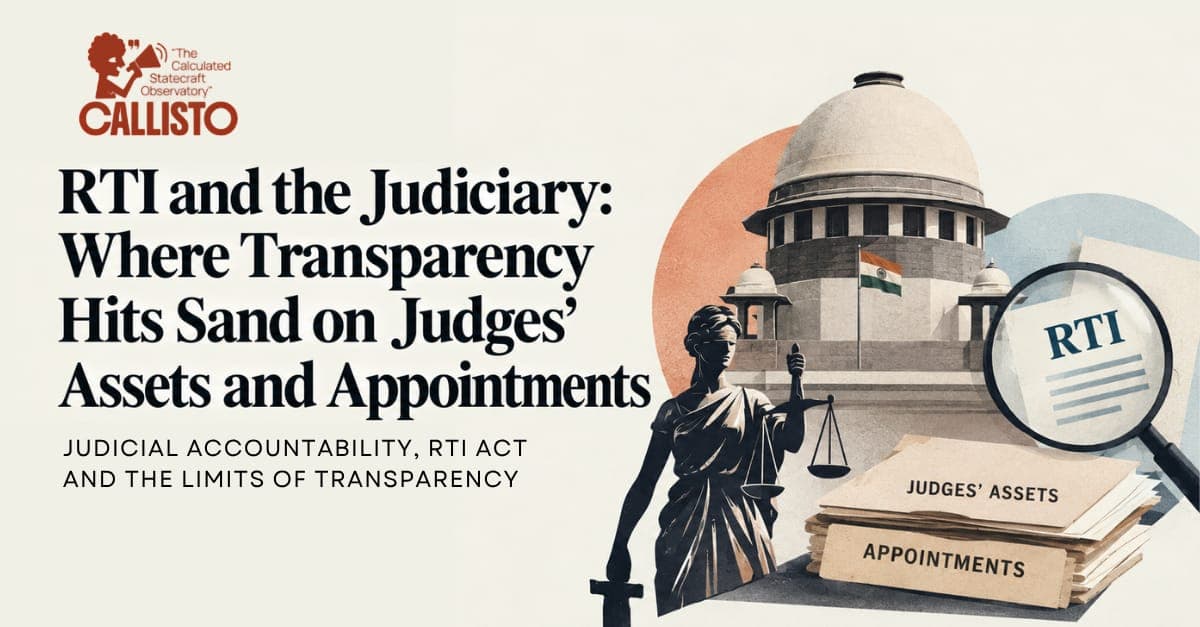
Hi readers, welcome back. This week we examine how the judiciary operates in relation to transparency. Since 2005, the RTI Act has enabled citizens to request records from ministries and panchayats. In 2019, the Supreme Court held that the Chief Justice’s office was a public authority under the Act. On two subjects, however, transparency appears to hit sand: the assets of judges, and the process of their appointment. Here’s how and why, and what can change. Judges’ assets: disclosure at the discretion of the judge.
Civil servants are required to declare their assets. So were election candidates, since the Supreme Court’s 2002 ADR judgment. Judges have taken a different path. A 1997 Supreme Court resolution asked them to submit information confidentially to the Chief Justice, and a 2009 full-court resolution permitted voluntary publication on the Court’s website.
In practice, this has left the public in the dark. Several High Courts have turned down RTI requests regarding judicial assets, and a 2023 Parliamentary Standing Committee has recommended a law requiring annual declarations.
The Supreme Court took an important step in 2025. Following reports of a cash recovery at the residence of a Delhi High Court judge, its full court resolved on 1 April 2025 to publish judges’ asset declarations. In May 2025, it uploaded those of 21 of its 33 judges to its website.
This is necessary, since judges decide on property, tax and cases where the government is a party. The public can only detect the possibility of conflict of interest if it can see what judges possess. A confidential file in the Chief Justice’s office will not do.
Appointments: Decisions Without Reasons
A similar lack of transparency prevails in appointments. In the 2019 case, the Attorney General argued that disclosure of the collegium’s communications would affect judicial independence. The five-judge bench differed, noting that transparency and judicial independence are not at odds. In October 2017, the collegium had itself decided to publish its decisions on the internet.
RTI activist Anjali Bhardwaj then sought the agenda and decisions of the collegium meeting of 12 December 2018, which she alleged had been referred to in public remarks by former collegium members Madan Lokur and Ranjan Gogoi. The collegium’s resolution of 10 January 2019 noted that consultations had occurred but no final decision had been taken. On 9 December 2022, the Supreme Court dismissed the appeal, holding that only a resolution signed by all members could be published, not tentative discussions.
That is a reasonable position regarding unadopted resolutions. Still, citizens cannot see the outcome of the deliberations, only the conclusion. We cannot know what prompted a name to reach the top of the list, or drop off. Concerns that premature disclosure may prejudice candidates are valid, but a brief note of reasons with the resolution would not violate them.
Why it Matters, and What Could be Done?
Secrecy breeds delays, and delays have their cost. With the number of judges limited, every litigant, whether a tenant in a property dispute or a small business owner seeking a tax remedy, faces longer wait times to get justice.
The numbers (from official parliamentary records):
As on 1 July 2026, High Courts had 781 judges against a sanctioned strength of 1,122, i.e. 341 posts (over 30 percent) vacant. Source: Rajya Sabha unstarred question, Ministry of Law and Justice (Department of Justice).
The Government has said High Courts should start recommendations six months prior to a vacancy, but this is rarely followed.
As of 28 July 2026, about 92,755 cases were pending in the Supreme Court and 64.67 lakh in the High Courts. Source: Lok Sabha unstarred question, Ministry of Law and Justice.
With multiple agencies involved and few reasons on public record, the location of obstruction cannot be said. Here’s what we could do:
Mandate and make public annual asset declarations of Supreme Court and High Court judges, as recommended by the 2023 Standing Committee.
Ensure the Supreme Court’s 2025 practice of publishing such declarations is adopted by all High Courts, in a uniform format and timeline.
Publish a brief, candidate-wise note of reasons with every collegium resolution, based on the 2017 resolution.
Add a stage-wise tracker of pending proposals to the vacancy data already published by the Department of Justice.
Several of the above require only a resolution, not a new law.
Final question: Where should the line be drawn between information that judges must give about their wealth and selection process, and what must be kept private to ensure judicial independence?
Sources
Anjali Bhardwaj v. Central Public Information Officer, Supreme Court of India. (2022, 9 December).
Central Public Information Officer, Supreme Court of India v. Subhash Chandra Agarwal. (2019, 13 November). Supreme Court of India, (2019) 16 SCC 1.
Supreme Court of India. (2025). Declaration of assets by judges.
Government of India, Ministry of Law and Justice, Department of Justice. (2026). Rajya Sabha unstarred question on vacancies in the High Courts (data as on 1 July 2026). Parliament of India.
Government of India, Ministry of Law and Justice. (2026, 28 July). Lok Sabha unstarred question on pending cases. Parliament of India.
SCC Online. (2019). Attorney General’s arguments concerning judicial transparency and disclosure under the Right to Information Act.
Verdictum. (n.d.). Delhi High Court on the 2018 collegium meeting.
Continue reading
 Public Policy
SIR and the Long Continuous Battle Surrounding it
11 October 2026
India’s Special Intensive Revision of electoral rolls has intensified debates over voter eligibility, democratic participation and the risk of wrongful exclusion. From women and transgender persons to religious minorities, the exercise raises urgent questions about electoral transparency, accountability and safeguards.
 Public Policy
BEYOND THE BORDER: WHY INDIA’S GLOF EARLY WARNING NEEDS A HIMALAYAN NEIGHBORHOOD
21 September 2026
India’s GLOF early-warning systems cover nearly 200 Himalayan lakes, yet border-crossing floods demand a shared Himalayan monitoring network. Transboundary data sharing and real-time alerts are essential, as climate risks ignore national boundaries.
 Public Policy
CONSTITUTIONAL PROVISIONS AND AMENDMENTS RELATED TO CITIZENSHIP IN INDIA
14 September 2026
India's citizenship provisions, classifications and the history of amendments in the context of a recent protests in Manipur for NRC and the row over SIR name deletions.
0 likes · 0 comments
Comments
No comments yet.
Your comment