
SIR and the Long Continuous Battle Surrounding it
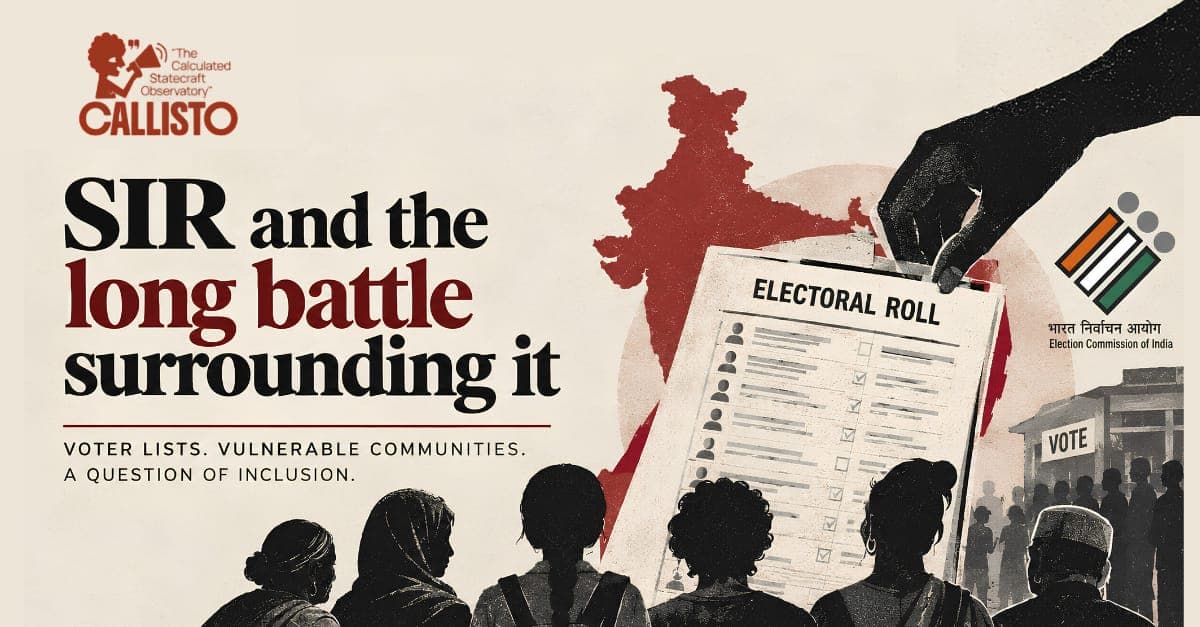
“Women, transgender persons, and members of minority, especially Muslim communities, got deleted in greater percentages than their proportion in the population,” declared a petition filed by All-India Feminist Alliance (ALIFA) to the Election Commission of India (ECI), raising concerns about the systematic decimation and large-scale erosion of women’s voting rights in the context of the Special Intensive Revision (SIR) of electoral rolls, underway since 2025.
Welcome back Readers, in this edition of the newsletter, we’ll be looking at SIR and the conflicts that surround it.
What is SIR?
SIR, called the Special Intensive Revision, involves a thorough revision of the electoral roll from scratch by the ECI.
The exercise commenced on 25 June 2025 with the distribution of enumeration forms to all the 8 crore voters in the electoral roll of Bihar.
Why is it taking place?
The ECI prepares electoral rolls under the provisions of the Representation of the People Act, 1950.
Section 21 of the RP Act deals with the preparation and revision of electoral rolls. A summary revision is carried out before each general election to the Lok Sabha or legislative assembly of a State or bye-election to any constituency. It also authorises the ECI to carry out special revision of the electoral roll at any time for reasons to be recorded.
The Commission noted in its order dated June 24, 2025 that there have been large-scale additions and deletions to the electoral rolls over the last 20 years due to rapid urbanisation and migration. This has increased the possibility of duplicate entries in the electoral roll.
So, Accordingly, the ECI has decided to carry out a Special Intensive Revision (SIR) for the entire country.
What then has been Challenged in such a seemingly Routine Activity?
The notification that announced the arrival of SIR, stated that ECI would carefully adhere to the provisions regarding eligibility and disqualification of voters in the revision of the electoral roll, clearly laid down under Article 326 of the Constitution of India and Section 16 of the Representation of People Act, 1950 (RPA).
However, in early July 2025, the Association for Democratic Reforms, Swaraj Party member and activist Yogendra Yadav, moved the Supreme Court under Article 32, challenging the ECI’s notification. They claim that the SIR is arbitrary and violative of the universal right to adult suffrage.
The petitions argued that the exercise excludes indicators like Aadhaar and ration cards and makes the proof of parents’ identity mandatory. Given Bihar’s high rates of poverty and migration, such requirements may disenfranchise millions. The petitions also criticise the short timeframe and absence of prior consultation, arguing that the exercise undermines democracy, equality, and the right to vote, particularly for the most vulnerable.
On 27 May 2026, the Supreme Court, however, unanimously upheld the Bihar SIR exercise. The Bench ruled that adopting a different procedure from routine electoral roll revisions does not make the exercise unconstitutional. It stated that measures adopted in the SIR are not manifestly excessive or disproportionate. The SIR secures the mandate of free and fair elections.
In light of the above judgment, continuing the exercise, we come across alarming data from the first two phases of the SIR that impacted 13 states and Union Territories, that up to 8.9% of living voters were not included in the updated rolls as per the appeal issued to the ECI, by The All-India Feminist Alliance (ALIFA-NAPM), a national coalition of feminist organizations.
The group warned that women, transgender persons, and minority communities, particularly Muslims, are being “deleted in greater percentages than their proportion in the population,” with substantial drops in the gender ratio observed in states like Bihar, Rajasthan and West Bengal
To put things better into perspective:
Bengal: About nine million voters, roughly 12% of West Bengal’s 76 million electorate, were removed from the 2026 rolls during the SIR. More than six million were struck off as absentee or deceased, while about 2.7 million awaited tribunal decisions (BBC News, 2026). West Bengal has the second-largest Muslim population among Indian states, about 14% of India’s 172 million Muslims (BBC News, 2026; Registrar General & Census Commissioner, India, 2015). Remarks by political leaders, including the Prime Minister, that the exercise would identify “illegal Bangladeshi infiltrators” have heightened tensions. The TMC says the term refers to Muslims, while many Hindu voters were also left off the rolls (BBC News, 2026).
Karnataka: The SIR process isn’t just a harmless addition/deletion exercise but rather something that gravely punishes the queer and marginalized communities:
74 transgender and intersex people were surveyed from various districts in Karnataka, and the results showed that respondents could not determine where their parents or grandparents would have been registered, or where they had cast their ballots in 2002.
While documentation may come naturally to cisgender, heterosexual citizens whose lives have often been validated by family and the state, from birth certificates and school records to address proofs and voter IDs, many trans people do not inherit documents in the same way. They have to leave households; some are even disowned or declared dead. The few documents they once had may also become unusable, as it carries a name and gender that no longer represent them.
What sections of the society are particularly affected, and why are they vulnerable?
Women: Women from vulnerable communities such as Dalits, Adivasis, denotified and nomadic communities, homeless women, women in shelters, women in bastis, sex workers, women with disabilities, elderly women, widows, survivors of domestic violence, deserted, single women, women in inter-faith / inter-caste marriages.
Transgender and Queer People: Many LGBTQ+ individuals, particularly those from lower-income and marginalised caste backgrounds, are rejected by their families because of their sexual orientation or gender identity.
This process can therefore put a certain pressure on these individuals to produce records tied to the same household that there are no longer a part of and even put them in dangerous and coercive situations going back there.
Religious Minorities: Independent analyses suggest deletions in West Bengal fell more heavily on Muslims in several constituencies. The SABAR Institute, a Kolkata-based research organisation, found that Muslims, about 25% of Nandigram’s population, made up over 95% of names removed from its supplementary lists (Mitra, 2026). The ECI says the exercise aims to ensure that all eligible citizens are included and no ineligible voter remains (Press Information Bureau, 2025), a position echoed by a BJP leader (Mitra, 2026). Separately, about 27 lakh voters whose inclusion was still to be decided by appellate tribunals could not vote in the April 2026 polls after the Supreme Court declined to allow voting while appeals were pending (“Why Election Commission,” 2026; Mitra, 2026). Whether these patterns reflect the design or the implementation of the process remains contested.
What can be done instead?
Alternative Documentation: The ECI must specify alternative routes of documentation and approaches for migrant, homeless, displaced and mobile communities, who are estranged from their natal families, finding documents is extremely difficult.
Transgender and Gender-Diverse Inclusion: The ECI must recognize name and gender mismatches as a structural issue.
In cases where people have them, gazette notification and transgender IDs/certificates should be admitted as documentary proof.
The ECI must then also create alternative methods of establishing linkage for transgender persons estranged from or in conflict with their families, as most of them cannot go back to their villages or towns of origin or families for records without fear for their lives and dignity.
Increase the time period for the completion of SIR: ECI should immediately increase the time period for the completion of SIR because Phase 1 and Phase 2 have shown that these short timelines are a major source of exclusions and errors in every step of the SIR process. Adequate time is essential for the BLOs to complete a task. Voters also need adequate time to collect the necessary documents and submit them to the designated officials.
Sources
Rangarajan, R. (2025, July 22). Explainer: What is the Special Intensive Revision of Electoral Rolls? The India Forum. https://www.theindiaforum.in/politics/explainer-what-special-intensive-revision-electoral-rolls
Press Information Bureau, Government of India. (2025, June 24). ECI to begin Special Intensive Revision of Electoral Rolls in Bihar [Press release]. https://www.pib.gov.in/PressReleasePage.aspx?PRID=2139342®=3&lang=2
Supreme Court Observer. (n.d.). Challenge to the ECI’s revision of electoral rolls in Bihar (SIR): Association for Democratic Reforms v. Election Commission of India. Retrieved September 12, 2026, https://www.scobserver.in/cases/challenge-to-the-ecis-revision-of-electoral-rolls-in-bihar-sir-association-for-democratic-reforms-v-election-commission-of-india/
BBC News. (2026, April 13). Political turmoil in Indian border state as nine million lose voting rights. https://www.bbc.com/news/articles/cy51qg00dezo
Registrar General & Census Commissioner, India. (2015, August 25). RGI releases Census 2011 data on population by religious communities [Press release]. Press Information Bureau. https://www.pib.gov.in/newsite/printrelease.aspx?relid=126326®=48&lang=2
S, S. (2026, July 15). SIR in Karnataka: When the state asks queer people to “prove” their past. Feminism in India. https://feminisminindia.com/2026/07/15/sir-in-karnataka-when-the-state-asks-queer-people-to-prove-their-past/
The News Minute. (2026). My Vote, My Right coalition flags exclusion fears ahead of Karnataka SIR exercise. https://www.thenewsminute.com/karnataka/my-vote-my-right-coalition-flags-exclusion-fears-ahead-of-karnataka-sir-exercise
Mitra, R. (2026, April 16). Muslims the target? Fury as millions lose voting rights in India’s Bengal. Al Jazeera. https://www.aljazeera.com/news/2026/4/16/muslims-the-target-fury-as-millions-lose-voting-rights-in-indias-bengal
Dola Sen v. Election Commission of India, W.P.(C) No. 1089/2025 (Supreme Court of India, Apr. 13, 2026). https://www.sci.gov.in
Shah, T. (2026, July 9). Women and transgender voters are being systematically erased from electoral rolls: All India Feminist Alliance writes to the Election Commission. The Leaflet. https://theleaflet.in/leaflet-reports/women-and-transgender-voters-are-being-systematically-erased-from-electoral-rolls-all-india-feminist-alliance-writes-to-the-election-commission
Bawa, A. K. (2026, January 12). Explained: Petitioners’ arguments in Supreme Court against SIR. LiveLaw. https://www.livelaw.in/top-stories/explained-petitioners-arguments-in-supreme-court-against-sir-518510
Continue reading
 Public Policy
BEYOND THE BORDER: WHY INDIA’S GLOF EARLY WARNING NEEDS A HIMALAYAN NEIGHBORHOOD
21 September 2026
India’s GLOF early-warning systems cover nearly 200 Himalayan lakes, yet border-crossing floods demand a shared Himalayan monitoring network. Transboundary data sharing and real-time alerts are essential, as climate risks ignore national boundaries.
 Public Policy
CONSTITUTIONAL PROVISIONS AND AMENDMENTS RELATED TO CITIZENSHIP IN INDIA
14 September 2026
India's citizenship provisions, classifications and the history of amendments in the context of a recent protests in Manipur for NRC and the row over SIR name deletions.
 Public Policy
Rethinking the collegium system
7 September 2026
The appointment of the judges of Supreme Court and High Courts in our country follows a process through collegium system. This system has been a point of contention, raised in legal battles in the tussle between the Executive and Judiciary
0 likes · 0 comments
Comments
No comments yet.
Your comment