
The Emerging Prospect of an “Islamic NATO”: Understanding the Strategic Implications of the Mecca Agreement
“The substance of this agreement is geared towards peacetime cooperation", Shafqat Ali Khan, spokesperson for Pakistan’s Ministry of Foreign Affairs about the Mecca Agreement which is very crucial in the context of the recent international issues and relations.
Introduction
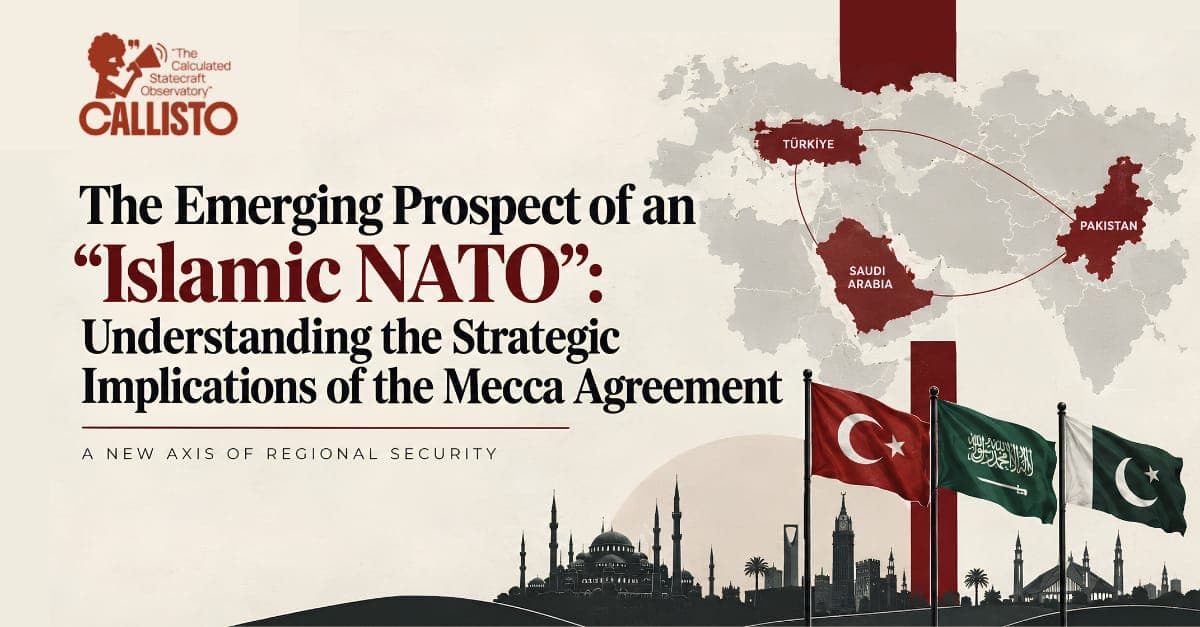
The recent trilateral security framework signed on 7th August, 2026 between Pakistan, Turkiye and Saudi Arabia has revived the notion of the establishment of an Islamic alliance, drawing its inspiration from NATO’s Article 5 which comes amidst the evolving security environment in West and South Asia and the changing nature of relationships between the countries.
This transregional framework linking the Gulf, Anatoli (Asia Minor) and South Asia creates a strategic corridor linking 3 distinct geopolitical theatres and expanding the scope of cooperation beyond the traditional physical boundaries and forms a broader architecture of collective security.
This framework has been officially deemed as purely defensive, as stated by Ishaq Dar, Pakistan’s Deputy Prime Minister and Foreign Minister, on 9 August 2026, two days after the Mecca Joint Defence Agreement was signed. The pact is also consistent with Article 51 of the UN charter, making ‘collective defense’ consistent with the right to individual and collective self defense.
It is important to note that this defense pact emerges out of existing ties rather than an alliance from nothing. Saudi Arabia-Pakistan has an existing Mutual Defence Agreement (2025), while Riyadh-Ankara have expanded defence-industrial cooperation.
Strategic Origins and Evolution of the Mecca Agreement
The emergence of the Mecca Pact was not a result of an isolated alliance initiative, but through the gradual evolution of converging strategic interest between Saudi Arabia, Pakistan, and Turkiye. Over the past several decades, these countries have expanded their areas of cooperation in defence, economy, intelligence sharing, etc. Despite the growing scope, the areas of cooperation between the countries have remained largely bilateral, with the emergence of the Mecca JDA changing this, marking a transition towards an institutionalised trilateral cooperation.
The emergence of this institutionalized trilateral framework can be understood better by understanding the trajectory of the individual relationships between the countries, which collectively laid down the bedrock for this agreement:
2.1 Pakistan–Saudi Arabia
“Since the 1960s, defence cooperation has served as one of the principal pillars of Pakistan-Saudi Arabia’s all-encompassing bilateral relations.”
— Pakistan Ministry of Foreign Affairs, September 2025
Although the roots of Saudi Arabia-Pakistan relationship predate the creation of Pakistan, Bilateral Relations emerged formally after independence, post recognition of Pakistan as a sovereign country. A Treaty of Friendship was signed between them (1951), leading to a formal basis for bilateral cooperation.
Over the decades, while being rooted in cultural and economic ties, this relationship has culminated into a comprehensive defense cooperation with multiple joint exercises as well as institutional exchanges taking place regularly. This relationship was significantly elevated on 17 September 2025 with the signing of the Strategic Mutual Defence Agreement, under which aggression against either country would be regarded as aggression against both, taking a page out of NATO’s Article 5.
2.2 Saudi Arabia-Turkiye
“The signing of the contracts is a continuation of the constructive cooperation and strategic partnership between the Kingdom and Türkiye in the defence field.”
— Dr. Faleh bin Abdullah Al-Sulaiman, Governor of Saudi Arabia’s General Authority for Defense Development, 2023
Riyadh and Ankara’s relations, while riddled with political relations, have undergone significant transformations over the years, with cooperation expanding to a strategic dimension as both sides sought greater cooperation in investment, technology, energy, and defence.
The turning point in their relations emerged with the signing of the Executive Plan for Cooperation in Defence Capabilities, Defence Industries, Research and Development. The acquisition of localised unmanned aerial systems which was a result of an agreement signed between Baykar and Saudi Arabian Military Industries in August 2023 stressed the importance of this cooperation.
In addition to that, in December 2023, Saudi Arabia's Chief of General Staff visited Türkiye and held talks with Turkish military leadership and defence-industry officials concerning military cooperation, defence industries, and scientific research.
2.3 Turkiye-Pakistan
“As long-standing allies and strategic partners, Pakistan and Türkiye maintain a tradition of regular high-level exchanges, reflecting the exceptional bonds of brotherhood between the two nations.”
— Ministry of Foreign Affairs, Government of Pakistan, April 2025
Ankara-Islamabad relations can be traced back to the 1920s when the Khilafat movement witnessed the mobilization of muslims in the Indian subcontinent in response to the removal of the head of the caliphate.
While that provided an important impetus for their relationship following Pakistan’s independence, it was subsequently institutionalised through the 1954 Treaty of Friendship and, decades later, the establishment of the High-Level Cooperation Council (2009).
Their historical relations have increasingly translated into institutionalized defence cooperation, with the relationship expanding from political and diplomatic spheres to joint military cooperation.
Mecca Agreement as a collective Security Framework
Nearly eighteen months into the Iran-US conflict, has demonstrated what history has shown us repeatedly, how the advent of war accelerates strategic decision making and shifts global dynamics significantly due to changing alliances. The Joint Mecca declaration can be seen as what can be said to be evidence of this realignment. The repeated collateral strikes that Riyadh had to withstand as well as security of the gulf region on a backfoot has made it lose confidence on the guarantees given by Washington and has led to a reassessment of its dependency on the US.
Meanwhile the recent statement given by the US ambassador Sergio Gor with respect to India’s position on Kashmir, albeit made after the signing of the declaration, has only solidified the strategic rationale of Pakistan for strengthening alternate security partners.
While it has been repeatedly stated on how the Joint Mecca Declaration embodies the Article 5 of NATO, there is however a significant distinction between the two. NATO is a decades old institution with a structured command while MJDA only forms a basis of the alliance which calls for intervention and military support of its signatories when any one member is attacked.
Relevance of the Mecca Agreement
In present day geopolitics, issue-based alliances are emerging to do away with the vicious cycle of dependencies that states may see themselves trapped in. MJDA can be analysed as something similar. Each signatory has a foundational level of American backed influence that they rest on.
This defence agreement has been created to reduce US dependency. Ironically, the inherent ties shared by each state with the US runs so deep, that it has inevitably called for greater American support itself. Pakistan, Turkiye, and Saudi Arabia, each have a distinctly interesting route of indelible subservience to the superpower.
4.1. Saudi Arabia
It approved the National Project for Atomic Energy (2017), aiming to use non-fossil-fuel-based energy for domestic purposes like electricity generation and water desalination. This civilian nuclear power industry is being built to free up its oil, more for export oriented activities, than domestically burning it for power. It has generated 41% and 58% electricity via natural gas and oil, thus becoming the second-largest consumer of energy in the Middle East. The USA has helped Saudi build small nuclear reactors to bring ease to this project through the 123 Agreement.
Additionally, the US has agreed to sell its F-35A Lightning II jets to Saudi Arabia, constituting a $142 billion defence package. The Islamic state has become the first ever Arab nation approved to operate the jet, but this procurement is a long-due process. Delivery activities aren’t scheduled until after 2029, further restricted by absence of full operational capabilities not earlier than the 2030s. This will keep Saudi Arabia inevitably obstructed from deliberately developing indigenous capabilities and inhabit directions that stray it away from the US, which it aims to, through MJDA.
4.2. Pakistan
Pakistan’s dependency upon the US for a strong financial and military support base. Financially, it has received more than 25 loans from the IMF, America being the largest shareholder. Militarily, Islamabad relies on Washington’s high-level military and intelligence channels and it requires US-controlled special security systems (Link-16) that helps it safely share targeting data with allied forces and avoid friendly fire - which Chinese J-10s can’t offer. Being a Major Non-NATO Ally (MNNA), since 2004, has given Pakistan access to US defence technology that many non-MNNA countries don’t.
4.3. Turkiye
Turkiye’s position in this agreement complicates the circumstances because it is the only Muslim-majority, Middle Eastern, geopolitically consequential NATO member that seeks to tie itself to a group aiming to gradually do away from US pressure. Over the years, it has contributed to activities that have been contradictory to NATO’s foreign policy - events where Turkiye has sided with both Russia-Ukraine, sold Akinci combat drones to Saudi Arabia, all while being a significant member of NATO. The Baykar–SAMI Akinci Agreement (2023) is alarming for the US because Saudi, its single largest arms buyer globally, is being swayed by Turkish goals to diversify Saudi’s military export sources, to countries other than the US, by presenting itself (Turkiye) as an alternative.
Turkiye has been quite upfront in its non-NATO aligning policies. The Saudi Arabia question, a country already significantly devoted to US aid, allying with Turkiye not just via general bilateral relations, but through a group that disguises its goal of de-Americanising security dependence and signalling diversification; is a mask that can make us question the relevance of this group.
Its Future As An Islamic NATO
What makes an alliance strong is the frequency of commonality that the participating member countries may share. The possibility of an Islamic NATO reflected through the Mecca pact, is ideally constructed to show unity within the Islamic world. But inherently, this factor of unity is guided more by religion, and less by combined foreign interests. While it aims to strengthen deterrence and military cooperation beyond Washington, the surrounding Israel and Iranian context makes it difficult for the signatories and other possible states to join hands on a military partnership in the present vulnerable geopolitical conditions.
Western NATO collaborates on historical tensions against Russia. Comparatively, Islamic NATO lacks a common enemy. Ministers from Pakistan, Saudi Arabia, Turkiye have stated how this partnership has no nuclear ambitions, doesn’t cancel or replace any existing agreements that member countries may already share, and while it may be similar to NATO’s Article 5 doctrine, it is “purely defensive”. Turkiye’s Fidan proceeded to mention that the partnership emphasises on no named/common enemy and they must raise their arms only if the member countries face an attack.
Realistically, this Islamic NATO, despite propositions of the absence of a common enemy, may proceed to be formed along those exact lines. The Abraham Accords (2020), signed to normalise tensions between Gulf-Israel, now obstruct the plea to solidarity that the pact wishes to construct. Israel has regularized relations with UAE-Bahrain (original signatories) and Morocco-Sudan (later joined in 2023). Egypt-Jordan normalised their tensions with Israel, the earliest in the Camp David Accords (1979). Countries, deemed to join MJDA, but simultaneously share sour relations with Israel and refused to accede to the Abraham Accords, Kuwait-Qatar, are the only ones as of now that truthfully align with the security interests shared by Pakistan-Turkiye-Saudi Arabia.
While Saudi is still comparatively silent on its bonds with Israel, Turkiye-Pakistan outright reject any claims of normalisation with the country in question. Dhaka has been invited to join the pact, a country having structurally no ideological relations with Israel. This raises an important angle; would countries, sharing zero relations with a state that the partnership may implicitly, indirectly be circled around, be comfortable possibly spoiling any future alliances or even deliberately creating an adversary with.
No agreement/alliance can be successful in the absence of a common enemy. The Baghdad Pact (1955) for example was signed against Soviet communism, but collapsed because the members never actually met on unified terms as to who the real threat was and a similarity may be noticed with MJDA.
It's not like the pact lacks shared goals or threats altogether. Some of its own probable future members may have active, structurally important relationships with the state the Mecca Agreement is implicitly organized against.
What the Mecca Framework Means for India’s Strategic Interests
India must fine-tune its approach to the Gulf. Its general connections in West Asia lie with I2U2 (Israel, UAE, India, US) and GCC (Saudi Arabia as a strong ally). Rest assured, it shares strategic partnerships with only a handful other Gulf countries; Kuwait, Qatar, Oman. From here on, India shall view the Mecca Agreement with close caution.
Hyphenatedly, India can view the Mecca Pact via two angles; IMEC and countering terrorism.
IMEC, connecting India-Gulf-Europe, originally includes India, UAE, Saudi, Jordan, Israel, Europe. The Mecca pact may not have a common enemy; but the possibility of Israel, through which the IMEC passes, may emerge as a common, undocumented threat among the Mecca member states. This would prove disadvantageous to India, which is trying to build a network, bypassing two integral chokepoints, that it can not regulate.
Countering terrorism has seemingly proved difficult for India as it can no longer deem cross-border strikes against Pakistan as bilateral matters. The agreement could invoke its Article 5 Doctrine, which may lead to a string of triggered responses, concluding in India spoiling its relations with the entire group (including future countries that may join it).
Therefore, India must treat its relations both individually and holistically.
6.1 Countering Türkiye: Deepening the Eastern Mediterranean Partnership
Rather than the conventional method of countering, India is making inroads with its neighbouring countries, most prominently Greece-Cyprus by increasing its diplomatic and maritime leverage in the Eastern Mediterranean as well as by diversifying its European partnerships.
The trilateral framework recently signed between the three countries provides a deeper foothold for India in the Mediterranean and a stronger presence. India-Cyprus’ growing relations have been elevated through a Strategic Partnership (2026) and a Defence Cooperation Roadmap for 2026–2031. Cyprus is also being considered a potential partner in IMEC and India has explicitly described Cyprus as an important connector between Europe and the Mediterranean, effectively negating the influence of Turkiye in this region in the future.
6.2 Saudi Arabia: Balancing Strategic Engagement with Energy Diversification
Riyadh has been an essential Middle Eastern partner with India-Saudi finalizing a significant $225 million defence agreement (2024) for India to export military ammunition to the Kingdom followed by the setup of a dedicated Ministerial Committee on Defence Cooperation (2025). The Joint Committee on Defence Cooperation, (2025), discussed cooperation over military training, the maritime field and defence-industrial partnerships, proving that bilateral relations are still robust and deepening.
Consequently, with the signing of MJDA, India’s response is better understood as diversifying its energy imports to reduce its vulnerabilities from dependency on a single country while simultaneously deepening its relationship with Riyadh.
6.3 Pakistan: Strategic Balancing and Containing Emerging Strategic Depth
The role of Pakistan with respect to this agreement poses fundamentally different challenges as compared to Turkiye-Saudi, due to it being the immediate neighbour of India. Having unsuccessfully waged multiple wars and conflicts since independence, the signing of this trilateral framework provides Islamabad with a greater diplomatic reach and future economic-defence backing, putting India into a potentially difficult position.
However India’s position in maintaining and deepening relations with countries such as Saudi Arabia and UAE has prevented the influence of Pakistan in being potentially exclusive in the Middle East. With its growing relations with Cyprus-Greece, New Delhi’s strategy of pursuing a parallel strategy of diversifying relations has been successful in denying Islamabad the ability to convert bilateral relationships into disproportionate strategic depth.
Conclusion
While the agreement is interpreted as an “Islamic Nato”, it is too early to call it that. Rather, it can be seen as a strategic hedging tool for the three countries to seek autonomy from the dominant influence of the United States and protect their own interests.
The agreement nevertheless represents a meaningful shift in the strategic landscape by connecting and creating a security framework between the Gulf, Anatoli and South Asian regions, transcending the traditionally interpreted geographical boundaries.
For India, it is not necessarily a threat despite posing challenges. Instead, it opens up new avenues and new opportunities to make deeper inroads with the Islamic countries.
Sources
Al Hussein, M. (2026, June 3). Expanding the Abraham Accords is a pipe dream. Except, maybe, in Kuwait. +972 Magazine. https://www.972mag.com/abraham-accords-kuwait-trump-iran/
Al Jazeera Staff, Anadolu and The Associated Press. (August 8, 2026). Turkiye says Mecca defence pact not aimed at Iran. Al Jazeera.https://www.aljazeera.com/news/2026/8/8/turkiye-says-mecca-defence-pact-not-aimed-at-iran
Blanchard, C. M., & Kerr, P. K. (May 26, 2026). Prospects for U.S.-Saudi Nuclear Energy Cooperation. (CRS Insight, IF10799). Library of Congress, Congressional Research Service. https://www.congress.gov/crs-product/IF10799
Deb, K. (August 30, 2026). Turkey, Pakistan, Saudi Arabia to hold first defence committee meeting under Mecca pact. WION. https://www.wionews.com/world/turkey-pakistan-saudi-arabia-mecca-defence-pact-meeting-1788088534160
D’Souza, S. M. (2026, August 21). What are the implications of the Mecca Pact for India? The Diplomat. https://thediplomat.com/2026/08/what-are-the-implications-of-the-mecca-pact-for-india/
Fazio, F. (June 27, 2026). NATO’s Article 5 in a changing global order: a contextual analysis. Journal of Conflict and Security Law. https://doi.org/10.1093/jcsl/krag009
Felstead, P. (August 8, 2023). Baykar signs major deal with SAMI for Saudi Akinci UCAV production. European Security & Defence. https://euro-sd.com/2023/08/news/33361/baykar-signs-major-deal-with-sami-for-saudi-akinci-ucav-production/
Hussain, A. (September 18, 2025). ‘Watershed’: How Saudi-Pakistan defence pact reshapes region’s geopolitics. Al Jazeera. https://www.aljazeera.com/news/2025/9/18/watershed-how-saudi-pakistan-defence-pact-reshapes-regions-geopolitics
Indian Defence News. (2026, August 10). Khawaja Asif links Operation Sindoor to Mecca Defence Pact, brings India into focus. Indian Defence News. https://www.indiandefensenews.in/2026/08/khawaja-asif-links-operation-sindoor-to.html
Kumar, D. (August 21, 2026). Pakistan’s rehabilitation in Washington: A test for India-US ties. Observer Research Foundation. https://www.orfonline.org/expert-speak/pakistan-s-rehabilitation-in-washington-a-test-for-india-us-ties
Massad, J. (August 22, 2026). Mecca Agreement: A Muslim NATO or yet another Baghdad Pact?. Middle East Eye. https://www.middleeasteye.net/opinion/mecca-agreement-muslim-nato-or-yet-another-baghdad-pact
Middle East Institute. (n.d.). Abraham Accords. Middle East Institute. https://mei.edu/backgrounder/abraham-accords/
MiGFlug Team. (March 31, 2026). Saudi Arabia gets the F-35: A Middle East power shift. Afterburner, MiGFlug’s Magazine. https://migflug.com/afterburner/saudi-arabia-gets-the-f-35-a-middle-east-power-shift/
Pihova, D. (August 13, 2026). ‘Muslim NATO’ could see Saudia Arabia, Turkey, and Pakistan clash with Israel or Iran. euobserver. https://euobserver.com/232254/muslim-nato-could-see-saudia-arabia-turkey-and-pakistan-clash-with-israel-or-iran/
Press Information Bureau. (2026, August 29). 11th Joint Defence Committee meeting between India and Egypt held in Cairo. Government of India. https://www.pib.gov.in/PressReleasePage.aspx?PRID=2254773®=48&lang=2
Rubin, M. (May 7, 2025). The IMF must stop bailing out Pakistan. American Enterprise Institute. https://www.aei.org/commentary/the-imf-must-stop-bailing-out-pakistan/
Smith, K. (December 11, 2025). Lockheed to serve as principal contractor for Pakistan’s potential $686M F-16 upgrade FMS. GovconWire. https://www.govconwire.com/articles/lockheed-pakistan-686m-fms-f-16-upgrade
The Hindu BusinessLine. (2026, August 28). MIL inks $225 million ammunition supply contract to Saudi Arabia. The Hindu BusinessLine. https://www.thehindubusinessline.com/companies/mil-inks-225-million-ammunition-supply-contract-to-saudi-arabia/article67821711.ece
TRT World. (August 8, 2026). Mecca agreement collective defence but sans any target, enemy: Trkriye’s Fidan. TRT World. https://www.trtworld.com/article/8ef5dab312c2
Yusuf, A. (October 13, 2021). Abraham Accords won’t bring peace as long as occupation continues: Qatar. Anadolu Agency. https://www.aa.com.tr/en/middle-east/abraham-accords-won-t-bring-peace-as-long-as-occupation-continues-qatar/2390672
Continue reading
 International Relations · Research Article
INDIA’S APPROACH TO DIGITAL PUBLIC INFRASTRUCTURE AS EXPORT POLICY
16 October 2026
India’s Digital Public Infrastructure export policy uses platforms like Aadhaar, UPI, and DigiLocker to strengthen digital governance, financial inclusion, and regional connectivity. By sharing these systems with the Global South, India advances its diplomatic influence and technological leadership, though data protection, institutional capacity, and effective implementation remain critical challenges.
 International Relations · Research Article
VISION 2030: Tracking Saudi's Reform Agenda
15 October 2026
Saudi Arabia’s Vision 2030 seeks to diversify the economy beyond oil through private-sector growth, foreign investment, technological innovation, and structural reforms. Despite progress, persistent oil dependence, investment gaps, employment inequalities, and geopolitical instability challenge its long-term economic transformation and strategic autonomy.
 International Relations · Research Article
Water as a Strategic Resource: India's Transboundary River Diplomacy
15 October 2026
India’s transboundary rivers shape its relations with Pakistan, China, Nepal, Bhutan, and Bangladesh. From treaty disputes to hydropower projects, water diplomacy reflects competing security and economic interests. The challenge lies in balancing strategic influence with regional cooperation, equitable governance, and climate resilience.
0 likes · 0 comments
Comments
No comments yet.
Your comment