
BRICS- An Alternative to the Western Power : Challenging Western Hegemony or Complementing existing Global Order
BRICS seeks to challenge Western hegemony by promoting a multipolar world order, strengthening South-South cooperation and reducing dependence on the US dollar. Through initiatives like the New Development Bank, it offers developing countries an alternative platform. However, ideological differences, competing national interests and continued Western influence limit its ability to fundamentally transform the existing global order.

Introduction
BRICS is emerging as an alternative to the western dominance in International Affairs. It brings together eleven major emerging markets and developing countries together: Brazil, China, Egypt, Ethiopia, India, Indonesia, Iran, Russia, Saudi Arabia, South Africa and the United Arab Emirates. The organisation was formalised in 2006 on the sidelines of the United Nations General Assembly in New York as BRIC and held its first meeting in 2009. The aim was to establish a global entity characterised by fairness and inclusivity especially with regard to economic association. It was expanded as BRICS in 2010 with the inclusion of South Africa. Egypt, Ethiopia, Iran, Saudi Arabia and UAE became full members of BRICS from January 2024 and Indonesia in January 2025.Belarus, Bolivia, Kazakhstan, Cuba, Malaysia, Nigeria, Thailand, Uganda, Uzbekistan and Vietnam joined BRICS as Partner Countries in 2025.
Today the organisation constitutes 49.5% of World population, 40% of GDP and 26% of World Trade, making it a significant decision-making platform. The organisation deliberates on key issues like terrorism, climate change, food and energy security, trade and agriculture. The expanded membership has increased the geographical reach of the organisation to Latin America, Asia, Africa and Middle East. This diversity brings together major markets, natural resources and technological capabilities. The organisation started with economic agendas but gradually expanded its area of cooperation and presently is a forum for countries to deliberate on critical issues and is also a platform for demanding a democratic, inclusive and more representative world order.
Western Dominance in the International Sphere
The contemporary world marked by the end of World War 2 has been dominated by western powers, especially by the United States of America. The pre-eminence of western nations led to development of global institutions that favoured them and worked in accordance with their ideology. Institutions like the World Trade Organisation, International Monetary Fund and World Bank run the global economy, rather than being impartial and inclusive they have become a pawn in the hands of western powers. The mechanism of domination, or hegemony, is maintained through the spread of knowledge and beliefs via habituation and indoctrination, leading to their incorporation into the collective consciousness of society. The hegemonic bloc that supports the internal system is not exclusively founded on economic (capitalist) and political (state) power, but also includes important aspects of civil society. The ongoing global power shift has often led to unilateral favouritism towards them creating an unequal and biased international system that is perpetuated through dominance of the International Trade System, Investment and oversight of Global Financial Institution. The dominance leads to pursuit for an alternative International System that can accommodate the needs and interest of Developing nations.
BRICS: Challenge to Western Dominance
BRICS emerged as an alternative to the Global System designed to empower developing countries to navigate the global financial and trade systems, which were predominantly influenced by Western nations. New Development Bank, an initiative by the organisation aims to finance all infrastructure and sustainable development projects by member countries and developing countries. Unlike traditional institutions like WTO, IMF etc. they provide aid for development without any conditions promoting the principle of national sovereignty and solidarity. The emphasis is on bilateral relations between governments, and projects typically receive quicker approval than those from traditional donors, who prioritize consultation processes, feasibility studies, and social and environmental protections. They focus on financing neighbouring nations and regional networks, while also providing the expertise to implement social and economic developmental projects as the member nations have themselves been pioneers in such projects. Investing in neighbouring regions also provides them political stability and peace in the region which further supports their national growth.
BRICS has gradually developed from an economic association to a union. It has become a platform to voice out the unfair representation in the global arena and demand for a multipolar world order based on mutual respect, national sovereignty and equality. In the 2026 BRICS Summit the member states criticised countries engaged in war in the middle east and also supported a greater role for Brazil and India in the United Nations Security Council. The NDB supplements the efforts of multilateral and regional financial institutions for global development.
A major initiative to counter the Western Hegemony by the organisation is its focus on de-dollarisation. Dollar is the primary currency in which world trade takes place, leading to reserves of dollars being crucial for nations. The developing countries are now focusing on trading in other currencies to reduce their dependency on the USA. The BRICS has emerged as a lucrative platform for these countries as they focus on de-dollarisation either through local currencies or making a BRICS currency. While the BRICS currency is a distant dream, Russia and China have already started trading in their own currency with each other and most of the world. It is not surprising that 95 percent of the trade between Moscow and Beijing is now entirely independent of the U.S. dollar.
BRICS: Complementing Existing World Order
BRICS has been envisioned as a challenge to global world order that is dominated by the western nations, however, it lacks the unified strategic identity and is a supplementary organisation in the existing global framework. The member states involved have diverse opinions and vision for the organisation. While China and Russia want to steer the organisation towards an anti-west direction, India wants to focus on South- South Cooperation. The countries differ in their understanding of the goal of BRICS, some believe that it should focus on economic cooperation only while others want a greater geopolitical functioning of the organisation.
Politically the organisation started with the motive of reforming major global institutions like IMF, WTO, UNSC etc. Over the years it has developed into a pressure group but has been unable to secure any substantial reform. The group has shown support towards a greater role for Brazil and India in UNSC, but does not encourage a permanent position for them due to the Chinese influence. The IMF is undergoing some changes, albeit at a gradual pace. Due to ongoing pressure, the IMF has begun to implement reforms to the uneven Quota system by officially starting what is known as the 16th General Review of Quotas. BRICS has called for a faster process and urged that discussions commence on the 17th General Review to ensure that the voting Quotas in the IMF are more representative and accurately reflect reality.
The most politically controversial agenda of the organisation De-dollarisation has taken a slow pace for now. The development of a common BRICS currency is nowhere to be seen in the long term due to reservation amongst some members towards completely abandoning the US dollar. Although the countries have started trading in local currency, this still does amount to a greater number and could potentially lead to ultimately strengthening the Chinese currency and economy only.
The admission of two close allies of the United States of America, United Arab Emirates and Egypt, could further weaken the functioning and decision-making abilities of the organisation. The UAE is a nation closely aligned with America, which might prevent any decisions by BRICS that could undermine U.S. interests. Similarly, Egypt, which receives over $2 billion in arms aid from America each year, could also obstruct such moves.
Conclusion
BRICS emerged as an economic cooperation to deal with the financial crisis of 2008 but is now transforming into a geopolitical organisation with greater ambition towards building a multipolar world order. The organisation has developed institutions like New Development Bank to support developing countries in monetary terms. It provides a space for developing countries to discuss and deliberate on their problems and innovation. The organisation is taking foundational steps towards de-dollarisation. The financial standing of the grouping has been enhanced due to the admission of new members now constituting 49.5% of World population, 40% of GDP and 26% of world Trade. Although the unified power of the organisation is still not at its peak due to ideological and vision differences among member states. The de-dollarisation and formation of new currency has also been weakened due to the same. Some of the new members are heavily influenced by the US, thus weakening the decision making of the organisation.
Sources
https://www.brics2026.gov.in/about-us/
https://www.pib.gov.in/PressNoteDetails.aspx?NoteId=159946&ModuleId=3®=3&lang=1
Tundjung Linggarwati and Nabil Hadiansyah(2025), BRICS as an Alternative to Western Dominance in Global Government, Journal of Social and Political Sciences, Asian Institute of Research https://www.asianinstituteofresearch.org/JSParchives/brics-as-an-alternative-to-western-dominance-in-global-government-
Sharon, S. (2018). BRICS: An alternative economic alliance to challenge Western hegemony, SSRN.
BRICS Joint Information Portal https://infobrics.org/en/post/88162
Continue reading
 International Relations · Research Article
Payment as Power: India's UPI Diplomacy
9 November 2026
UPI has emerged as an instrument of India’s soft power, offering an interoperable and sovereignty-preserving alternative to Western Big Tech and China’s Digital Silk Road. Its international expansion strengthens digital diplomacy and Global South cooperation. However, geopolitical suspicions, market concentration, transaction costs and limited reciprocity remain challenges, requiring stronger regulatory frameworks for sustainable global adoption.
 International Relations · Research Article
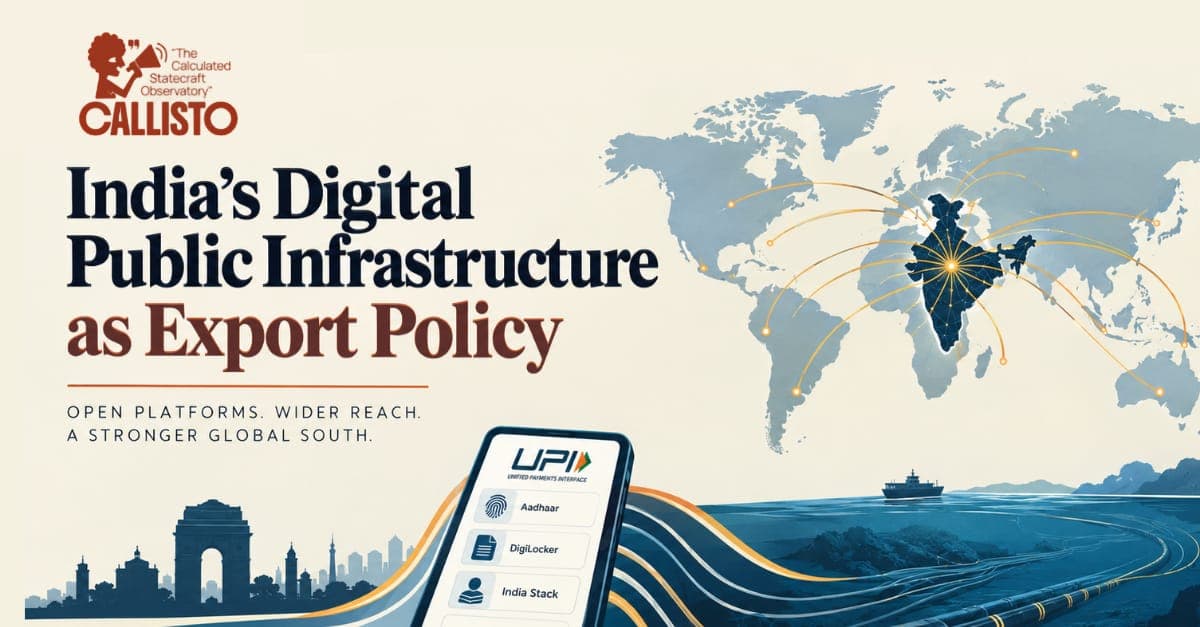
INDIA’S APPROACH TO DIGITAL PUBLIC INFRASTRUCTURE AS EXPORT POLICY
16 October 2026
India’s Digital Public Infrastructure export policy uses platforms like Aadhaar, UPI, and DigiLocker to strengthen digital governance, financial inclusion, and regional connectivity. By sharing these systems with the Global South, India advances its diplomatic influence and technological leadership, though data protection, institutional capacity, and effective implementation remain critical challenges.
 International Relations · Research Article
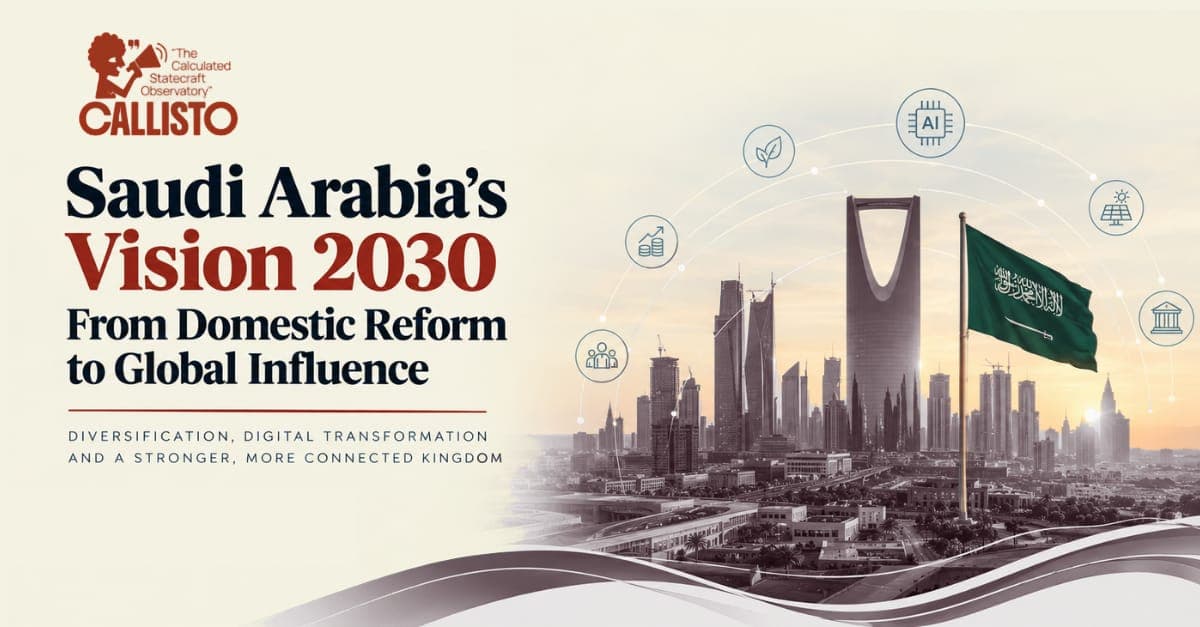
VISION 2030: Tracking Saudi's Reform Agenda
15 October 2026
Saudi Arabia’s Vision 2030 seeks to diversify the economy beyond oil through private-sector growth, foreign investment, technological innovation, and structural reforms. Despite progress, persistent oil dependence, investment gaps, employment inequalities, and geopolitical instability challenge its long-term economic transformation and strategic autonomy.
Comments
Your comment