
PERILS OF PANCHAYAT PROXIES
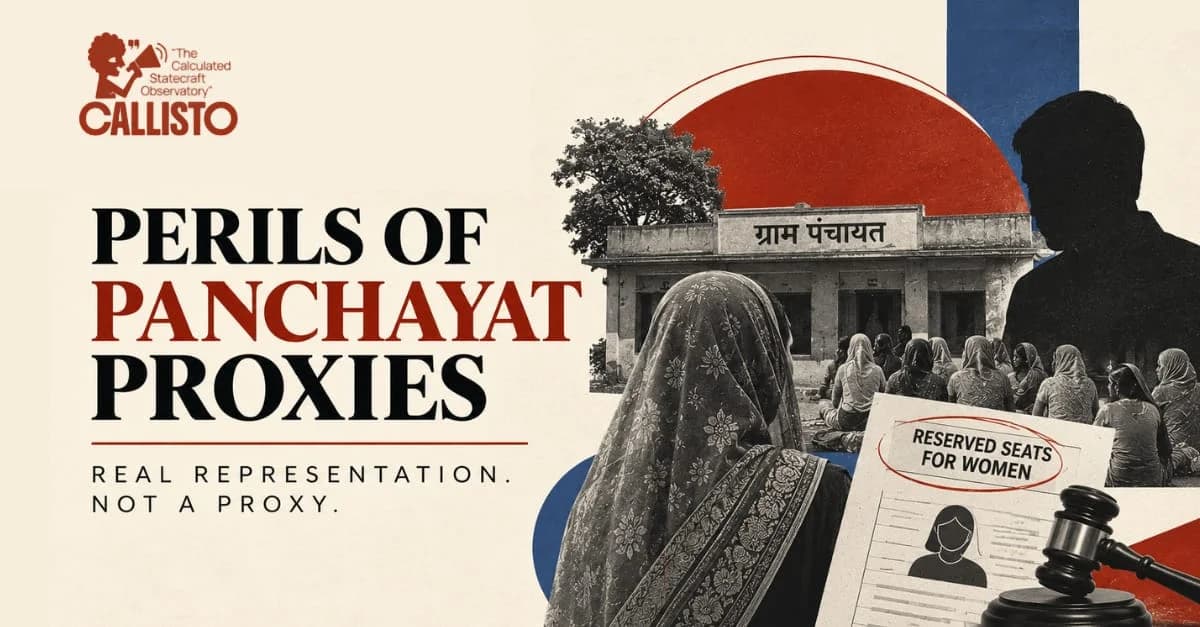
In April 2026, the Constitution (131st Amendment) Bill, 2026, meant to advance the implementation of women’s reservation in Parliament and state legislatures, failed to secure the required special majority in the Lok Sabha. The related Delimitation Bill, 2026, consequently became infructuous. While the Women’s Reservation Act (2023), or the Nari Shakti Vandan Adhiniyam (2023), remains in place, the framework of its implementation remains a subject of political debate for now. Meanwhile, India already has decades’ worth of experience with women’s reservation in Panchayati Raj Institutions. We can turn to this experience to understand women’s political empowerment in our country. Have reserved seats enabled women to exercise power independently, or has the existence of “Sarpanch Patis” allowed representation to exist without real authority?
The De Jure of Women’s Political Representation in India
(De Jure: the law on paper)
The 73rd and 74th Constitutional Amendment Acts were passed in 1992 under Prime Minister PV Narasimha Rao. These acts constitutionalised rural and urban local governing bodies, respectively. They mandated states to establish a three-tier structure of Panchayats and Municipalities with a clear devolution of powers, responsibilities, and finances.
The most revolutionary provision in these acts is the reservation of seats for women in local governments. According to the 73rd Constitutional Amendment Act, “Not less than one-third (including the number of seats reserved for women belonging to the Scheduled Castes and the Scheduled Tribes) of the total number of seats to be filled by direct election in every Panchayat shall be reserved for women.”
By ensuring at least one-third representation, and later many states expanding it to 50%, the act opened up political spaces to women they were previously denied. Thirty years since its enactment, India has over 1.45 million women in local decision-making roles. This has allowed women to reshape development priorities at the grassroots level. They can put forth greater emphasis on issues pertaining to health, education, sanitation and social justice.
But the election of a woman as a Sarpanch does not automatically dismantle existing patriarchal power relations within her family and the community. Gender inequalities are so deeply embedded in our social and political life that this reservation policy may underestimate how pervasive these inequalities are.
The De Facto of Women’s Reservation in Panchayati Raj Institutions
(De-Facto: actual; the reality on the ground)
On paper, a woman is elected as the Sarpanch, but in practice, her husband, father or son might handle the governance of the Gram Panchayat. The elected woman representative’s role becomes merely symbolic. When a male relative exercises political power on behalf of an elected woman, acting as her proxy, the very purpose of reservation stands defeated. The Supreme Court, while addressing a 2023 Public Interest Litigation, identified this problem of proxy representation as an “unconstitutional subversion of gender reservation.”
Patriarchal norms are so deeply rooted in our society, where women are expected to focus on domestic roles, while men continue to dominate public leadership and political authority. However, Patriarchy is not the only thing we can blame here.
Proxy representation is driven by an intersection of social, cultural, and institutional factors.
Many elected women representatives are first-time candidates who often have less formal education, lower literacy, and no political training. As a result, they have to rely on their family members for advice and help with administrative tasks, especially with financial matters or fund allocations.
Women Sarpanches are expected to manage both household duties and public governance. Without institutional support, such as childcare and flexible meeting schedules, they may struggle to perform their official responsibilities independently.
Government officials and male peers often bypass female leaders during meetings, instead choosing to interact directly with their male relatives. This reinforces the male relative’s role as the effective decision-maker. The man acting as a proxy holds real influence but carries no formal accountability. Because he is not the elected representative, his decisions often escape scrutiny.
This extends this issue beyond a debate between symbolic versus substantive representation for women or women’s political representation being turned into tokenism. It opens the door to governance failures, poor transparency, misuse of public funds, and weak governance.
Substantive Authority Beyond Symbolic Quotas
First of all, there should be strict disqualification against proxies. State governments must enforce strict rules to disqualify any Sarpanch who allows male relatives to act as her proxy or execute official administrative tasks on her behalf. Simple technical checks like biometric attendance and video recording of all Panchayat meetings should be mandated to ensure this.
Hands-on training through targeted capacity-building programmes to build basic administrative and digital literacy among women representatives is equally important. This will reduce their reliance on male relatives for documentation. This is already underway.
Leadership and Governance training has been provided to over 28.6 lakh women representatives under the Rashtriya Gram Swaraj Abhiyan (RGSA). This number is a measure of reach, not necessarily proof of administrative independence of women.
Lastly, state governments should set up networks at the district level to connect first-time women Sarpanches with experienced ones; this would ensure professional relationships outside the limits of their households through regular peer meetings.
None of these fixes works in a vacuum. To evaluate the success of women’s reservation, we cannot rely on how many women occupy Panchayat seats. We must look at how many of them can actually sign a file, question an official, control public funds, and make decisions without asking a man for permission.
Closing Question: How can Panchayats tell the difference between genuine family support and a male relative being the elected woman representative’s proxy?
Sources
https://www.pib.gov.in/PressReleasePage.aspx?PRID=2226324®=3&lang=1
https://prsindia.org/billtrack/the-delimitation-bill-2026
https://dmeo.gov.in/sites/default/files/202206/Thematic_Paper_Gender_Mainstreaming_220622.pdf
https://cdnbbsr.s3waas.gov.in/s316026d60ff9b54410b3435b403afd226/uploads/2025/09/202509241727574699.pdf
https://panchayat.gov.in/state-ut-wise-details-of-elected-representatives-ewrs/
https://www.orfonline.org/research/elected-women-representatives-in-local-rural-governments-in-india-assessing-the-impact-and-challenges
https://www.thehinducentre.com/the-arena/current-issues/women-as-proxies-in-politics-decision-making-and-service-delivery-in-panchayati-raj/article64931527.ece
Continue reading
 Public Policy
RTI and the Judiciary: Where Transparency Hits Sand on Judges' Assets and Appointments
25 October 2026
From judges’ asset declarations to opaque collegium deliberations, India’s judiciary faces persistent transparency gaps. What should be disclosed, what must remain private, and how can accountability improve without undermining judicial independence?
 Public Policy
SIR and the Long Continuous Battle Surrounding it
11 October 2026
India’s Special Intensive Revision of electoral rolls has intensified debates over voter eligibility, democratic participation and the risk of wrongful exclusion. From women and transgender persons to religious minorities, the exercise raises urgent questions about electoral transparency, accountability and safeguards.
 Public Policy
BEYOND THE BORDER: WHY INDIA’S GLOF EARLY WARNING NEEDS A HIMALAYAN NEIGHBORHOOD
21 September 2026
India’s GLOF early-warning systems cover nearly 200 Himalayan lakes, yet border-crossing floods demand a shared Himalayan monitoring network. Transboundary data sharing and real-time alerts are essential, as climate risks ignore national boundaries.
Comments
Your comment