
South India's Bet Against the Map: Inside the Delimitation Standoff
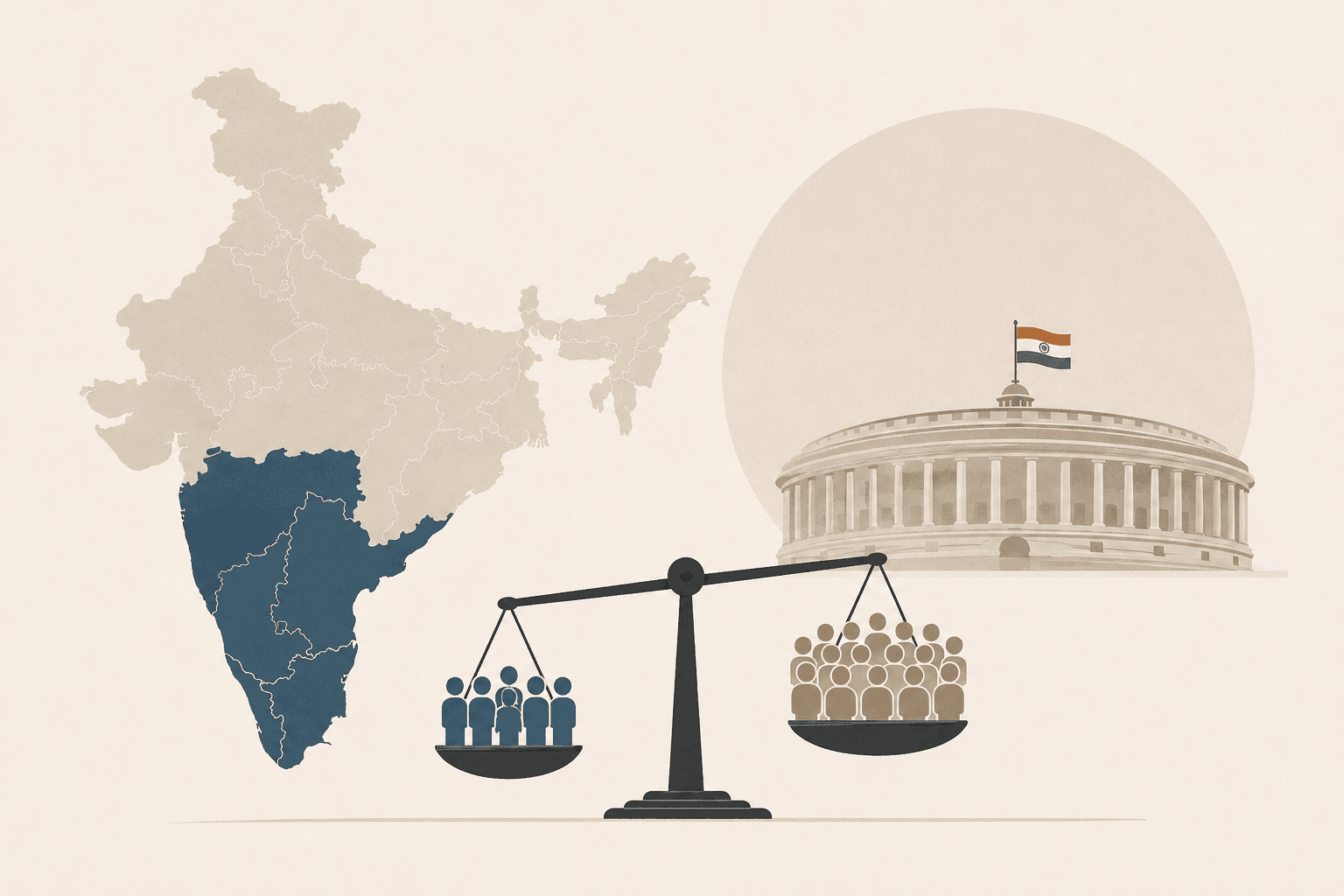
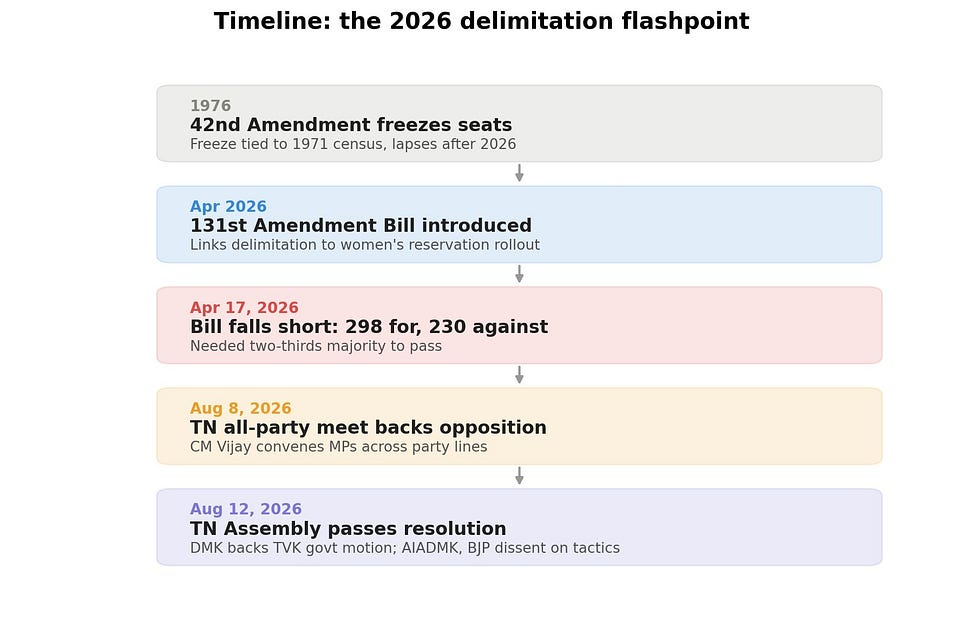
Tamil Nadu’s Assembly has passed a resolution on Wednesday (August 12, 2026) opposing any move to redraw Lok Sabha constituencies. Chief Minister C. Joseph Vijay’s TVK(Tamilaga Vettri Kazhagam) government urged the Union government to permanently freeze the number of Lok Sabha seats at 543. The resolution had broad political consensus: Leader of the Opposition in Tamil Nadu Assembly, Udhayanidhi Stalin extended the DMK’s support, arguing Tamil Nadu must not lose parliamentary representation due to any future redrawing of the constituencies, while the AIADMK and BJP opposed the resolution’s approach even as they urged any future exercise must not reduce Tamil Nadu’s representation.
The flashpoint traces back to April, 2026 when the Centre has introduced the Constitution’s 131st Amendment Bill during a special session of the Parliament, bundling delimitation with the rollout of the 2023 Women’s Reservation Act, a bill that needed a two-thirds majority the ruling NDA does not command in either House currently. The bill could not pass in the Lok Sabha on April 17. This was the first time a constitutional amendment brought by the Modi government has failed in Parliament, with 298 votes in favour against 230 in opposition. Following the bill’s April defeat, the Monsoon Session was paralyzed by unrelated opposition protests over police action at Jantar Mantar. This deadlock blocked all remaining legislative business before the session concluded on Thursday.
The tension in one line: Delimitation just means redrawing constituency boundaries so every seat represents roughly the same population. India froze the count in 1976 so states that had already slowed population growth wouldn’t be punished while the north kept growing. That freeze was due to lift in 2026 which is exactly why this is back in the news.
Tamil Nadu draws the line
Tamil Nadu’s earlier outreach, a Joint Action Committee convened in Chennai had drawn in the Chief Ministers of Kerala, Telangana and Punjab, Karnataka’s deputy Chief Minister, and even Odisha’s BJD, whose president warned the state could lose seats in both the Lok Sabha and its own Assembly if 2026 population projections become the yardstick. A delegation of MPs from South India, Odisha and Punjab was tasked with taking the case directly to Prime Minister Modi.
The Centre’s public position till now has been reassurance without commitment. Union Home Minister Amit Shah has assured southern states their representation won’t be reduced, a line the AIADMK and BJP invoked on Wednesday even while declining to back Tamil Nadu’s resolution. A verbal assurance over a stalled bill with no fixed formula is exactly what’s keeping the pressure alive. No state trusts the reassurance enough to back down, and the Centre hasn’t offered legislative solutions that would address their concerns.
Reform suggested
Some of the reforms suggested by consultants and pol. Scientists are:-
Make Rajya Sabha seats directly elected like Lok Sabha, or adapt the US Senate system with states having fixed numbers of senators.
Continue the existing number of seats and freeze the process for next 25 years, the same was recently being stated by TN’s CM Vijay.
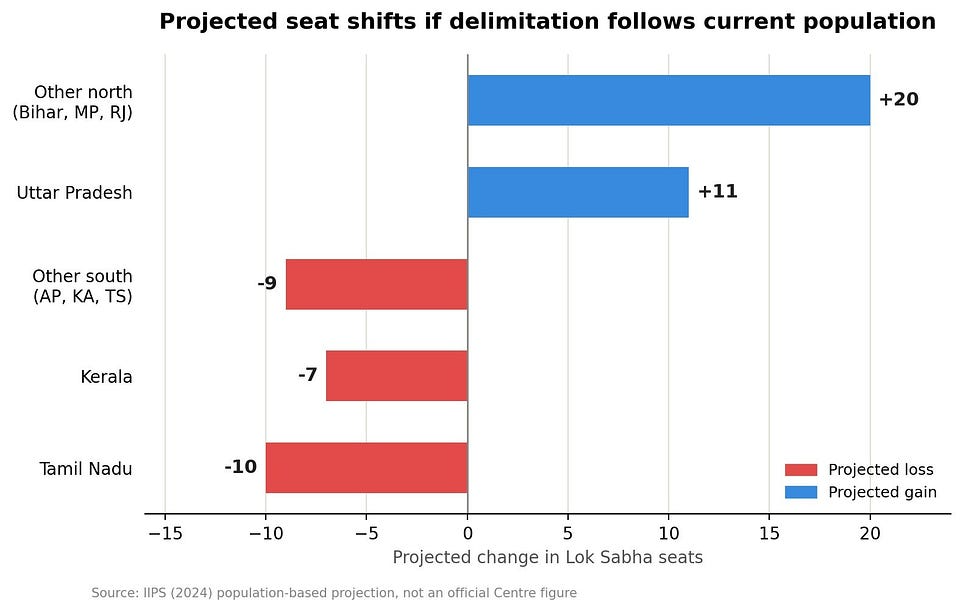
Expand Lok Sabha seats without reducing existing strength. For example, UP might gain some seats but Kerala and TN will not lose any seat from their current strength. While not reading their current representation, this will lead to reduction in their proportional seat share.
Writers are in that instead of solely using population as base of redistribution, use economic contribution of respective states as base of their seat allocation. Since southern states contribute more to the country’s total GDP.
What to Watch Next
The Delimitation exercise is heavily based on the 2027 Census, the results of which are expected to be published in 2028.
Drafting a new Delimitation Bill to address southern concerns.
Suggestions for Lok Sabha extension to 816 seats.
Southern states to get seat increase- Tamil Nadu from 39 to 49, Karnataka from 28 to 42, Kerala from 20 to 30, Telangana from 17 to 26 and Andhra Pradesh from 25 to 38, as planned originally.
The ongoing caste census- Phase 1 being digital mapping and Phase 2 being household counting.