
A Breakthrough, not a Verdict: Deconstructing the Bankipur Bypoll

Beyond the Headlines: Testing the “PK Playbook”
While Prashant Kishor scores his first electoral victory, the verdict is far from conclusive. With his party’s campaign in the last general election (2025) in Bihar not mustering a single seat in the state’s 238-member Lok Sabha, Kishor wrested Bankipur - a parliamentary constituency that BJP had been holding since 1995 - in the by-election in August 2026. The victory is being hailed by India’s political press as a vindication of Kishor’s “PK playbook”; however, we think the evidence is far from conclusive. For one, the figures show a significant shift in voting pattern in Bankipur. But whether it reflects across constituencies and the reason for such a turn of events are altogether different questions.
A Few Facts
According to the Election Commission of India, Kishor polled 64,151 votes (49.23%) to the BJP’s 44,827 (34.40%) in Bankipur; that is, a 19,324-vote majority for the newly-formed Jan Suraaj. The regional party RJD came in third with a 10.95% vote share (14,273 votes). In the 2025 general election, however, BJP’s Nitin Nabin polled a landslide 98,299 votes (62.66%), to RJD’s 46,363 (29.55%) and Jan Suraaj’s meagre 7,717 (4.92%). This means that compared to 2025, BJP’s vote share fell by 28%, RJD’s by 19%, and Jan Suraaj’s jumped by 44%. Put simply, the two major parties lost nearly 92% of their votes to the new entrant, Jan Suraaj.
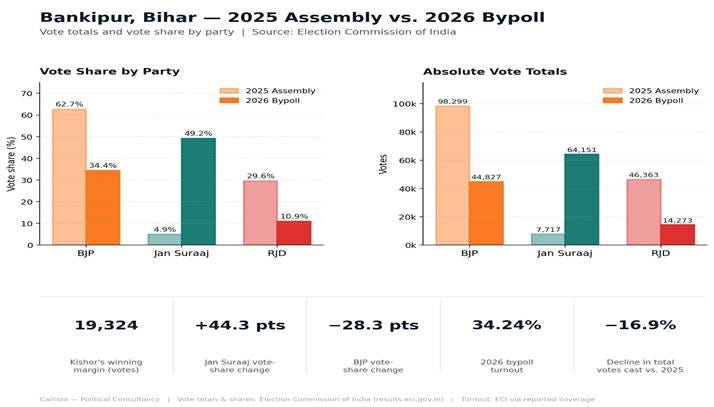
Not to be outdone by the BJP’s collapse, RJD’s share also fell steeply. At the same time, compared to 2025, the voter turnout fell significantly as well, from approximately 41% to 34%, or 26,572 voters. In addition, the victory in Bankipur comes on the heels of Nitin Nabin’s resignation to enter the Rajya Sabha, which saw a comparatively lesser-known MLA contesting in the by-polls for the first time. Overall, it is a confluence of circumstances that have contributed to this turn of events rather than a definitive turnaround.
What We Know (And Don’t Know)
While the shift in votes may represent an anti-incumbency sentiment, it is important to note that at the constituency level, the vote share alone does not tell us what happened. In other words, it is one thing to say that BJP votes “went to” Jan Suraaj, but the figures could also reflect voters who stayed at home, those who switched from the RJD as well as those who voted against BJP’s new, unrecognised candidate.
In fact, unless an exit poll or voting figures from individual booths in Bankipur from 2025 and 2026 were to match up, we cannot conclude anything about who exactly switched to Jan Suraaj. Similarly, we cannot conclude that Muslim voters disproportionately voted for Jan Suraaj , a theory that is being put forth by some commentators, not without evidence. In fact, unless a survey of the state’s voters conducted immediately after the polls, which would show us the demographic breakdown of votes for each party, is available, we cannot conclude anything with certainty.
That RJD’s votes fell, too, compared to the general election of 2025, is also noteworthy for it suggests that RJD supporters also voted independently or for Jan Suraaj. Given that RJD filed the same candidate in both elections, it cannot be explained away as a candidate effect for this constituency, as the exit polls are available for comparison. However, the theory of the disenchanted RJD voter is also not beyond criticism since the voter turnout fell considerably this time around. Until further evidence is forthcoming, it is best to treat such claims as plausible but unsubstantiated. The same goes for the claim about Muslim voters, which is at best a conjecture.
A Consultancy View
For campaign strategists, the question of ‘what’s next?’ takes precedence. A reading into these figures should begin with
Strategy → Organisation → Conversion
Jan Suraaj’s campaign in 2025 was a national campaign that ran in 238 constituencies but failed to win even one due to its inability to raise the necessary organisational machinery in every constituency. In Bankipur, on the other hand, a close but victorious contest took place with Kishor himself contesting from the constituency. His party’s organisational outreach was reportedly “deep but lean”, which may or may not be the explanation as to why he won. Compared to the national campaign, it may be construed as an overwhelming victory. On the other hand, we cannot forget the drop in voter turnout. It is, therefore, possible that Nitin Nabin, the sitting MLA, lost due to his own shortcomings, including his lack of popularity in the wake of his elevation to the Rajya Sabha.
In short, the three potential explanations :
A superior organisational campaign in Bankipur
Kishor’s popularity as a chief candidate
And a lower-than-expected turnout - are not mutually exclusive, and a good strategist should be able to distinguish which among them deserves more credence.
Lesson for consultants
The lesson for consultants, then, is to not extrapolate from Bankipur.
First, if a client asks them to apply the “PK formula” in other constituencies, they must ask for matched booth-level data (preferably) or at least expenditure data before doing so. The drop in turnout in Bankipur may have been due to voter apathy or dissatisfaction with the incumbent, but it should be measured against an average turnout across all constituencies. In the case of Jan Suraaj, the organisation was stretched perilously thin in 2025, which is why it did not win any seats. While its presence in Bankipur may have been significant due to Kishor’s campaigning and the turnout might have been skewed due to such concentration, it does not reflect the actual organisational reach. Thus, if a campaign has to be designed in the image of Kishor’s “breakthrough” in Bankipur, it would make far more sense to do so under conditions of low turnout and high organisational concentration.
A single seat, while undoubtedly a significant victory, is not an indication of a statewide organisational strength that Jan Suraaj is supposedly lacking. At the best, it suggests that Jansuraaj has a credible candidate in Kishor, who is popular at least in Bankipur, and can contest under conditions of low organisational turnout, which is a much weaker claim than the national press would like to believe. This victory, for now, remains a one-off, a fluke that has been exaggerated into a turnaround. That is the danger that consultants run when extrapolating from one constituency’s victory. There may well be other victories in the offing for Jan Suraaj, but until more evidence comes in, treating it as a surefire formula for success is malpractice.
This is not to say that Bankipur is not a significant victory for Jan Suraaj. On the contrary: it is a much-needed morale booster for the campaign, which needs it after the general election fiasco. The evidence for it being anything more than that, however, is sorely lacking, which is why we take great issue with the national press’s breathless commentary on the “turnaround” the victory represents. A single winnable by-election under easy conditions in a constituency represented by a weak incumbent is not much of an indicator for a statewide campaign. It is true for BJP in 2025 – it should be true for Jan Suraaj in 2026. So, while we congratulate Kishor on his much-needed breakthrough, we urge caution in extrapolating from this one constituency.
How much should a campaign strategist extrapolate from a single winnable constituency in a low-turnout by-election? How much should a campaign strategist extrapolate from a single winnable constituency in a low-turnout byelection?
Sources
Primary source :official results:
· Election Commission of India — Bankipur (AC 182) bypoll candidate-wise results, August 2026
Bypoll result, margin, and context:
2025 Bankipur assembly election and constituency history:
· Deccan Herald — “Bankipur Constituency Results 2025 | Bihar Assembly Election”
Jan Suraaj’s 2025 statewide performance (baseline for comparison):
· The Tribune — “Prashant Kishor’s party fails to open account in Bihar”
Note: figures reported by news outlets for turnout and margin (e.g., 34.24–34.31% turnout; 18,953–19,324-vote margin at different counting stages) vary slightly by publication and by the moment of counting they describe. Where a discrepancy exists, this document uses the Election Commission’s final published totals as the authoritative figure.