
The FTA Adrenaline – Can India’s Domestic Capability Utilise it?
Introduction
India’s Free Trade Agreements have significant geo-economic potential, particularly for diversifying trade relationships and integrating India into global supply chains; however, the strategic value of these agreements ultimately depends on domestic productive capacity, competitiveness and effective utilization.
In 2025, free-trade agreements (FTAs) became a significant part of India’s geo-economic toolkit. New Delhi concluded new trade agreements with the United Kingdom, Oman and New Zealand, and was in negotiations to sign 12 other new agreements. The latter included talks aimed at reaching a bilateral-trade agreement (BTA) with its largest export market, the United States, and the final stages of long-running negotiations with its largest trade partner, the European Union – which culminated in the signing of an ambitious FTA on 27 January 2026. India has also been in negotiations to update eight existing agreements.
India’s exports have been negatively impacted by the US imposing 25% tariffs on Indian goods (as well as a 25% tariff to punish India for its purchases of Russian oil), and by delays in finalizing the BTA due to political factors and the complexities of concluding such a comprehensive agreement. However, since mid-2025, India has been exploiting the delay by diversifying its export markets. It has signed a total of seven new trade agreements since 2021, after having signed none at all in the previous ten years. The size of India’s economy and market now enables it to have more leverage when negotiating with trade partners
In the post-Covid phase, free trade agreements (FTAs) have been the drivers of India’s foreign trade. In this period, India has finalized seven FTAs while six more FTAs are in the making, with the soon-to-be completed bilateral trade agreement with the US being the most significant among them. India is implementing or negotiating 17 FTAs and is among the more active countries in forging bilateral trade deals.
Expectedly, about two-thirds of India’s total trade was conducted with its FTA partners in 2025-26 and almost 71% of its exports and 57% of its imports were accounted for by these countries. In the recent past, overall exports were driven by the two largest markets — the US and European Union (EU) — although during the previous fiscal year, exports to the US remained almost stagnant while India’s presence in the EU declined for the second consecutive year.
India’s overall record of implementing FTAs is not very impressive. From the end of the previous decade, trade with its FTA partners has not reflected the increased opportunities that Indian businesses have been offered through preferential access to their markets. In the post-Covid years, India’s overall exports increased by a compounded rate of 1.2%, while overall imports increased by 6%.
On the other hand, the increase in India’s exports to its FTA partners was identical, while its imports were slightly higher. While growth in exports remained sluggish, imports have registered a consistent increase, given the sizeable market access that India gave to its partner countries in all the recent FTAs. Consequently, India faces the specter of a rising merchandise trade deficit, which has now begun to hurt the economy.
A closer look at the trends of implementing FTAs with major partners — including the Association of South East Asian Nations members, Republic of Korea, and Japan, which are being implemented for nearly a decade and a half — provide some answers why the country has not realized the expected benefits from these agreements.
The problem seems to be the inability of Indian businesses to consistently serve these markets. Until 2022-23, India’s exports to all the three FTA partners increased steadily, but in subsequent years the rising trends reversed sharply, especially with Korea (by over 25%). The FTA with the European Free Trade Association raised considerable expectations of increased market access for Indian businesses due to the lowering of tariffs by the four-member bloc, but exports to these countries stagnated at less than $2 billion. Thus, standard argument that FTAs stimulate export growth and GVC integration warrants a far more nuanced view.
Widening trade deficit
India’s FTA experience with Asian economies have been not be favorable. India’s trade with key FTA partners such as Association of Southeast Asian Nations (ASEAN), South Korea, Japan and Singapore has become increasingly import-driven, resulting in widening trade deficits. Data shows that India’s trade deficit with ASEAN increased sharply from US$10.4 billion in 2012 to US$51.2 billion in 2025, driven by rapidly rising imports. In the same manner, imports increased at much faster pace than exports in case of Japan and South Korea. India’s trade surplus has turned into trade deficit in case of Singapore after signing the trade agreement exhibiting weakening export competitiveness. Exports are ultimately a reflection of manufacturing capability, not merely trade agreements.
Declining share in FTAs partner import basket
India’s export performance across its major Asian FTAs partners such as ASEAN, Japan, South Korea and Singapore reveals an intriguing picture its underperformance. India’s share of the FTA partner import basket has either stagnated or gradually eroded between 2012 to 2025, indicating a weakening its export competitiveness post FTAs. The most striking decline is in case of ASEAN countries where India’s share to ASEAN’s import basket dropped from 3.42 percent to 1.71 percent while in case of Singapore, the import share declined from 2.27 percent to 1.71 percent. Similarly, India’s share in South Korea’s import basket has declined from 1.33 percent to 1.02 percent while its share in Japan’s import basket shows mixed trends throughout the period.
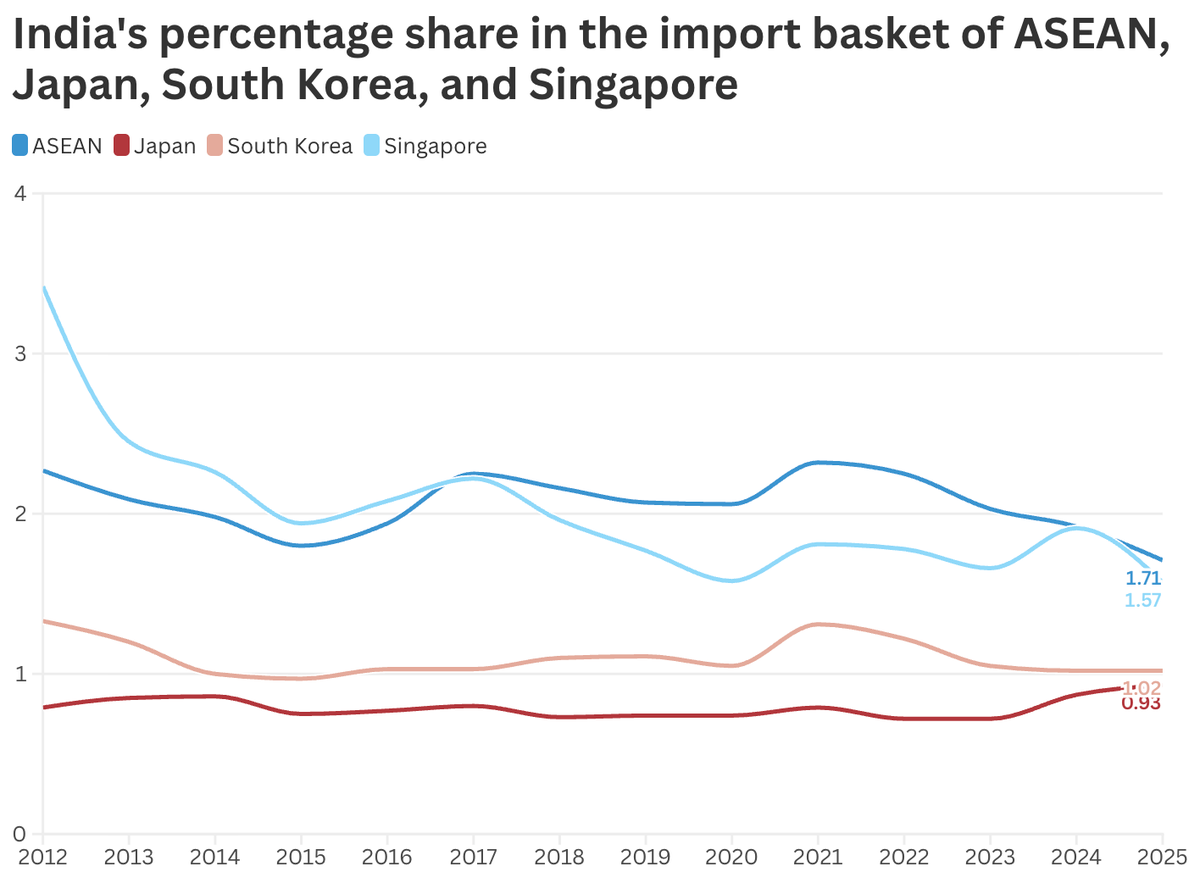
Collectively, these trends indicate that instead of leveraging trade agreements to integrate into regional production networks, India is stuck on the margins of manufacturing-led trade integration. The inability to capitalize on tariff preferences under FTAs demonstrates that market access based on tariff elimination alone cannot compensate for weak domestic industrial capabilities, factor and goods market reforms, logistical inefficiencies, infrastructure, and operational constraints. India’s trade challenge is not fundamentally about negotiating more FTAs but about strengthening domestic productive capabilities and associated impediments. Without adequate deeper industrial transformation, FTAs risk becoming instruments that increase import penetration faster than export competitiveness, thereby widening asymmetrical trade outcomes and structural vulnerabilities.
The declining export shares and weakening GVC integration in the case of India’s key FTA partners clearly highlight the limitations of considering FTAs primarily as instruments of market access. It is understandable that FTAs may enhance market access in certain product categories, but their abilities to foster productive capabilities is still contested issue. This essentially means that India’s FTA strategy needs to move beyond the standard argument of market access as the primary rationale for trade agreements and GVC integration. It should focus on greater interaction with the broader industrial policy framework that emphasizes technological upgrading, strategic investment, supply chain realignment, domestic value addition and domestic reforms. Without such complementary policies, FTAs are likely to remain instrument of trade liberalization that constrain policy flexibilities rather than drivers of industrial transformation.
GVC Integration
FTAs are often presented as drivers of deeper integration into global value chains by eliminating barriers to the development of shared production arrangements and industrial upgrading. GVC related to trade percentage to gross trade is an important indicator to understand a country’s total trade (export-import) that is linked to the participation in GVC. It is interesting to note that India’s GVC related to trade as a percentage of gross trade declined from 37.13 percent to 34.38 percent, indicating that India’s integration in global value chain networks has actually weakened. A similar trend is observable in India’s GVC trade with FTA partners. India’s GVC trade as a share of gross trade with its FTA partners has declined in the case of South Korea, Japan, Indonesia, Thailand, Vietnam, and Cambodia. Only in case of Malaysia, Singapore and Philippines, it has increased.
Conclusion
The declining export shares and weakening GVC integration in the case of India’s key FTA partners clearly highlight the limitations of considering FTAs primarily as instruments of market access. It is understandable that FTAs may enhance market access in certain product categories, but their abilities to foster productive capabilities is still contested issue. This essentially means that India’s FTA strategy needs to move beyond the standard argument of market access as the primary rationale for trade agreements and GVC integration. It should focus on greater interaction with the broader industrial policy framework that emphasizes technological upgrading, strategic investment, supply chain realignment, domestic value addition and domestic reforms. Without such complementary policies, FTAs are likely to remain instrument of trade liberalization that constrain policy flexibilities rather than drivers of industrial transformation.
Sources
Continue reading
 International Relations
Close in Interest , Far in Reach : India's Central Asia Problem
17 October 2026
A region Delhi calls its extended neighborhood matters for energy, security and diplomacy, yet it remains hard to reach.
 International Relations
Trump-Xi Summit: Navigating a New Cold War
10 October 2026
Trade relations of the commodity of AI tech are analyzed through the Trump-Xi Summit in the context of the changing dynamics of U.S.-China relationship and Taiwan as a site of importance in this.
 International Relations
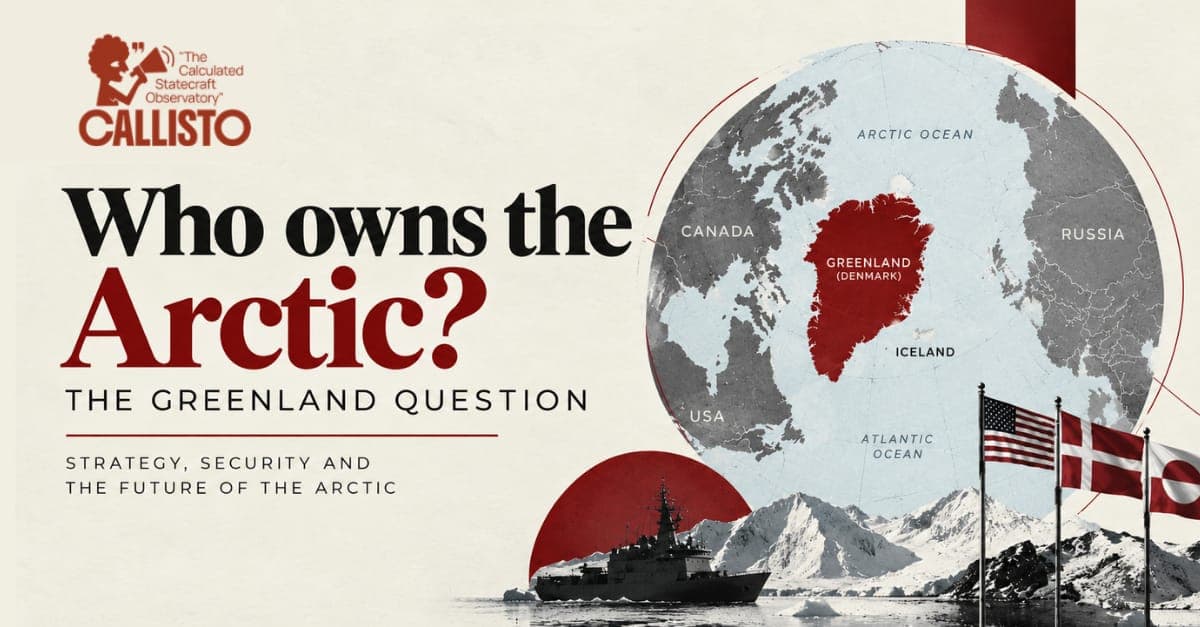
WHO OWNS THE ARCTIC? THE GREENLAND QUESTION
3 October 2026
Greenland’s strategic importance is reshaping Arctic security, but the new U.S.–Denmark–Greenland defence agreement raises questions beyond military cooperation. As Washington expands its presence, Greenland’s sovereignty, self-determination, environment, economy, and cultural priorities remain central to understanding the Arctic’s changing geopolitical landscape.
0 likes · 0 comments
Comments
No comments yet.
Your comment