
Nepal’s Floods Exposing the Gap in Himalayan Early-Warning Systems
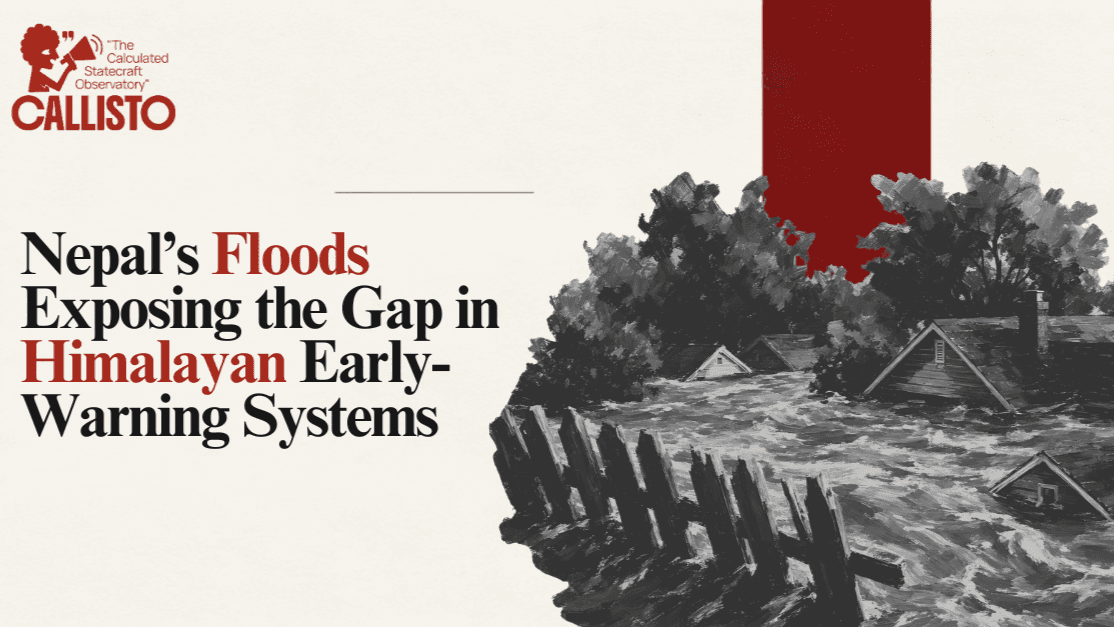
The Catastrophic flooding and glacial collapse in August 2026, which killed more than 1,399 people, are not just a warning from the Earth but also show a chasm in cooperation on essential resources among riparian states. Nepal’s upstream monitoring stations were damaged before they could send an alert. This creates a situation of dependence concerning the upstream data under the control of China, since there exists no obligatory system to move the glacial and hydrological data from the plateau that comes under the purview of Beijing, as it’s considered strategically sensitive and ultimately inhibits any riparian state from gaining any valuable information to avoid such a catastrophe.
A Region without Rules
This is not the only situation in the region. The Mahakali Treaty, signed between India and Nepal in 1996, sought to build a dam and was accompanied by a commission meant to oversee implementation and resolve disputes; after 30 years on, policy analysis suggests it promised institutional resolutions but never executed them. In 2016, the Central Electricity Authority(CEA) issued guidelines regarding trade in electricity to be carried out from only Indian Government owned or funded or those with majority Indian ownership. Similarly, levying such restrictions on the import of electricity makes it difficult for third parties like China to invest in hydropower projects in Nepal. This shows not an infrastructural gap, which is often assumed, but India using its leverage over resources and restricting coordination to build productive institutions and solutions to mitigate such problems. The issue here is that such treaties lead to securitization, as they go against the spirit of cooperation and development as promised by the Indian politicians and hydrocrats.
During the Doklam Conflict, India states that China stopped sharing hydrological data, while it continued to do so from the same operating stations with Bangladesh. This is another instance of using leverage over vital resources and cooperation being dependent on the political situation, which ultimately leads to securitization. The takeaway for the geopolitical world from the Nepal floods should be that the Himalayan region should not become a region of conflict but one of cooperation.
The 60% Gap
According to NUS LKY School, around 60 per cent of shared water sources between India and China lack treaties and agreements for collaborative administration. Under such circumstances, exchanging hydrological data and information becomes the foundation of future cooperation and mutual trust, largely between countries like India and China, which face hostilities on varied fronts.
Responsive Diplomacy
In light of established treaties and those discussed above, both India and China have been observed playing the card of “responsive diplomacy”. This refers to countries initiating the sharing of data only at the demand of the riparian states. This often leads to situations where warnings and data aren’t conveyed promptly, resulting in calamities. Although most of the South Asian states are not signatories, except for Bangladesh, to the United Nations Watercourses Convention(UNWC), which makes cooperation on water bodies easier. The existence of such conventions among the states of YBR (Yarlung Zangbo–Brahmaputra River Basin) could enhance data sharing and management in the region.
A Model already in works
Such a framework already exists in the form of the Lancang Mekong Cooperation(LMC), a six-country cooperation mechanism that includes China. Its foundation was laid by the Sanya Declaration of 2016, which formed the International Secretariat to ensure continuous sharing of data among all the riparian states while addressing their individual issues. This mechanism focuses on five prioritized fields, one of which is water governance. However, deficiencies exist concerning an excessive focus on economic benefits beyond river management and a focus on riparian activities, with environmental sustainability being absent from the agenda. Hydrological data sharing is limited to the flood season and is not a year-round practice.
What is Nepal already asking for?
The Nepal Flood Forecasting Division’s proposal of a data-sharing arrangement with China is modelled on the existing Nepal-India framework, which will seek readings every 10 minutes rather than only during high-precipitation forecasts. Hydrologists remark that “ we shouldn’t miss any future disaster” in light of this proposal. This leads one to ask why such frameworks haven’t been formed in the YBR. This could be because the existing bilateral treaties and MoUs in the region are fragmented and narrow, covering specific water-related issues rather than taking a holistic approach towards the question of water sharing, including dam-building, irrigation activities, data transfers, etc. Secondly, such treaties rely on mutual goodwill rather than enforcing binding mechanisms, allowing room for responsive diplomacy.
Yarlung Zangbo/Brahmaputra Cooperation
Following this, the region requires an act of Preventive Diplomacy in the form of the Yarlung Zangbo/Brahmaputra Cooperation mechanism. Scaled to a mid-tier cooperation body where preventive diplomacy refers to states actively anticipating and attempting to address disputes among riparian states before they escalate and cause significant harm. Both China and India have begun to engage in a multilateral manner by engaging in the Brahmaputra Dialogue, the BBIN cooperation mechanism, and India’s MoU on the Dorjilung dam with Bhutan, all embodying methods of preventive diplomacy that both India and China already practice, just without a unifying framework. This cooperation mechanism can be built on two mechanisms, learning from the LMC drawbacks: first, year-round hydrological data sharing to take place instead of only during a particular season and secondly, a prior notification and impact assessment system to be established for new developmental projects on the transboundary. This is where both New Delhi and Beijing should leverage their existing expert level mechanisms and advanced technologies to foster collaboration.
Prime Minister Balen Shah’s government has deliberately avoided depending excessively on either India or China and instead focuses on engaging with them on an equal footing. This YBC mechanism is the best possible way to shape such a multilateral engagement among the independent and powerful states that surround Kathmandu. Thus helping foster routine interaction between the rival powers that could help prevent conflicts from escalating, while economic cooperation (as in the case of LMC) eases further political tensions.
Sources
China Global South Project-Before Flood Catastrophe, Nepal Asked China for Early Warnings as Risks Mounted https://chinaglobalsouth.com/analysis/nepal-china-glacier-data-sharing-himalayan-flood/
The Conversation- Nepal floods: China’s strict control of Tibet makes it harder to prepare for Himalayan disasters https://theconversation.com/nepal-floods-chinas-strict-control-of-tibet-makes-it-harder-to-prepare-for-himalayan disasters-290659
Lee Kuan Yew School of Public Policy-Importance of Transboundary River Data Sharing Between India and China https://lkyspp.nus.edu.sg/cag/publications/center-publications/publication-article/detail/importance-of-transboundary river-data-sharing-between-india-and-china
National Library of Medicine- Practicing security: securitisation of transboundary rivers by hydrocrats in Himalayan South Asia https://pmc.ncbi.nlm.nih.gov/articles/PMC9932403/
Stimson- Investigating an Emerging Climate Hazard: Transboundary Glacial Floods on the China-Nepal Border https://www.stimson.org/2025/investigating-an-emerging-climate-hazard-transboundary-glacial-floods-on-the-china nepal-border/
World Water Council Journal IWA Publishing-Current and future transboundary water cooperation over the YarlungZangbo/Brahmaputra River basin: from an interdisciplinary perspective https://iwaponline.com/wp/article/23/5/1107/83824/Current-and-future-transboundary-water-cooperation
Continue reading
 International Relations
Close in Interest , Far in Reach : India's Central Asia Problem
17 October 2026
A region Delhi calls its extended neighborhood matters for energy, security and diplomacy, yet it remains hard to reach.
 International Relations
Trump-Xi Summit: Navigating a New Cold War
10 October 2026
Trade relations of the commodity of AI tech are analyzed through the Trump-Xi Summit in the context of the changing dynamics of U.S.-China relationship and Taiwan as a site of importance in this.
 International Relations
WHO OWNS THE ARCTIC? THE GREENLAND QUESTION
3 October 2026
Greenland’s strategic importance is reshaping Arctic security, but the new U.S.–Denmark–Greenland defence agreement raises questions beyond military cooperation. As Washington expands its presence, Greenland’s sovereignty, self-determination, environment, economy, and cultural priorities remain central to understanding the Arctic’s changing geopolitical landscape.
0 likes · 0 comments
Comments
No comments yet.
Your comment