
MINIATURE DEMOCRACY: DECODING DUSU’s PARTY POLITICS
“How North Campus’s student union has become a proving ground for India’s two largest parties”
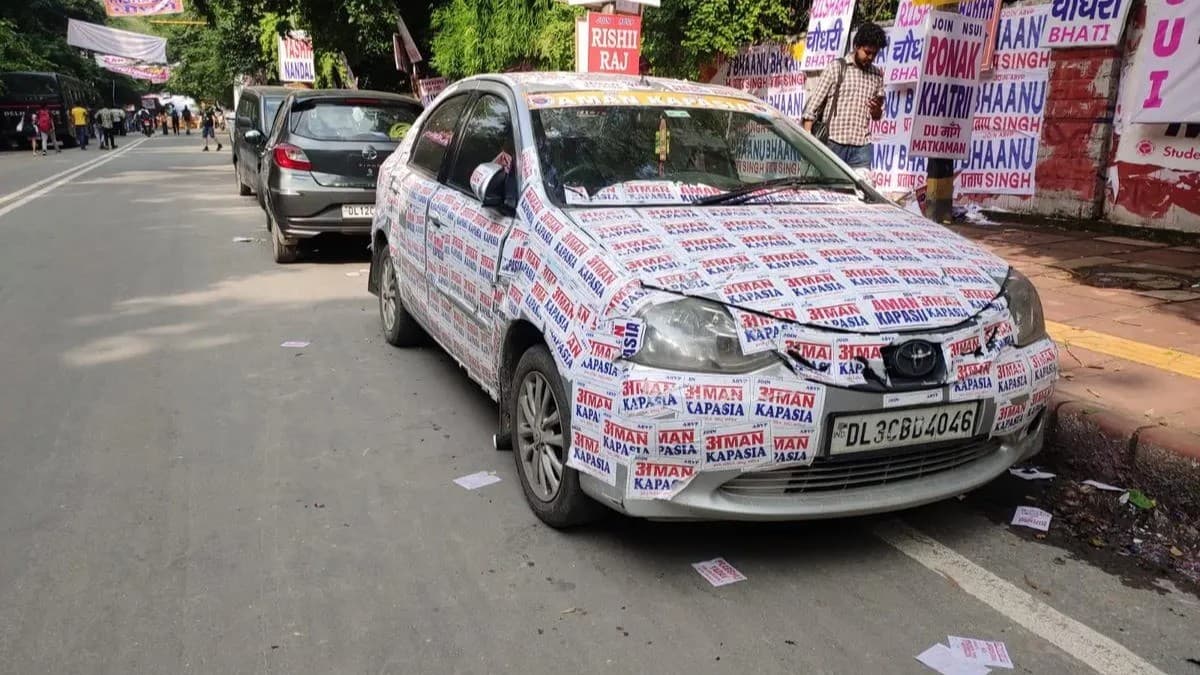
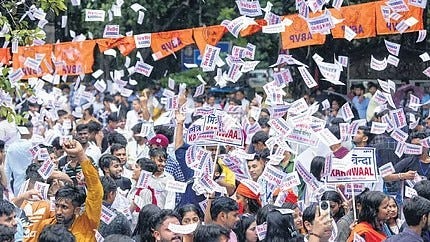
With the onset of monsoon ,the university election fever is on the peak in the University of Delhi. This is also referred as Microcosm of Indian Politics. North Campus turns into something closer to a battlefield than a university , walls disappear under posters overnight, the air smells of print ink and promises, and every college gate becomes a stage for a much bigger performance. The faces change and the slogans get louder but the script feels strangely familiar with the same rivalry, the same colours, the same old war between two ideologies fighting for a young mind’s first vote.
DU-el: The duel party politics:
The first elections polls came out in 1954 with Gajraj Bahadur Nagar as the President who later became the Food Minister of Haryana. The products of this institution are the prominent leaders such as Arun Jaitley (1974–75), Alka Lamba (1995–96), Rekha Gupta (1995–96). This miniature democracy is represented by two major union groups- ABVP (Akhil Bharatiya Vidyarthi Parishad) and NSUI (National Students’ Union of India). Their parent linkages with BJP and Congress shows up in campaign resourcing, in the visible presence of state-level party leaders during campus visits, in the way results are covered by national media as a referendum on party mood, and in how each side’s cadre treats a DUSU win as a talking point in state and national campaigns. ABVP’s campus messaging leans on nationalism, cultural issues, and continuity with BJP’s broader youth outreach; NSUI’s leans on student welfare, fee concerns, and civil-liberties framing, echoing Congress’s opposition posture nationally.
Lyngdoh Guidelines:
These elections include everything that an election ideally shouldn’t have. There is money, muscle power, violence and FREEBIES! To monitor and regulate these elections ,the Supreme Court of India constituted the Lyngdoh Committee in 2005. This committee gave its recommendations in 2006 .
A candidate cannot spend more than 5000 rupees during the campaign. Well the use of rented Rolls Royce, pizzas delivered to PGs, free canteen hours shows a unaligned image. As the theorist Max Weber constituted authority with legitimacy and public recognition along with power.
A candidate cannot use paper for campaigning. Thousands of handwritten cards and printed papers are distributed on entry gates, classrooms and amphitheaters. These papers are laid across the pathways…
Only posters and handmade papers are permitted to be showcased in allowed spaces. These posters are everywhere, from the blackboards of classes to the AC vents of the lift.
Candidates cannot disrupt classrooms and college activities while campaigning. Several cases of violence between professors and candidates have been registered due to disruption of academics.
DUSU 2025 Polls:
Around 2.75 lakh students were eligible to cast their votes in this year’s student elections. 39.45 per cent voter turnout was recorded, higher than the 2024 turnout. ABVP’s Aryan Maan won the president’s post with 28,841 votes against NSUI’s Joslyn Nandita Choudhary’s 12,645. NSUI’s only consolation came at vice-president, where Rahul Jhansla polled 29,339 votes to ABVP’s Govind Tanwar’s 20,547. A reminder that despite four decades of framing this as a two-party contest, no third force has come close to breaking in. Nearly 23,674 students across all four posts chose NOTA, a number that exceeds what either NSUI or the Left alliance managed at any post. ABVP’s 23,460-vote win in 2023, followed by NSUI’s narrow 1,300-vote upset in 2024, marked NSUI’s win after 7 years. The changing role of women’s representation in the union also changed last year with Joslyn Nandita Chaudhary contesting for president.
Why This Deserves Attention Beyond Campus:
When students march over unaffordable PG rents, gender safety, or library access, they are engaging in what Jürgen Habermas calls the “communicative rationality of the public sphere“ which is a process where authority is challenged through open debate rather than top-down decrees. Hannah Arendt argued that politics only exists when citizens step into the “space of appearance“ to act and speak together. Campus activism is often a young person’s first deliberate act of public presence. Antonio Gramsci similarly noted that cultural and political hegemony is maintained or contested not just in parliaments, but across civil society’s everyday institutions. As a student of Political Science ,experiencing elections for the first time in this miniature democracy and actively observing campaigns and groups continuously aiming to gather support with mass events and demonstrations provides a practical ground for the study. Political scientists studying youth engagement in India have long pointed out that most first time voters form their political instincts not from manifestos but from smaller, local experiences of politics and for a large section of Delhi’s students, DUSU is that experience. But reducing it to the larger framework od national political parties, something gets lost. The actual purpose of student politics which has evolved greatly over the decades. This raises the question whether the election season should continue with the ongoing representation of money, power and violence or a new committee should be formed to regulate this distort process?
Sources
Primary sources: Official Data
https://du.ac.in/ - University of Delhi
Elections Poll results:
Lyngdoh Committee:
Continue reading
 International Relations
Close in Interest , Far in Reach : India's Central Asia Problem
17 October 2026
A region Delhi calls its extended neighborhood matters for energy, security and diplomacy, yet it remains hard to reach.
 Journalism
One Seat Multiple Stakes
15 October 2026
By-elections may involve fewer voters, but their political consequences can be significant. From historic victories to closely contested seats, they shape leadership, test political strength, and uphold representation, proving that even a single seat can influence the broader democratic landscape.
 Public Policy
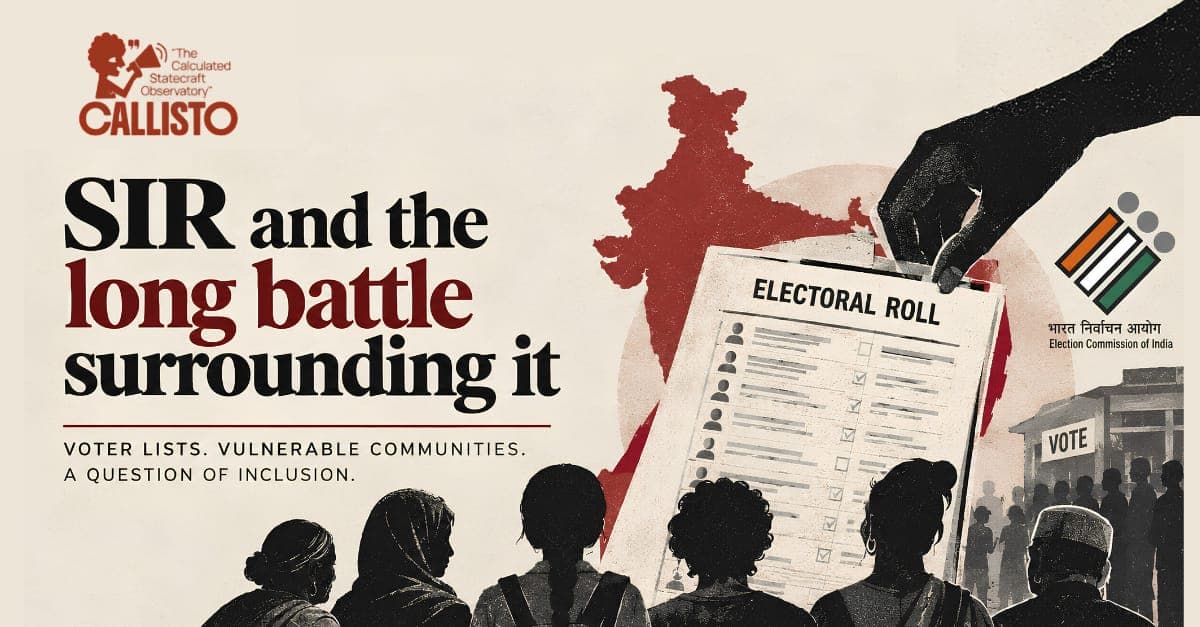
SIR and the Long Continuous Battle Surrounding it
11 October 2026
India’s Special Intensive Revision of electoral rolls has intensified debates over voter eligibility, democratic participation and the risk of wrongful exclusion. From women and transgender persons to religious minorities, the exercise raises urgent questions about electoral transparency, accountability and safeguards.
0 likes · 0 comments
Comments
No comments yet.
Your comment